
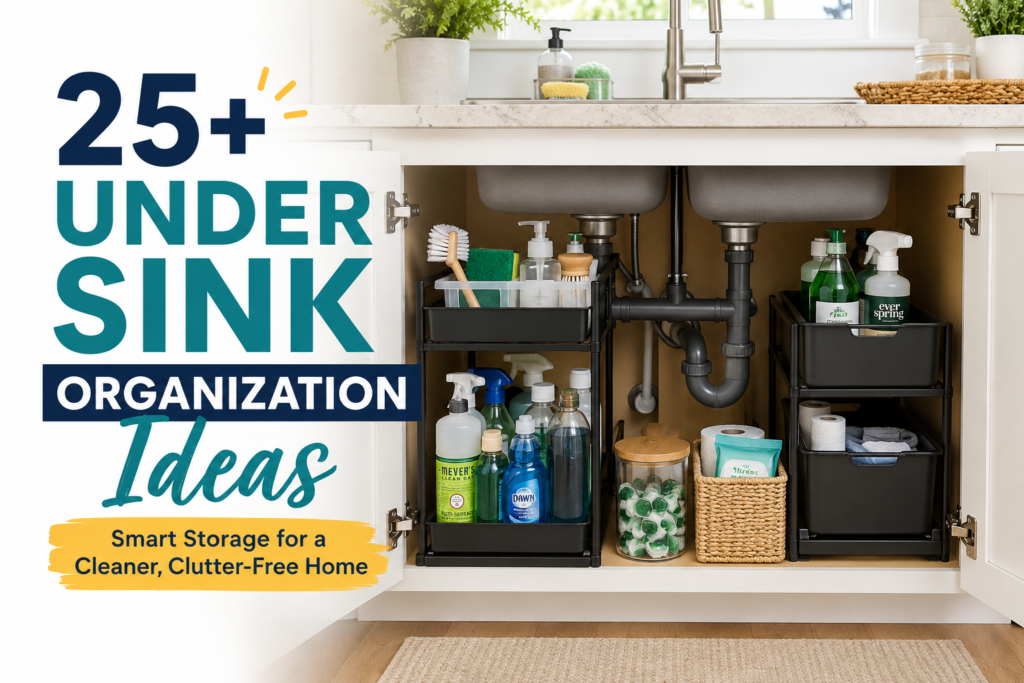
25 Under Sink Organization Ideas to Maximize Storage
The cabinet underneath your sink is one of the easiest places in your home to ignore—and one of the fastest to become cluttered. Cleaning sprays, sponges, trash bags, extra supplies, toiletries, and random household items can quickly turn into an unorganized pile.
The good news is that you don’t need a large kitchen or bathroom to make this space work better. With the right under sink organization ideas, you can turn an awkward cabinet into a practical storage zone where everything has a place.
The key is to work around the plumbing, use the vertical space intelligently, and choose storage solutions that make frequently used items easy to reach.
In this guide, we’ll cover practical under sink storage ideas for kitchens and bathrooms, solutions for small spaces, common mistakes to avoid, and what to look for when buying an under sink organizer.
Why Under Sink Organization Matters
Under-sink cabinets are different from ordinary cabinets. The plumbing takes up valuable space, the cabinet can be relatively deep, and many items stored there are liquids or cleaning products.
Simply putting everything into one large bin may make the cabinet look better initially, but it can make everyday items harder to find.
A better approach is to divide the cabinet into zones.
For example:
- Daily-use items: Keep these toward the front.
- Backup supplies: Place these farther back or higher up.
- Cleaning products: Group them together.
- Small accessories: Use baskets or smaller containers.
- Bulky items: Give them a dedicated section.
This approach makes your under sink storage more functional instead of simply making it look tidy.
25 Under Sink Organization Ideas (Under sink shelf category taxonomy)
1. Start With a Complete Cabinet Cleanout
Before purchasing an organizer, remove everything from the cabinet.
Check expiration dates, throw away empty containers, and identify duplicate products. You may discover that the biggest storage problem isn’t the cabinet itself—it’s keeping things you no longer use.
Clean and completely dry the cabinet before putting anything back.
This is also the best time to check for signs of leaks or moisture around the plumbing.
2. Measure Before Buying an Organizer
One of the most common mistakes is buying an organizer before measuring the cabinet.
Measure:
- Cabinet width
- Cabinet depth
- Available height
- Door opening
- Space around pipes
- Position of plumbing fixtures
Remember that the usable space may be smaller than the cabinet’s advertised dimensions.
For example, a two-tier organizer might technically fit inside the cabinet but become difficult to use if a drainpipe blocks the upper shelf.
3. Use a Two-Tier Under Sink Organizer
A two-tier organizer can make better use of vertical space.
Instead of placing cleaning bottles on top of each other, the lower level can hold taller products while the upper level stores smaller items.
This is particularly useful in cabinets with reasonable vertical clearance.
Look for designs with open sides or removable shelves so you can work around plumbing.
4. Try Pull-Out Storage
A deep cabinet creates a simple problem: items at the back are difficult to reach.
An under sink pull out organizer solves this by allowing the entire container or shelf to slide toward you.
Pull-out storage is particularly useful for:
- Cleaning sprays
- Dishwasher supplies
- Sponges
- Trash bags
- Bathroom cleaning products
Instead of kneeling down and reaching into the back of the cabinet, you can bring the contents forward.
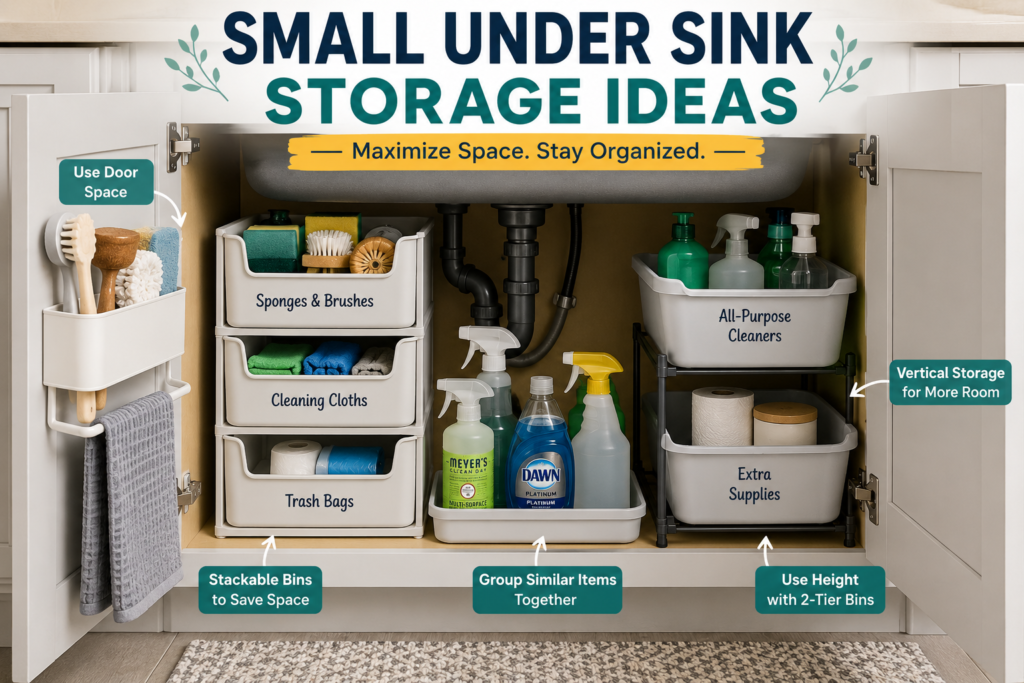
5. Use Stackable Storage Bins
Stackable bins are one of the simplest under sink storage solutions.
Use one bin for surface cleaners, another for dishwasher supplies, and another for spare sponges or cloths.
However, avoid stacking bins so high that you need to remove three containers just to reach the bottom one.
Accessibility matters more than maximum storage capacity.
6. Add a Small Lazy Susan
A compact under sink lazy susan can be useful for bottles and smaller containers.
Instead of moving several bottles to reach one at the back, rotate the organizer until the product you need comes forward.
This works particularly well for:
- Cleaning sprays
- Detergent bottles
- Bathroom products
- Small household supplies
Choose a model with a raised edge so bottles are less likely to slide off.
7. Create a Dedicated Cleaning Zone
If you’re organizing beneath a kitchen sink, create a specific area for cleaning supplies.
For example:
Zone 1: Dishwashing supplies
Zone 2: Surface cleaners
Zone 3: Sponges and brushes
Zone 4: Trash bags and replacement liners
This makes kitchen sink organization easier to maintain because similar products stay together.
8. Use Small Bins for Loose Items
Small items are often responsible for under-sink clutter.
Think about:
- Sponges
- Gloves
- Scrubbers
- Brushes
- Replacement heads
- Microfiber cloths
- Small cleaning accessories
Instead of allowing these items to spread across the cabinet floor, place them in smaller baskets or bins.
This is one of the easiest small under sink storage ideas to implement.
9. Install an Adjustable Shelf
An adjustable under sink shelf organizer can divide one large cabinet into two usable levels.
The advantage is flexibility. You can adjust the shelf around plumbing and change the arrangement when your storage needs change.
This can be especially useful for renters or homeowners who don’t want permanent modifications.
10. Use the Cabinet Doors Carefully
The inside of the cabinet door can provide additional storage.
Depending on the door and available clearance, you could use a suitable organizer for lightweight items such as:
- Sponges
- Cleaning cloths
- Gloves
- Small brushes
- Trash-bag rolls
Before installing anything, close the door and make sure the organizer won’t hit bottles, pipes, or shelves.
11. Store Trash Bags Vertically
Trash bags don’t need to occupy a large amount of horizontal space.
A compact dispenser or vertical storage system can keep rolls accessible while freeing up the cabinet floor.
This is particularly useful for kitchen sink storage ideas, since trash bags are commonly used near the kitchen sink.
12. Create a Bathroom Toiletry Zone
Under a bathroom sink, the contents will usually be different from those beneath a kitchen sink.
Consider grouping:
- Hair-care supplies
- Personal-care items
- Extra soap
- Toilet-cleaning products
- Bathroom cleaning supplies
- Spare towels or cloths, where appropriate
This creates a more practical bathroom sink organization system.
13. Use Clear Containers for Small Supplies
Clear containers make it easier to see what’s inside without opening every box.
They’re particularly helpful for smaller accessories that can otherwise disappear inside a dark cabinet.
However, don’t transfer chemical products into unmarked containers just for appearance. Household chemicals should remain in their original containers and be stored according to their labels.
14. Keep Frequently Used Products at the Front
Organization isn’t only about appearance.
If you use dish soap every day, it should be easy to grab. If a bathroom cleaner is used once a month, it can occupy a less convenient position.
A simple rule is:
Use often = front
Use occasionally = back
Backup = higher or farther back
This makes your system easier to maintain.
15. Organize Around the Plumbing
Don’t fight the pipes.
Instead, use them as the starting point for your layout.
For example, you can place a narrow organizer on either side of the plumbing and reserve the center for taller bottles.
This is often the best way to organize under sink cabinets because it uses the available space instead of pretending the plumbing isn’t there.
16. Use Narrow Organizers in Small Cabinets
A wide organizer isn’t always better.
If your cabinet has limited space because of plumbing or a narrow opening, a narrow under sink organizer may work much better.
Two narrow organizers can sometimes provide more usable storage than one oversized unit.
17. Give Backup Products Their Own Area
Don’t mix unopened backup supplies with products you use every day.
For example, keep your current dish soap near the front and unopened bottles together in a backup zone.
This prevents you from accidentally buying another product when you already have several stored underneath the sink.
18. Add a Waterproof Mat
A removable waterproof cabinet mat can make cleaning easier and help protect the cabinet surface from small spills.
This is particularly useful underneath kitchen and bathroom sinks because these areas can occasionally experience moisture.
Check the cabinet periodically rather than assuming a mat eliminates the need to inspect for leaks.
19. Use Baskets to Create Portable Categories
An under sink storage basket can turn a group of loose items into one easy-to-remove category.
For example, you could have:
- “Kitchen cleaning”
- “Dishwashing”
- “Bathroom cleaning”
- “Extra supplies”
When you need several items, simply pull out the relevant basket.
20. Use Vertical Space Without Blocking Access
Vertical storage is valuable, but don’t fill the cabinet from floor to ceiling if doing so makes everything difficult to reach.
Leave enough clearance to remove bottles and containers comfortably.
The goal is usable storage, not simply the highest possible number of items.
21. Create a Small-Space System
For a tiny bathroom or kitchen, prioritize multifunctional storage.
A compact system might include:
- One two-tier organizer
- One small basket
- One narrow container
- One door-mounted storage solution
- A designated area for tall bottles
This can provide surprisingly effective under sink organization for small spaces without overcrowding the cabinet.
22. Label Storage Bins
Labels are especially useful when multiple people share the home.
Instead of digging through every container, someone can immediately identify:
- Cleaning
- Sponges
- Extra supplies
- Bathroom
- Trash bags
Simple labels can also make it easier for children or other family members to return household items to the correct location—although hazardous cleaning products should remain securely stored away from children.
23. Keep Heavy Bottles on a Stable Lower Surface
Heavy liquid containers are generally better placed low and on a stable surface.
Avoid creating a tall, unstable stack of bottles.
For households with children, the U.S. Consumer Product Safety Commission recommends keeping household chemicals and cleaning supplies secured and out of children’s reach.
24. Do a Five-Minute Monthly Reset
You don’t need to reorganize the entire cabinet every week.
Once a month, spend a few minutes:
- Removing empty containers
- Wiping surfaces
- Checking for leaks
- Returning misplaced items
- Checking backup supplies
- Reorganizing anything that has moved
Small maintenance sessions prevent the cabinet from returning to its original cluttered state.
25. Build the System Around Your Routine
The best under sink organization ideas aren’t necessarily the ones that look best in photographs.
They’re the ones that work with your daily habits.
If you constantly use dish soap, sponges, and trash bags, those items should be immediately accessible. If you rarely use a particular cleaner, it doesn’t need prime storage space.
Good organization reduces friction in everyday life.
Under Kitchen Sink Organization Ideas
The kitchen sink cabinet usually needs to handle more frequent use than a bathroom cabinet.
A practical under kitchen sink organization system can include:
- Dishwashing supplies
- Cleaning sprays
- Sponges and brushes
- Microfiber cloths
- Trash bags
- Dishwasher-related supplies
- Backup cleaning products
One effective layout is to keep daily-use products toward the front and backup products toward the rear.
For particularly small kitchens, combine a narrow organizer with stackable bins rather than filling the entire cabinet with one large storage basket.
Kitchen Sink Storage Ideas for Small Kitchens
If you’re working with a small cabinet, start by removing anything that doesn’t belong there.
Then use vertical space strategically.
A narrow two-tier organizer, small basket, and door storage can often provide more practical capacity than a large container that blocks access to everything behind it.
Under Bathroom Sink Organization Ideas
Bathroom cabinets often have a different storage challenge: lots of small items mixed with cleaning supplies and personal-care products.
A useful under bathroom sink organization system can separate the cabinet into categories.
For example:
Daily care: frequently used personal-care products
Backup: unopened toiletries
Cleaning: bathroom cleaning supplies
Accessories: brushes, cloths, and small items
This makes bathroom vanity organization much easier to maintain.
Small Bathroom Sink Organization
For tiny bathrooms, avoid buying oversized storage systems.
Instead, look for compact, adjustable, or narrow organizers that fit around the plumbing.
The objective isn’t to fill every available inch. It’s to make the items you actually use easier to find.
What Should You Store Under the Sink?
The right items depend on the location.
Under a Kitchen Sink
Suitable categories may include:
- Dishwashing supplies
- Cleaning tools
- Trash bags
- Sponges
- Gloves
- Household cleaning products
Under a Bathroom Sink
You might store:
- Bathroom cleaning products
- Extra toiletries
- Hair-care accessories
- Cleaning cloths
- Personal-care supplies
Always follow individual product labels for storage requirements.
Household hazardous products should remain in their original containers, and the U.S. EPA advises following label instructions and keeping hazardous products away from food.
What Should You Avoid Storing Under the Sink?
Not everything belongs underneath a sink.
Avoid using the cabinet as a general-purpose storage dump.
Be particularly careful with:
- Food
- Medications
- Products requiring special storage conditions
- Unlabeled chemicals
- Items vulnerable to moisture
- Anything that should be kept away from children
The EPA recommends keeping hazardous household products in their original containers and following their storage and disposal instructions.
The CPSC likewise recommends securing household chemicals and cleaning supplies away from children.
Benefits of Good Under Sink Organization
A well-organized cabinet can provide several practical benefits.
Easier Access
You can find what you need without removing half the cabinet.
Better Use of Space
Shelves, baskets, and vertical organizers can turn wasted space into useful storage.
Less Clutter
Categorizing products prevents loose bottles and small accessories from spreading everywhere.
Easier Cleaning
Removable baskets and bins make it easier to take everything out and wipe the cabinet.
Better Inventory Control
When backup products are visible, it’s easier to know what you actually need to buy.
Drawbacks and Things to Consider
Organization products aren’t automatically a solution.
Limited Cabinet Dimensions
A product that works perfectly in one kitchen may not fit another.
Plumbing Can Reduce Usable Space
Pipes, drains, garbage disposals, and water lines can interfere with shelves and drawers.
More Organizers Can Mean More Clutter
Buying several containers without planning the layout can make the cabinet harder to use.
Moisture Can Be a Problem
Under-sink areas can be vulnerable to leaks, so inspect the cabinet regularly.
Safety Comes First
An attractive storage system isn’t worth creating a safety hazard. Cleaning chemicals should remain properly labeled and secured according to their instructions.
Under Sink Organizer Buying Guide
If you’re shopping for an under sink organizer, consider the following before purchasing.
Who Should Buy One?
An organizer can be particularly useful if:
- Your cabinet is difficult to access.
- Bottles are constantly falling over.
- You have unused vertical space.
- Small items disappear underneath larger products.
- You frequently struggle to find cleaning supplies.
1. Measure First
Check the width, depth, height, and plumbing clearance.
Also measure the cabinet opening—not just the inside dimensions.
2. Choose the Right Design
Popular options include:
- Two-tier organizers
- Pull-out drawers
- Sliding shelves
- Stackable bins
- Adjustable shelves
- Lazy Susans
- Narrow organizers
- Door-mounted storage
3. Consider Materials
Common organizer materials include:
- Plastic
- Metal
- Wire
- Bamboo
- Acrylic
For areas that may encounter moisture, choose materials that are appropriate for the environment and easy to clean.
4. Check Stability
An organizer should remain stable when loaded with bottles.
Look for a sturdy base and, where appropriate, raised edges that help prevent items from falling.
5. Prioritize Ease of Cleaning
Cleaning products can leak or leave residue.
Removable shelves, washable bins, and smooth surfaces can make maintenance easier.
6. Think About Your Budget
You don’t necessarily need an expensive system.
A simple combination of a few appropriately sized bins and one adjustable organizer may outperform a costly system that doesn’t fit your cabinet.
7. Consider Durability
If the organizer will hold heavy bottles, pay attention to construction quality and weight capacity.
Don’t choose solely based on appearance.
8. Check Warranty Information
A warranty isn’t always necessary for a simple storage basket, but it can be useful for more complex pull-out or mechanical organizers.
Always check the manufacturer’s actual warranty terms before purchasing.
Under Sink Storage Options Compared
| Feature | Two-Tier Organizer | Pull-Out Organizer | Storage Bins | Lazy Susan |
| Vertical storage | Excellent | Good | Good | Moderate |
| Easy access | Good | Excellent | Good | Excellent |
| Best for | Bottles & supplies | Deep cabinets | Categorizing items | Small bottles |
| Plumbing flexibility | Moderate | Depends on design | Excellent | Good |
| Portability | Moderate | Low | Excellent | Moderate |
| Small cabinets | Good | Moderate | Excellent | Good |
Best overall: Choose based on your cabinet rather than simply choosing the most expensive option.
Expert Tips for Better Under Sink Storage
A few simple rules can make your system much more effective.
Use the front-to-back principle: frequently used items belong near the front.
Use vertical space: shelves and tiers can prevent valuable height from going unused.
Don’t overfill: leave enough room to remove items without knocking everything else over.
Group similar products: categories are easier to maintain than random arrangements.
Leave plumbing accessible: don’t create an organizer system that makes basic maintenance difficult.
Inspect for leaks: organization should never hide a plumbing problem.
Follow product labels: household chemicals can have specific storage requirements.
Common Under Sink Organization Mistakes
Mistake 1: Buying Before Measuring
Always measure the cabinet and plumbing first.
Mistake 2: Using One Giant Bin
One large container may hide everything underneath the top layer.
Mistake 3: Ignoring Vertical Space
A flat cabinet floor can waste a lot of usable height.
Mistake 4: Overloading Shelves
Heavy bottles require stable, appropriately rated storage.
Mistake 5: Storing Dangerous Products Within Children’s Reach
Cleaning products and chemicals should be secured appropriately. The CPSC recommends locked storage and keeping household chemicals away from children.
Mistake 6: Removing Product Labels
Do not sacrifice safety for a cleaner-looking cabinet. The EPA and Poison Control recommend keeping household chemicals in their original containers and retaining their labels.
Mistake 7: Forgetting About Maintenance
A cabinet that looks perfect today can become cluttered again without a simple maintenance routine.
Frequently Asked Questions
1. What is the best way to organize under a sink?
The best approach is to divide the cabinet into categories, use vertical space, keep frequently used products toward the front, and choose organizers that work around your plumbing.
2. How do I organize under the kitchen sink?
Start by removing unused products and measuring the cabinet. Then group cleaning supplies, dishwashing products, trash bags, and accessories into separate zones using bins, shelves, or a suitable under sink organizer.
3. How can I organize a small sink cabinet?
Use narrow organizers, stackable bins, and vertical storage. Avoid oversized containers that consume valuable floor space or block access.
4. What should I store under the kitchen sink?
Common items include dishwashing supplies, cleaning tools, trash bags, sponges, gloves, and appropriate household cleaning products. Always follow product-specific storage instructions.
5. How do I organize under a sink with pipes?
Measure the available spaces on either side of the pipes and select narrow or adjustable storage solutions. Modular organizers are often easier to adapt than one large fixed shelf.
6. Are pull-out organizers worth it?
They can be especially useful in deep cabinets because they bring items from the back toward you. However, make sure the mechanism and dimensions are appropriate for your cabinet.
7. How do I organize under a bathroom sink?
Separate personal-care supplies, backup toiletries, and bathroom cleaning products into different categories. Use small baskets or bins for loose items.
8. How can I maximize under sink storage?
Use vertical space, organize products by frequency of use, select storage that fits around plumbing, and avoid wasting space on duplicate or unused products.
9. Can I store cleaning products under the sink?
Some cleaning products may be stored there if their labels permit it, but hazardous products should remain in their original containers and be secured appropriately. Always follow the product label and keep chemicals away from children.
10. How often should I reorganize under the sink?
A quick monthly reset is usually enough for routine maintenance. You should also inspect the cabinet whenever you notice moisture, unusual odors, or a possible plumbing leak.
Final Verdict
The best under sink organization ideas don’t require a complete kitchen or bathroom makeover.
Start with the cabinet you already have. Remove unnecessary items, measure the available space, work around the plumbing, and divide your supplies into useful categories.
For deep cabinets, consider pull-out storage. For vertical space, try a two-tier organizer. For small items, use baskets or bins. And for small kitchens or bathrooms, narrow and adjustable storage can make a significant difference.
Most importantly, choose organization based on how you actually use the space. A cabinet that is easy to access and easy to maintain will stay organized much longer than one designed purely to look good.
Make Your Under-Sink Space Work Harder
Ready to turn a cluttered cabinet into useful storage?
Explore the home organization and storage products at Al Falah Trader to find practical solutions that can help make your kitchen, bathroom, and other areas of your home easier to organize.
Choose products based on your cabinet dimensions, storage needs, and daily routine—and remember to measure before you buy.
Read More Pet Care Tips/Articles from Al Falah Trader
If you found this guide helpful, you might also enjoy these Blogs/articles:
25 Small Bathroom Storage Ideas for Renters
Recommended Products
Cordless Electric Spin Scrubber with Extendable Handle – Rechargeable Bathroom & Tile Cleaning Brush – SHOP NOW
Cordless Electric Spin Scrubber – Rechargeable Cleaning Brush for Bathroom, Tile & Kitchen – SHOP NOW
Cordless Handheld Vacuum Cleaner – SHOP NOW
Robot Vacuum and Mop with 10000Pa Suction, Self-Cleaning Dock & Hot Air Drying – SHOP NOW
Authoritative External Sources to Consult
For additional reader guidance, you can reference authoritative organizations such as:
U.S. Consumer Product Safety Commission (CPSC) — useful for general consumer product and household safety information.
U.S. Environmental Protection Agency (EPA) — useful for household chemical and cleaning-product safety information.
National Center for Healthy Housing (NCHH) — useful for housing conditions and healthy-home information.
American Cleaning Institute (ACI) — useful for household cleaning-product and safe-use information.