
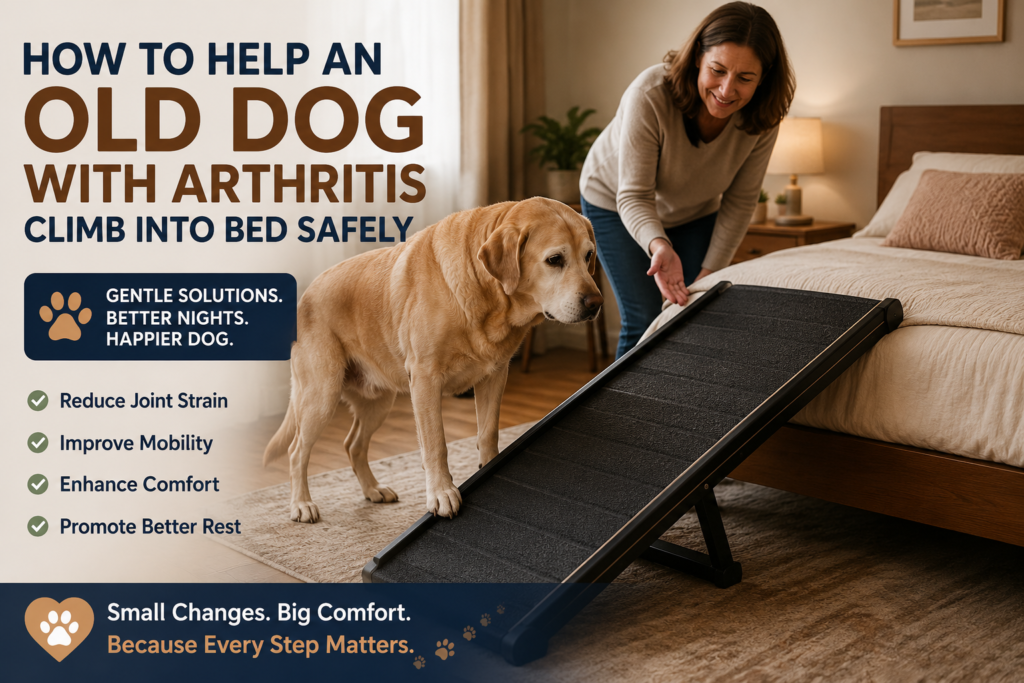
To help an old dog with arthritis climb into bed, you must reduce the impact on their joints. The best methods include installing non-slip pet ramps, setting up a block of dense foam pet stairs, or transitioning them to a dedicated ground-level orthopedic memory foam dog bed that completely eliminates the need to climb.
Why This Topic Matters
Watching an older dog struggle to get onto a favorite bed can be difficult for any pet parent. A dog that once jumped up without thinking may now hesitate, place one paw on the mattress, back away, or simply sleep on the floor.
Arthritis can make everyday movements—including standing, walking, climbing, and jumping—more difficult. However, difficulty getting onto a bed does not automatically mean your dog should stop moving. The goal is to make necessary movement safer while reducing unnecessary jumping and slipping.
For many families, the answer is not simply finding a taller or softer bed. It may involve changing the route your dog takes to reach it, improving traction around the bed, using a ramp or steps, or providing a comfortable sleeping area at floor level.
If your dog suddenly becomes reluctant to move, develops significant lameness, cries when handled, or seems much more painful than usual, contact your veterinarian rather than assuming arthritis is the only cause.
Signs Your Senior Dog May Be Struggling With Mobility at Bedtime
Dogs can be surprisingly good at hiding discomfort. Instead of crying, they may simply change their routine or avoid movements that have become difficult.
Pacing, Whining, or Restlessness Before Bed
An older dog that repeatedly changes position, circles before lying down, gets up several times, or seems unable to settle may be uncomfortable.
These behaviors can have many causes, so they are not proof of arthritis. Still, a change from your dog’s normal bedtime routine is worth paying attention to.
Keep a simple record of what you notice. For example, note whether your dog has difficulty standing after resting, hesitates before jumping, or appears stiff after getting up.
Hesitation or Refusal to Climb Onto Furniture
One of the clearest practical clues is a change in behavior.
If your dog used to jump onto the bed but now waits for you to lift them, places their front paws on the mattress and gives up, or refuses altogether, the movement may be uncomfortable or feel unsafe.
This is especially important with tall beds. A dog may manage to climb onto a low couch but struggle with a mattress that requires a much higher jump.
Stiffness or Limping After Rest
Some dogs appear stiff when they first get up after a long sleep. Others may take shorter steps or need extra time before walking normally.
Persistent limping, worsening mobility, or obvious pain deserves veterinary attention. Arthritis is common in older dogs, but other orthopedic or neurological problems can also affect mobility.
5 Safe Ways to Help an Arthritic Dog Get Into Bed
There is no single solution that works for every senior dog. Consider your dog’s size, strength, balance, confidence, and the height of your bed.
1. Use a Non-Slip Dog Ramp
A ramp can turn a difficult jump into a gradual walk.
For a dog with arthritis, this can be particularly useful when the bed is high. A properly designed ramp should be sturdy enough for your dog’s weight, wide enough to provide confidence, and covered with a surface that provides reliable traction.
A gradual incline is generally more useful than a steep ramp. Large dogs such as Labrador Retrievers and Golden Retrievers may benefit from a longer ramp because their size can make steep climbs more demanding.
The American Kennel Club recommends looking for a gentle slope, an anti-slip surface, and appropriate weight capacity when choosing a dog ramp.
Before buying, check:
- Maximum supported weight
- Ramp width
- Overall length
- Surface traction
- Stability on your flooring
- Whether it folds or stores easily
- Whether the ramp fits securely against your bed
A ramp is only helpful if your dog feels comfortable using it. Introduce it gradually rather than placing your dog halfway up and expecting them to figure it out.
2. Try Foam Pet Stairs for a Low-to-Medium Bed
Dog stairs can be a good option for some senior dogs, especially those that still have reasonable balance and can comfortably walk up individual steps.
Look for deep, wide steps with a non-slip surface rather than narrow, steep steps.
Foam stairs can also provide a softer walking surface and may be easier for some dogs to navigate than hard plastic steps. However, they must still be stable and appropriately sized for the dog.
Stairs are not automatically better than ramps. A dog that has significant weakness, poor balance, or difficulty controlling its descent may be better suited to a ramp or a ground-level bed.
3. Use a Supportive Harness When Appropriate
If your dog needs occasional assistance, a properly fitted mobility harness can give you more control while reducing the temptation to grab or pull awkwardly.
This can be particularly useful for larger dogs that are difficult to lift.
However, a harness should provide support rather than forcing your dog’s body into an uncomfortable position. If your dog needs substantial assistance to stand or walk, ask your veterinarian or a veterinary rehabilitation professional how the harness should be used.
The American Animal Hospital Association includes fitted, padded harnesses among home-support options that can assist senior pets with mobility.
4. Add High-Traction Flooring Around the Bed
Sometimes the biggest problem isn’t the bed itself.
Hardwood, tile, laminate, and other smooth flooring can make it difficult for an older dog to get enough traction. A dog may approach the bed confidently but slip when turning, standing, or pushing off with the back legs.
Place a non-slip rug, carpet runner, or suitable traction mat along your dog’s normal route to the bed.
The Canine Arthritis Resources and Education organization specifically recommends improving traction with rugs, runners, yoga mats, or other non-slip surfaces in areas where dogs with osteoarthritis move around.
Make sure the rug itself does not slide. A loose rug can create another hazard.
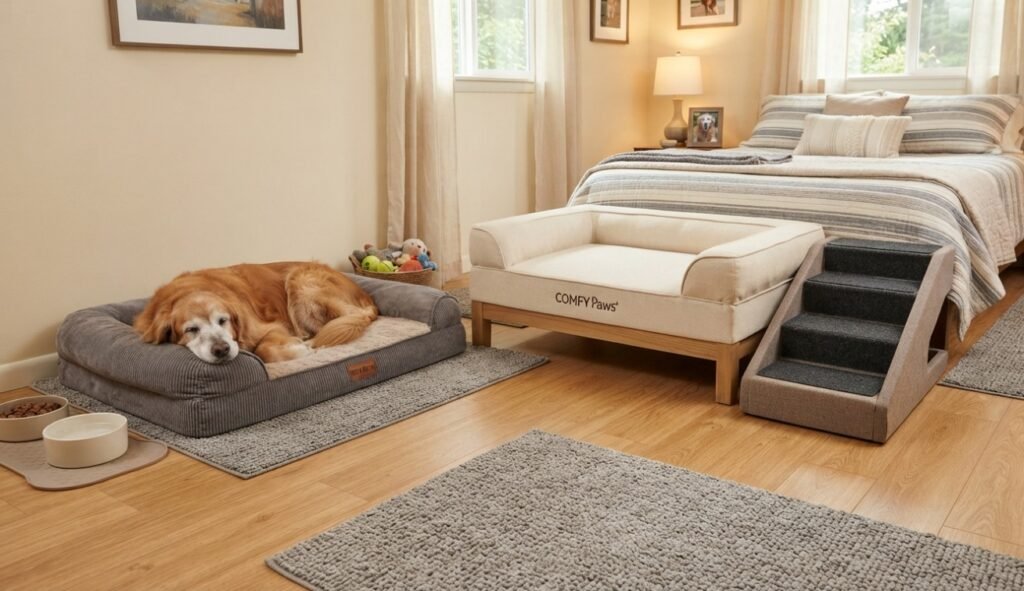
5. Consider Moving Your Dog’s Bed to the Floor
Sometimes the safest solution is also the simplest.
If your dog has substantial difficulty climbing, jumping, or balancing, you may not need to help them reach the human bed at all. Instead, create a comfortable sleeping station beside your bed.
This lets your dog remain close to you while eliminating the need to climb onto a tall mattress.
A supportive floor-level dog bed can be especially practical for dogs that repeatedly jump off the human bed during the night.
How to Safely Lift an Old Dog Onto the Bed
If lifting is necessary, don’t treat it like picking up a small puppy.
A large senior dog can be heavy, and an awkward lift can cause injury to both you and your pet.
Before lifting
- Clear the area around the bed.
- Make sure you have a stable footing.
- Move slowly and calmly.
- Support the dog’s body rather than pulling on the front legs.
- Consider using a properly fitted support harness for a large dog.
- Ask for help if the dog is too heavy to handle safely.
Never drag an unwilling dog onto the mattress.
If your dog becomes tense, cries, snaps, or tries to escape when lifted, stop and consult your veterinarian. Pain may be contributing to the reaction.
For many families, a ramp, stairs, or floor-level bed is a better long-term solution than lifting the dog several times every day.
How to Help a Dog With Arthritis Climb Stairs
The answer depends heavily on the individual dog.
Some larger dogs with osteoarthritis can still walk up ordinary stairs in a controlled manner. Others may struggle with even a few steps.
The Canine Arthritis Resources and Education organization notes that stairs are not necessarily inappropriate for every dog with osteoarthritis, but traction, stair design, dog size, and the dog’s ability to walk rather than jump between steps all matter.
Going down stairs can also be more challenging because it requires controlled weight-bearing and balance.
If your dog is struggling with stairs:
- Add non-slip stair treads or carpeting.
- Keep the staircase well lit.
- Prevent uncontrolled running.
- Supervise your dog when necessary.
- Consider a ramp or alternative sleeping location.
- Ask your veterinarian whether the current level of activity is appropriate.
Don’t force an arthritic dog to climb stairs simply because exercise is generally beneficial.
Are Ramps Better Than Stairs for Dogs With Arthritis?
Not always, but ramps are often worth considering when a dog has difficulty with individual steps.
| Feature | Dog Ramp | Dog Stairs | Best Choice |
| Joint-friendly access | Gradual movement | Repeated step-ups | Ramp for many mobility-limited dogs |
| Space required | Usually more floor space | Usually more compact | Stairs for tight spaces |
| Large dogs | Good if wide and sturdy | Can work if steps are deep | Depends on dog |
| Small dogs | Often easier than tall steps | Step height matters greatly | Often ramp or low steps |
| Balance problems | Can be easier | Requires repeated stepping | Often ramp |
| Storage | Some fold | Some are compact | Depends on model |
| Training | May require practice | May require practice | Individual |
| High bed | Requires sufficient length | Can fit closer to bed | Measure first |
The best choice depends on your dog’s mobility and the physical layout of your home.
For an arthritic dog that cannot comfortably negotiate steps, a stable ramp with a gentle incline may be preferable. For a dog with good balance that simply can’t make the final jump onto a low bed, sturdy pet stairs may be sufficient.
Should Dogs With Arthritis Jump on Beds?
Regularly jumping on and off a tall bed is not an ideal mobility strategy for an arthritic dog.
The landing can be particularly problematic because the dog has to absorb the impact through its limbs. A dog may also slip when landing on hardwood or tile.
That doesn’t mean every arthritic dog must be prevented from moving independently. Instead, look for ways to replace unnecessary high-impact movements with controlled access.
Ramps, appropriate stairs, traction surfaces, and floor-level bedding can all help.
Canine Arthritis Resources and Education specifically recommends avoiding jumping down from elevated surfaces and using stairs or ramps to assist dogs with arthritis.
Choosing the Best Bed for a Dog With Arthritis
If your dog spends most of the night on the floor, choosing a supportive dog bed becomes especially important.
A good bed should allow your dog to lie down, get up, turn around, and stretch without struggling.
Look for supportive foam
Memory foam or other supportive foam can help provide a more stable sleeping surface than a bed that quickly flattens under the dog’s weight.
However, don’t assume that the most expensive foam is automatically the best. The dog’s size, sleeping position, mobility, and ability to get in and out of the bed all matter.
Choose an easy-entry design
A senior dog may struggle with a tall-sided bed.
A lower entry can make getting in and out easier, especially for dogs with stiff hips or knees.
Consider a washable cover
Older dogs can have occasional accidents or may track dirt into their sleeping area.
A removable, machine-washable cover makes routine cleaning much easier.
Use non-slip support underneath
Even an excellent orthopedic bed can be difficult to use if it slides across hardwood flooring.
Place a non-slip mat underneath the bed if necessary.
Keep the sleeping area warm and accessible
A comfortable sleeping area should be away from drafts and positioned where your dog can easily reach it.
CARE recommends supportive bedding, a warm location, and non-slip flooring around the bed for dogs with osteoarthritis.
Home Modifications for Dogs With Arthritis
Helping your dog get onto the bed is only one part of making the home easier to navigate.
Think about the entire route your dog takes throughout the day.
Useful changes include:
- Non-slip runners on hardwood floors
- Rugs with secure backing
- Traction surfaces near food and water bowls
- Ramps where jumping is unavoidable
- Secure pet stairs where appropriate
- Gates around hazardous staircases
- A low-entry orthopedic bed
- Keeping food, water, and bedding on an accessible level
- Regular nail and paw care
- Clear pathways without clutter
The goal is to create predictable routes with fewer opportunities for slipping, jumping, or sudden changes in direction.
How Much Exercise Should a Dog With Arthritis Get?
Dogs with arthritis generally should not be placed on complete bed rest unless specifically instructed by a veterinarian.
Appropriate, controlled movement can help maintain mobility and fitness, but the right amount varies by dog.
A senior Labrador with mild arthritis may have very different exercise needs from a small dog with advanced mobility problems.
Talk with your veterinarian about the appropriate duration and intensity of walks and other activities for your dog.
Weight management also matters. Maintaining a healthy body condition can reduce the mechanical burden placed on weight-bearing joints, and AAHA guidelines recognize nutritional and weight management as important components of canine osteoarthritis care.
Benefits of Making Bed Access Easier
A thoughtful setup can provide several practical benefits.
Reduced jumping
Replacing a high jump with a ramp or controlled steps reduces the need for sudden impact.
Better traction
Non-slip flooring can make standing, walking, and turning more secure.
Greater independence
Instead of waiting for you to lift them, some dogs can use a properly designed ramp or stairs independently.
Easier nighttime movement
A safe route can make it easier for your dog to move between the bed, water bowl, and bathroom area.
More comfortable rest
A supportive, easy-access bed gives your dog a comfortable place to sleep without requiring repeated climbs.
Drawbacks and Things to Consider
Every solution has limitations.
Ramps need space
A ramp long enough to provide a gentle incline can extend several feet into the room.
Stairs aren’t suitable for every dog
Dogs with poor balance or significant weakness may struggle with steps.
Some dogs need training
A dog that has never used a ramp may initially refuse to walk across it.
Foam stairs can move
Lightweight stairs may slide on smooth floors unless they have a secure base or are placed on appropriate traction material.
Lifting isn’t a long-term strategy for everyone
Repeatedly lifting a large dog can be physically demanding and may become unsafe as the dog’s mobility declines.
Products don’t replace veterinary care
Ramps, beds, harnesses, and flooring modifications can support mobility, but they don’t diagnose or treat the underlying cause of pain.
Buying Guide: What to Look For
If you’re shopping for a dog ramp for bed for older dogs, evaluate the product rather than buying based solely on appearance.
Who should consider a ramp?
A ramp may be worth considering for:
- Senior dogs
- Dogs with arthritis
- Dogs that struggle with jumping
- Dogs with reduced balance
- Large dogs that are difficult to lift
- Dogs that need safer access to a tall bed
Key features
Look for:
- Strong construction
- Appropriate weight capacity
- Wide walking surface
- Reliable traction
- Stable base
- Gentle incline
- Secure connection to the bed
- Easy cleaning
Materials
Common materials include plastic, wood, metal frames, foam, and fabric-covered surfaces.
The best material depends on the location and your dog’s size. A lightweight ramp may be convenient, but stability should never be sacrificed for portability.
Durability
Check the manufacturer’s weight rating and dimensions. A ramp that flexes, shifts, or feels unstable can make an older dog less confident.
Maintenance
Choose surfaces that can be vacuumed or wiped down easily. If the ramp has a removable fabric covering, check whether it can be washed.
Warranty
If a manufacturer provides a warranty, review what it covers before purchasing. Pay particular attention to structural defects and the warranty period.
How to Teach a Dog to Use Steps or a Ramp for a Bed
Don’t wait until bedtime to introduce a new ramp or staircase.
Place it on the floor first and allow your dog to investigate.
Then:
- Reward your dog for approaching it.
- Encourage one or two steps at a time.
- Use small treats or praise to create a positive association.
- Keep the ramp stable.
- Practice when your dog is relaxed.
- Gradually position it toward the bed.
- Supervise early attempts.
Never push or pull your dog up a ramp.
If your dog repeatedly refuses to use it, the ramp may be too steep, too narrow, unstable, or simply unsuitable for that individual dog.
Common Mistakes to Avoid
1. Buying a ramp without measuring
Measure the height of your bed and the available floor space first.
2. Ignoring traction
A smooth ramp over a slippery floor can create another mobility problem.
3. Choosing stairs that are too narrow
Senior dogs may need more room to place all four paws confidently.
4. Letting the dog jump down
Owners often focus on getting the dog onto the bed and forget that the dog also has to get down.
5. Lifting incorrectly
Don’t lift a large dog by the front legs or pull them upward by the collar.
6. Assuming arthritis explains every mobility change
A sudden or severe change should be evaluated by a veterinarian.
7. Buying the softest bed instead of the most supportive one
A bed that feels extremely plush to your hand may not provide the stable support an older dog needs.
8. Forgetting the floor underneath the bed
Even the best orthopedic dog bed can be difficult to exit if your dog’s paws immediately slide on hardwood.
Frequently Asked Questions
Can an old dog with arthritis still sleep on my bed?
Yes, many senior dogs can continue sleeping on a human bed if they can access it safely. The important issue is reducing unnecessary jumping and providing a safe way to get both onto and off the bed.
How do I help a senior dog get on the bed?
A ramp, appropriately sized pet stairs, a supportive mobility harness, or a floor-level orthopedic bed can help. The best choice depends on your dog’s strength, balance, size, and the height of your bed.
Are ramps better than stairs for dogs with arthritis?
Not necessarily. A ramp may be easier for dogs that struggle with individual steps or have poor balance, while some dogs with good coordination may use appropriately designed stairs comfortably.
Should dogs with arthritis jump on beds?
It is better to minimize repeated jumping onto and especially off high furniture. A ramp or suitable stairs can provide a more controlled route.
What is the best dog ramp for a senior dog?
Look for a ramp with an appropriate weight rating, stable construction, a wide walking surface, good traction, and a gentle incline. The “best” ramp depends on your dog’s size and your bed’s height.
How can I safely lift an old dog onto the bed?
Use proper body support and avoid pulling on the dog’s legs or neck. A mobility harness may help with larger dogs. If lifting is difficult or your dog appears painful, consider a ramp or floor-level bed instead.
How can I help a senior dog with weak legs get on the bed?
Improve traction first, then consider a low-incline ramp or an easy-entry sleeping area. A veterinarian can also help determine why the dog’s legs are weak and whether rehabilitation or other treatment is appropriate.
Can a dog with arthritis climb stairs?
Some dogs with arthritis can manage stairs in a controlled manner, while others cannot. Stair height, traction, dog size, balance, and the severity of mobility problems all matter.
What type of bed is best for a dog with arthritis?
Look for a supportive, stable sleeping surface with enough room for the dog to stretch out and an entry height they can manage comfortably. Memory foam or other supportive foam can be a useful option.
When should I take my dog to the veterinarian?
Seek veterinary advice if mobility suddenly worsens, your dog develops significant lameness, cries when touched or moved, cannot comfortably stand or walk, or shows other concerning changes.
Expert Tips for a Safer Senior-Dog Bedroom
Think about your dog’s entire bedtime routine instead of focusing only on the mattress.
A good senior-dog setup might look like this:
Human bed → stable ramp → non-slip runner → supportive floor-level dog bed → accessible water
This gives your dog choices.
If your dog wants to sleep beside you, they have a safer route to the bed. If they become tired or uncomfortable, they have a comfortable alternative nearby.
Also, observe your dog for a few days after making changes. The best setup is the one your dog actually uses confidently.
Final Verdict
If you’re wondering how to help an old dog with arthritis climb into bed safely, start by reducing unnecessary jumping and improving traction.
For some dogs, a stable, gently inclined ramp will be the most practical solution. For others, deep, non-slip pet stairs may work well. If your dog’s mobility is significantly reduced, a supportive floor-level orthopedic dog bed beside your bed may be the safest and simplest choice.
Don’t forget the way down. A dog that can climb onto a mattress but launches themselves onto a slippery floor at 2 a.m. is still exposed to unnecessary risk.
Most importantly, treat mobility changes as useful information. Home modifications can make daily life easier, but they should complement—not replace—appropriate veterinary care.
Give Your Senior Dog a More Comfortable Place to Rest
If your older dog no longer feels comfortable jumping onto a high bed, you don’t necessarily have to sacrifice comfort or closeness.
A supportive orthopedic dog bed placed beside your bed can give your pet a dedicated resting space without requiring repeated jumps. Look for a design with supportive foam, an easy-to-access profile, a washable cover, and enough room for your dog to stretch out comfortably.
Explore the Al Falah Trader pet collection for supportive dog bedding and other products designed to make everyday life with your pet easier.
Read More Pet Care Tips/Articles from Al Falah Trader
If you found this guide helpful, you might also enjoy these Blogs/articles:
Dog Care Tips for First-Time Owners: Complete Beginner Guide
Daily Dog Care Checklist: Essential Tasks for a Healthy Dog
How Much Sleep Do Dogs Need? A Complete Age-by-Age Guide
Pedigree Dog Food Recall 2026: What Every Dog Owner Should Know
Best Orthopedic Dog Beds for Comfort and Joint Support
Recommended Products
Memory Foam Dog Beds for Maximum Comfort & Support – Shop Now
Best Heated Dog Beds for Winter – Shop Now
Plush Calming Dog Bed – Soft Pet Nest Bed for Dogs & Cats – Shop Now
Princess Dog Bed – Cozy Fantasy Pet Nest Bed for Dogs & Cats – Shop Now
Dog Potty Training in 7 Days – E-books
Authoritative External Resources
For readers who want to learn more about canine health and behavior, consider linking to: