
Introduction
The best dog toys do more than keep your dog busy for a few minutes. The right toy can encourage exercise, provide mental stimulation, support healthy chewing habits, strengthen the bond between you and your dog, and give your pet an appropriate outlet for natural behaviors.
But choosing a toy isn’t always simple. A toy that keeps a gentle Shih Tzu entertained may be destroyed within minutes by a powerful Labrador. Likewise, a plush toy that is perfect for supervised cuddling may not be suitable for a dog that immediately tears out the stuffing.
So, what toys do dogs like? The answer depends on your dog’s age, size, personality, chewing style, energy level, and preferred way to play.
In this guide, we’ll explain how to choose the best dog toys, compare popular toy types, discuss safety and durability, and share practical tips for keeping your dog entertained.
Why Choosing the Right Dog Toy Matters (best dog toys)
Dogs naturally explore their environment through behaviors such as chewing, sniffing, chasing, carrying, and searching. Toys give them appropriate ways to express these behaviors.
Mental enrichment is especially important for dogs that spend significant time indoors or alone. UC Davis School of Veterinary Medicine notes that insufficient enrichment and stimulation can contribute to unwanted behaviors, while appropriate toys and activities can provide positive outlets.
A good toy can help with:
- Mental stimulation and problem-solving
- Physical activity
- Appropriate chewing
- Interactive play with owners
- Reducing boredom
- Training and reward-based activities
- Puppy teething
- Fetching and retrieving
- Comfort and relaxation
However, toys aren’t a replacement for walks, training, social interaction, or veterinary care. Think of them as one part of a balanced daily routine.
Types of Dog Toys (best dog toys)
There isn’t one universal “best” dog toy. Instead, the best choice is usually a combination of several toy types.
Interactive Dog Toys
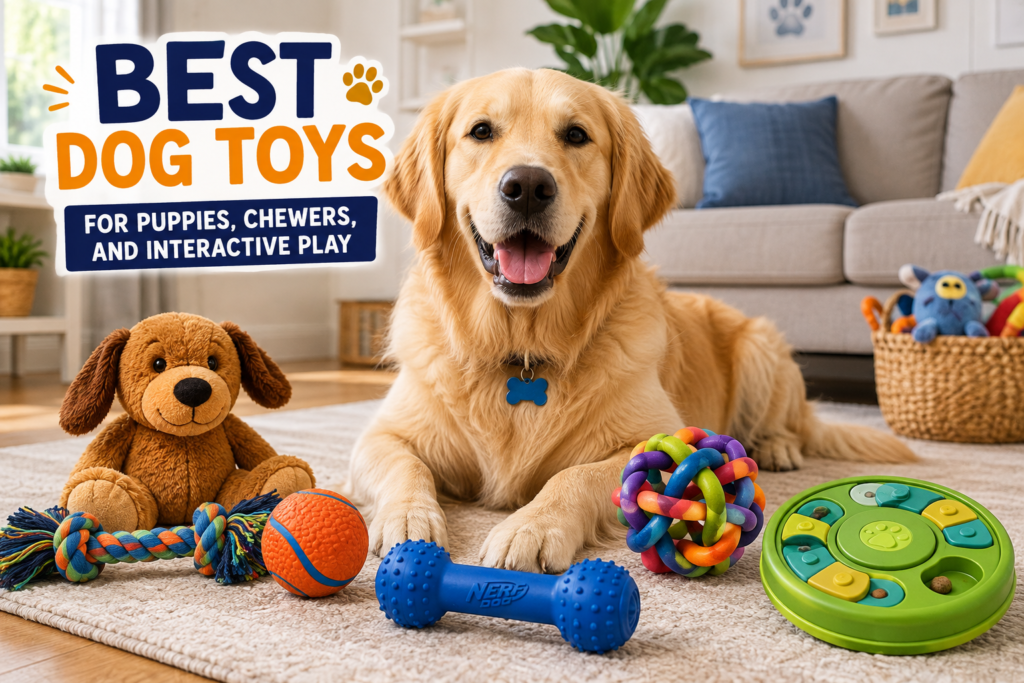
Interactive dog toys are designed to make your dog think, manipulate objects, search, or work for a reward.
Examples include:
- Treat-dispensing toys
- Puzzle feeders
- Food-dispensing balls
- Snuffle-style enrichment toys
- Hide-and-seek toys
- Interactive training toys
These are particularly useful for dogs that become bored easily.
For example, instead of giving your dog their entire meal in a bowl, you can use an appropriate food puzzle to turn part of mealtime into an enrichment activity. UC Davis veterinary behavior specialists describe food toys and puzzles as useful forms of environmental enrichment.
Best for: Smart, energetic, food-motivated, or easily bored dogs.
Chew Toys for Dogs
Chewing is a normal canine behavior. Puppies chew while exploring and teething, while adult dogs may chew for entertainment, relaxation, or stimulation.
Good chew toys for dogs should be appropriately sized and durable enough for the individual dog without being excessively hard.
Avoid assuming that harder automatically means safer or better. Very hard objects can damage teeth. UC Davis recommends considering the flexibility of a chew toy and notes that excessively hard objects can contribute to tooth fractures.
Best for: Dogs that naturally love chewing.
Puppy Toys
Puppy toys need extra consideration because puppies have developing teeth, curious mouths, and a tendency to investigate almost everything.
Look for:
- Puppy-specific materials
- Appropriate size
- Flexible textures
- Easy-to-clean surfaces
- Toys designed for teething
- Products without easily detachable pieces
Puppies should also be supervised during play. If a toy develops tears, deep punctures, loose fibers, or detachable parts, replace it rather than trying to repair it.
Squeaky Dog Toys
Many dogs love squeaky dog toys because the sound can make play more exciting.
Are squeaky toys good for dogs? They can be, provided they’re appropriate for the individual dog and used safely.
A gentle dog may happily carry and squeak a toy for months. A determined dog may immediately try to locate and remove the squeaker.
If your dog destroys squeaky toys, use them during supervised play rather than leaving them available all day.
Plush Dog Toys
Plush dog toys can be excellent for dogs that enjoy carrying, cuddling, tossing, or gently chewing toys.
They’re often popular with puppies and dogs that enjoy soft textures. However, plush toys can become problematic when a dog quickly tears them open and consumes stuffing, fabric, squeakers, or other internal components.
For destructive chewers, plush toys should generally be treated as supervised-play toys rather than unattended toys.
Best Dog Toys by Your Dog’s Personality
The easiest way to choose a toy is to start with your dog’s behavior rather than the product category.
| Dog’s Behavior | Toy Type to Consider | Best For |
| Loves chewing | Durable rubber chew toy | Daily chewing |
| Loves chasing | Ball or dog-safe disc | Fetch and exercise |
| Loves food | Puzzle or treat-dispensing toy | Mental stimulation |
| Gets bored easily | Interactive toy | Independent enrichment |
| Loves carrying toys | Plush or lightweight toy | Indoor play |
| Loves squeaking | Squeaky toy | Supervised play |
| Puppy that chews | Puppy teething toy | Teething and redirection |
| Powerful chewer | Durable, appropriately sized chew toy | Heavy chewing |
| Senior or gentle chewer | Softer, flexible toy | Comfortable play |
Remember that individual preferences vary. Breed can offer clues, but your dog’s actual behavior is more useful when choosing between toys.
Benefits of Good Dog Toys
1. They Help Fight Boredom
Bored dogs may find their own entertainment, which can include chewing furniture, digging, excessive barking, or exploring things they shouldn’t.
Appropriate enrichment gives your dog another outlet. UC Davis specifically recommends enrichment, exercise, and appropriate toys as ways to redirect unwanted behaviors.
2. They Provide Mental Stimulation
A puzzle toy can make a dog figure out how to access food or treats. This creates a simple problem-solving activity rather than passive entertainment.
3. They Encourage Physical Activity
Fetch, tug, chasing, and other forms of active play can get dogs moving.
4. They Support Appropriate Chewing
Instead of allowing a puppy to chew shoes or furniture, you can redirect the behavior toward a suitable chew toy.
5. They Can Strengthen Your Relationship
Interactive play gives you an opportunity to train, communicate, and reward your dog while having fun together.
Are Chew Toys Good for Dogs?
Generally, appropriate chew toys can be useful, but the specific toy matters.
A chew toy should match your dog’s:
- Age
- Body size
- Jaw strength
- Chewing intensity
- Health and dental condition
- Playing habits
Don’t automatically choose the hardest toy available for an aggressive chewer. A toy that’s extremely hard may last longer but can pose a dental risk.
Also avoid giving your dog random household objects as substitutes for toys. A puppy that learns that shoes, socks, furniture, and children’s toys are acceptable chewing targets can be difficult to retrain.
What Toys Are Safe for Aggressive Chewers?
There is no truly “indestructible dog toy.” Even products marketed as durable dog toys can eventually be damaged by a determined dog.
For powerful chewers, prioritize:
- Thick, durable construction
- Appropriate size
- Flexible or resilient materials
- Minimal detachable components
- Simple designs
- Products intended for heavy chewing
- Regular inspection
The goal isn’t to find a toy that can never break. The goal is to select a toy that gives your dog an appropriate chewing outlet while minimizing the chance of dangerous pieces breaking off.
If your dog routinely destroys toys within minutes, consider discussing appropriate chew options with your veterinarian.
Comparison: Which Dog Toy Is Best?
| Feature | Interactive Toys | Chew Toys | Plush Toys | Squeaky Toys |
| Mental stimulation | Excellent | Moderate | Low–Moderate | Moderate |
| Chewing | Moderate | Excellent | Low–Moderate | Low–Moderate |
| Physical play | Moderate | Moderate | Moderate | Good |
| Puppy suitability | Good | Excellent when puppy-specific | Good with supervision | Good with supervision |
| Heavy chewer suitability | Depends on design | Usually best | Often poor | Depends on design |
| Independent play | Excellent | Good | Depends on dog | Depends on dog |
| Supervision needed | Usually | Recommended | Often | Often |
For most households, a mix of toy types works better than buying several toys that all serve the same purpose.
How to Choose Dog Toys
When deciding how to choose dog toys, use this checklist.
1. Consider Your Dog’s Size
A toy should be large enough that your dog cannot accidentally swallow it.
At the same time, an oversized or excessively heavy toy may be difficult for a small dog to carry or use.
2. Consider Chewing Strength
A gentle chewer has very different requirements from a dog that destroys every toy within an hour.
Observe what your dog does with existing toys. Does your dog carry them, gently chew them, shake them, rip them apart, or try to remove individual components?
That behavior tells you more than the label “tough” or “durable.”
3. Examine the Material
Look for materials appropriate to the intended use.
For chew toys, flexible and resilient materials can be preferable to extremely hard objects. For plush toys, examine stitching and construction, especially if your dog likes to tear fabric.
4. Think About the Toy’s Purpose
Ask what you want the toy to accomplish.
Do you want:
- Exercise?
- Chewing?
- Mental stimulation?
- Training?
- Comfort?
- Fetch?
- Entertainment while you’re busy?
Once you identify the purpose, choosing becomes much easier.
5. Check for Small Parts
Avoid toys with components your dog can easily remove and swallow.
Pay particular attention to:
- Squeakers
- Plastic eyes
- Loose threads
- Ribbons
- Stuffing
- Broken rubber pieces
- Detached handles
6. Consider Cleaning
Dogs can drool on toys, carry them outdoors, and drop them on the floor. Toys that are easy to clean are therefore practical for everyday use.
Follow the manufacturer’s cleaning instructions rather than assuming every toy can go into a washing machine or dishwasher.
How to Keep a Dog Entertained
You don’t need to buy a new toy every week.
Try rotating toys instead.
For example:
Monday: Puzzle toy
Tuesday: Fetch toy
Wednesday: Chew toy
Thursday: Plush toy during supervised play
Friday: Treat-dispensing toy
Weekend: Interactive play with you
Keep some toys out of sight and bring them back later. A toy that has been unavailable for several days can feel more interesting when it returns.
You can also combine toys with training. Ask your dog to sit, wait, or perform another learned behavior before starting a short play session.
How to Keep Dogs Busy While Alone
Toys can help occupy a dog while you’re away, but you should choose unattended toys more carefully than toys used during interactive play.
For dogs that are comfortable playing alone, consider appropriately sized food-dispensing or enrichment toys that have been tested under supervision first.
Before leaving your dog alone with a toy, observe how they use it. If they immediately destroy it, remove pieces, or attempt to swallow parts, that toy isn’t appropriate for unsupervised use.
Also remember that a toy cannot solve every separation-related behavior. Persistent destructive behavior, vocalization, pacing, or distress when alone may require guidance from a veterinarian or qualified behavior professional.
Why Do Dogs Destroy Their Toys?
Dogs destroy toys for many different reasons.
They may:
- Enjoy tearing and dissecting objects
- Have strong chewing instincts
- Be bored
- Be overexcited during play
- Want to reach the squeaker
- Prefer certain textures
- Have excess energy
- Simply enjoy destroying things
Destruction isn’t necessarily a sign that your dog “hates” the toy.
For some dogs, destroying the toy is actually the most entertaining part.
How to Stop Dogs From Destroying Toys
You may not be able to completely stop a determined dog from destroying toys, but you can manage the behavior.
Try these strategies:
- Choose toys designed for your dog’s chewing style.
- Supervise high-energy play.
- Remove toys when they become damaged.
- Rotate toys rather than leaving every toy available.
- Provide exercise before longer periods of rest.
- Use puzzle toys for mental stimulation.
- Teach “drop it” and “leave it.”
- Redirect destructive chewing toward appropriate toys.
Don’t punish a dog after discovering that a toy or household object was destroyed earlier. Instead, focus on prevention, management, exercise, enrichment, and positive training.
How Often Should You Replace Dog Toys?
There’s no universal replacement schedule.
Inspect toys regularly and replace them when they become unsafe.
Replace a toy if you notice:
- Large tears
- Deep cracks
- Missing pieces
- Loose stitching
- Exposed stuffing
- Detached squeakers
- Pieces that can be swallowed
- Sharp or jagged edges
- Significant deterioration
A toy may last a gentle dog for months but only survive a few days with a powerful chewer.
The condition of the toy matters more than its age.
How to Clean Dog Toys
Cleaning frequency depends on the toy, how often it’s used, and whether your dog carries it outdoors.
For washable toys:
- Remove visible dirt or debris.
- Follow the manufacturer’s washing instructions.
- Use an appropriate cleaning method.
- Rinse thoroughly when required.
- Allow the toy to dry completely before giving it back.
How often should you wash dog toys?
Frequently used toys should be cleaned regularly rather than waiting until they’re visibly dirty.
Food-dispensing toys may need more frequent cleaning because leftover food can remain inside them.
Inspect toys after cleaning as well. Washing can sometimes reveal weakened stitching, cracks, or other damage.
Expert Tips for Getting More From Dog Toys
Use Toy Rotation
Keep a small selection available and rotate the rest.
Match Toys to Activities
Use fetch toys for exercise, puzzle toys for mental work, and chew toys for appropriate chewing.
Introduce New Toys Slowly
Some dogs immediately understand a puzzle toy. Others need you to demonstrate how it works.
Use Food Strategically
For food-motivated dogs, a properly designed treat-dispensing toy can turn snack time into an enrichment session.
Supervise New Toys
The first few play sessions tell you a lot about how your dog interacts with the toy.
Watch Your Dog, Not Just the Label
“Heavy duty,” “indestructible,” and “aggressive chewer” are marketing descriptions, not guarantees that a toy cannot be destroyed.
Common Dog Toy Mistakes
Buying Based Only on Appearance
A cute toy isn’t necessarily appropriate for your dog’s play style.
Choosing the Hardest Toy Possible
Harder doesn’t always mean safer. Excessively hard objects can damage teeth.
Giving a Powerful Chewer a Fragile Plush Toy Unsupervised
If your dog tears plush toys apart, don’t leave one with them when you’re away.
Ignoring Toy Damage
A toy that was safe yesterday may become unsafe after part of it breaks.
Giving Puppies Adult Toys
Puppies need toys appropriate for their age, size, chewing ability, and stage of development.
Using Toys as a Substitute for Exercise
A puzzle toy can provide enrichment, but it doesn’t replace walks, play, training, or social interaction.
Frequently Asked Questions
1. What toys do dogs like the most?
Dogs have individual preferences, but common favorites include chew toys, balls, squeaky toys, plush toys, tug toys, and interactive food puzzles. Watch how your dog naturally plays to determine which type they prefer.
2. What are the best dog toys for aggressive chewers?
Look for appropriately sized, durable chew toys made for strong chewers. Avoid assuming any product is completely indestructible, and inspect toys regularly for damage.
3. Are squeaky toys good for dogs?
Squeaky toys can be fun and engaging, especially for dogs that enjoy sound-based play. However, dogs that quickly destroy them should use squeaky toys only under supervision.
4. Are plush toys safe for dogs?
Plush toys can be suitable for dogs that play gently. If your dog tears fabric, removes stuffing, or swallows small parts, choose a different toy or restrict plush toys to supervised sessions.
5. What toys are best for puppies?
The best puppy toys are appropriately sized, durable enough for puppy play, and designed for chewing or teething. Puppy-specific chew toys and interactive toys can provide useful outlets for developing dogs.
6. How often should you replace dog toys?
Replace toys whenever they become damaged or develop pieces that could be swallowed. There isn’t a fixed replacement period because dogs destroy toys at very different rates.
7. How can I keep my dog entertained?
Use a combination of walks, training, interactive play, chew toys, puzzle toys, sniffing activities, and food-based enrichment. Rotate toys to prevent them from becoming boring.
8. How can I keep my dog busy while I’m away?
Use only toys that you have already observed your dog using safely. Appropriate food-dispensing or enrichment toys may help, but dogs with significant distress when left alone may need behavioral support rather than simply more toys.
9. Why does my dog destroy every toy?
Your dog may enjoy chewing, ripping, dissecting, or trying to reach internal components. Strong chewing instincts, boredom, excess energy, or simply a preference for destructive play can all contribute.
10. Are chew toys good for dogs’ teeth?
Some appropriately designed chew toys may support chewing activity, but they are not a replacement for regular dental care. Avoid extremely hard objects that could fracture teeth.
Final Verdict: What Are the Best Dog Toys?
The best dog toys aren’t necessarily the most expensive, most complicated, or most heavily advertised products.
The right toy is the one that fits your dog’s:
- Age
- Size
- Personality
- Chewing strength
- Activity level
- Play style
- Safety needs
For most dogs, a balanced collection is ideal: one or two durable chew toys, an interactive or puzzle toy, a fetch or active-play toy, and a softer toy for supervised play.
Most importantly, inspect every toy regularly and replace it when it becomes damaged. A well-chosen toy can provide hours of enrichment, but safety should always come before entertainment.
At Al Falah Trader, we’re focused on helping dog owners find practical pet essentials that fit real everyday needs. Explore our dog toy and pet product collection to find options for playtime, chewing, enrichment, and keeping your dog happily occupied.
Explore Comfortable Dog Beds at Al Falah Trader
Looking for the perfect bed for your furry companion?
At Al Falah Trader, we offer carefully selected orthopedic dog beds, memory foam dog beds, washable pet beds, and comfortable sleeping solutions designed to support dogs of all sizes.
Browse our collection today and find the perfect sleeping space that keeps your dog comfortable, supported, and happy for years to come.
Read More Pet Care Tips/Articles from Al Falah Trader
If you found this guide helpful, you might also enjoy these Blogs/articles:
Best Memory Foam Dog Beds: Comfort, Support & Buying Guide
Dog Care Tips for First-Time Owners: Complete Beginner Guide
Daily Dog Care Checklist: Essential Tasks for a Healthy Dog
Best Heated Dog Beds for Winter: Keep Your Dog Warm & Comfortable
Best Cooling Dog Beds for Summer: Stay Cool & Comfortable
Best Orthopedic Dog Beds for Comfort and Joint Support
Recommended Products
Memory Foam Dog Beds for Maximum Comfort & Support – Shop Now
Best Heated Dog Beds for Winter – Shop Now
Plush Calming Dog Bed – Soft Pet Nest Bed for Dogs & Cats – Shop Now
Princess Dog Bed – Cozy Fantasy Pet Nest Bed for Dogs & Cats – Shop Now
Dog Potty Training in 7 Days – E-books
Durable Cactus Dog Chew Toy – Interactive Toy for Aggressive Chewers & Puppies – Shop Now
Authoritative External Resources
For readers who want to learn more about canine health and behavior, consider linking to:
- American Veterinary Medical Association (AVMA)
- American Kennel Club (AKC)
- American Animal Hospital Association (AAHA)
Editorial Note:
Product safety depends on the individual dog and the specific toy. Always follow the manufacturer’s instructions, supervise dogs with new or potentially destructible toys, and contact a veterinarian if your dog swallows part of a toy or develops signs of illness.