
Introduction
A dog can have plenty of toys and still get bored. A tennis ball may be exciting for a few minutes, while a plush toy might become yesterday’s news. What many dogs really need is an activity that makes them think, explore, sniff, solve problems, or work for a reward.
That’s where interactive dog toys can make a difference.
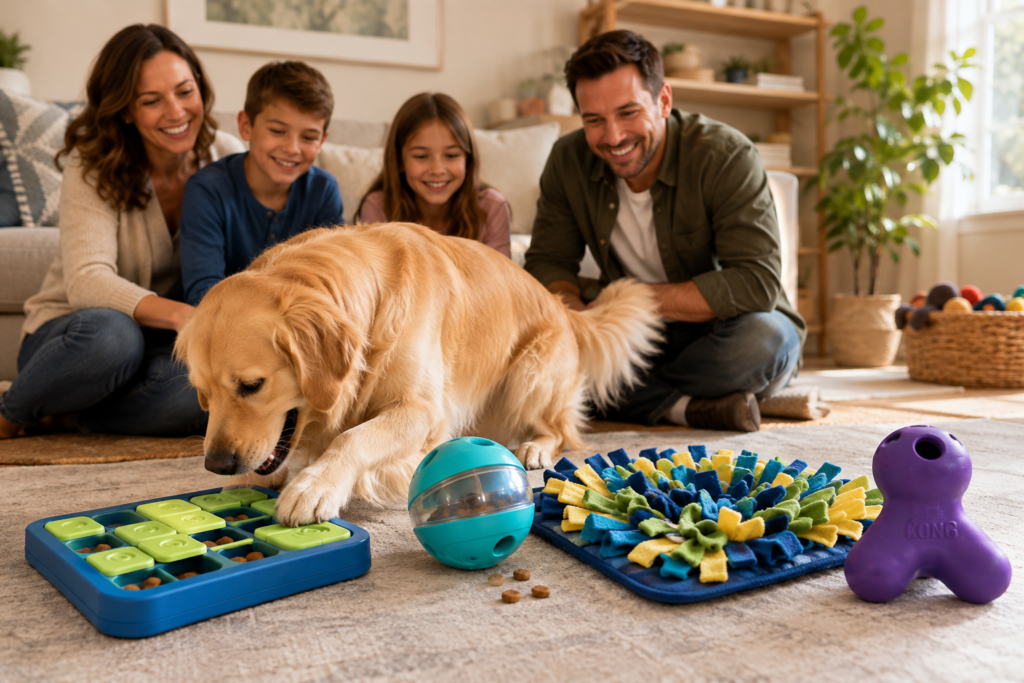
The best interactive dog toys to keep dogs busy and mentally stimulated do more than provide something to chew or chase. They encourage dogs to interact with their environment and use natural behaviors such as sniffing, searching, manipulating objects, and working toward a reward. The American Kennel Club notes that puzzles and play can provide both physical and mental stimulation, while UC Davis veterinary behavior experts describe food toys and puzzles as useful forms of environmental enrichment.
For busy U.S. households, these toys can be especially useful during work hours, rainy days, travel, or other times when a dog needs an appropriate activity.
In this guide, we’ll explain the different types of interactive toys, their benefits and limitations, what to look for before buying, and how to choose an option that fits your dog’s age, size, personality, and chewing habits.
Why “Interactive Dog Toys” Matter
Dogs need more than physical exercise. Walks, running, and fetch are important, but mental activities can add another layer of enrichment to a dog’s day.
Without enough appropriate stimulation, some dogs may create their own entertainment. That can mean chewing household objects, digging, barking for attention, or repeatedly seeking activities. UC Davis notes that inadequate exercise, mental stimulation, interactive toys, or social interaction can contribute to unwanted behaviors in some dogs.
Interactive toys give owners another way to make everyday activities more engaging.
For example, instead of simply placing your dog’s entire meal in a bowl, you could use an appropriate food-dispensing toy for part of the meal. The dog then has to manipulate the toy to access the food, turning mealtime into an enrichment activity.
That doesn’t mean a toy replaces walks, training, social interaction, or time with you. Instead, it becomes another useful tool in a balanced routine.
What Are Interactive Dog Toys?
Interactive dog toys are toys designed to encourage active participation rather than simply being objects a dog carries or chews.
Depending on the design, a dog may need to:
- Push or roll the toy
- Find hidden treats
- Lift or move compartments
- Sniff out food
- Pull or manipulate parts
- Chase a moving object
- Figure out how to release a reward
- Work through a simple puzzle
Dog puzzle toys are one of the most popular categories. Many use food or treats as motivation and require the dog to perform an action before receiving the reward.
However, interactive play doesn’t have to involve food. Tug toys, interactive balls, scent games, and certain electronic toys can also encourage active engagement.
Best Types of Interactive Dog Toys
There isn’t one perfect toy for every dog. The right choice depends heavily on your dog’s motivation and play style.
1. Dog Puzzle Toys
Puzzle toys are designed around problem-solving. Some contain compartments that hide treats, while others require a dog to slide, lift, roll, or manipulate different parts.
They’re particularly useful for dogs that enjoy working for food.
For beginners, choose a simple puzzle that your dog can understand relatively quickly. If the toy is too difficult from the beginning, your dog may lose interest or become frustrated.
As your dog learns the basic concept, you can gradually introduce more challenging designs.
2. Treat-Dispensing Dog Toys
Treat-dispensing dog toys release small amounts of food as the dog rolls, pushes, or manipulates them.
These can be useful for food-motivated dogs because the reward is directly connected to the activity.
You can also use a portion of your dog’s regular daily food rather than automatically adding extra treats. This can help you keep overall calorie intake in check.
The American Kennel Club describes food-stuffed toys and treat-dispensing puzzles as ways to give dogs an engaging activity while they work for food.
3. Snuffle Mats
Snuffle mats use fabric folds, strips, or pockets to hide pieces of kibble or treats.
Instead of solving a mechanical puzzle, the dog uses its nose to search for food.
This makes snuffle mats particularly interesting for dogs that enjoy sniffing and foraging. They can also add variety to mealtime.
However, a snuffle mat isn’t automatically suitable for every dog. If your dog aggressively tears apart fabric or attempts to eat pieces of the mat, discontinue use.
4. Interactive Balls
Interactive balls can combine movement with food rewards.
A dog may need to roll the ball around the floor before kibble or treats fall out. This encourages movement while adding a simple problem-solving component.
They’re often a good starting point for dogs that don’t understand traditional puzzle boards yet.
5. Hide-and-Seek Toys
Hide-and-seek toys contain smaller toys or objects that a dog can search for and remove.
They’re appealing to dogs that enjoy finding things and can provide a different form of mental engagement from food puzzles.
Because some designs contain removable components, inspect them carefully and supervise your dog if they are prone to destroying plush toys.
6. Interactive Chew Toys
Some durable rubber or similar toys can be filled with dog-safe food.
The dog works to access the contents while also engaging in appropriate chewing behavior.
Material and construction matter greatly here. A toy that survives one dog may be destroyed quickly by another, particularly if the dog is a powerful chewer.
7. Electronic and Smart Interactive Toys
Technology has introduced toys that move, respond to touch, dispense treats, or otherwise encourage dogs to interact with them.
The American Kennel Club notes that technology-based dog toys can provide mental and physical engagement, with some designed to mimic movement or prey-like activity.
These can be entertaining, but don’t assume an expensive electronic toy is automatically better than a simple puzzle. Some dogs prefer food puzzles, sniffing activities, or human-led games.
Benefits of Interactive Dog Toys
Mental Stimulation
The biggest advantage is that these toys give dogs something to figure out.
A puzzle that requires your dog to locate hidden food or manipulate an object creates a small problem-solving challenge. AKC describes puzzle toys as activities in which dogs work for a reward, providing both physical and mental engagement.
Help With Boredom
Dog toys for boredom can give dogs an appropriate activity when their normal routine is temporarily disrupted.
For example, an interactive toy may be useful during:
- Rainy weather
- Extremely hot days
- Busy work periods
- Quiet indoor time
- Travel
- Short periods when you cannot actively play
However, toys should complement exercise and interaction rather than become a replacement for them.
Make Mealtime More Engaging
Food-based enrichment can transform an ordinary meal into an activity.
Instead of consuming food quickly from a bowl, some dogs can spend additional time sniffing, manipulating, and working for their meal.
UC Davis veterinary experts specifically identify food toys and puzzles as forms of environmental enrichment.
Encourage Natural Behaviors
Dogs naturally investigate smells, search for resources, chew, chase, and manipulate objects.
Well-designed dog enrichment toys can give them appropriate outlets for some of these behaviors.
That is one reason enrichment isn’t simply about “keeping a dog distracted.” It is about creating opportunities for appropriate activity.
Support Training and Engagement
Interactive toys can also be incorporated into training.
You might teach your dog to:
- Wait before approaching the toy.
- Touch or move the toy.
- Find a hidden reward.
- Return to you after completing the activity.
- Settle down after play.
This combines mental stimulation with communication and learning.
Are Interactive Toys Good for Bored Dogs?
Yes, they can be—but they are only one part of the solution.
If your dog appears bored, start by looking at the overall routine. Is your dog getting appropriate exercise? Does it receive social interaction? Does it have opportunities to sniff and explore? Does it receive regular training or play?
The AKC recommends mental stimulation in addition to physical activity and highlights interactive games and puzzle toys as ways to help challenge dogs.
If boredom is accompanied by significant anxiety, destructive behavior, unusual repetitive behavior, or other concerning changes, speak with your veterinarian rather than relying solely on toys.
Interactive Dog Toys vs. Regular Dog Toys
| Feature | Regular Dog Toy | Interactive Dog Toy | Best Choice |
| Mental challenge | Usually low | Usually higher | Interactive |
| Problem solving | Limited | Common | Interactive |
| Food-based activity | Sometimes | Often | Interactive |
| Fetch/play | Excellent | Depends on design | Both |
| Chewing | Often | Depends on design | Both |
| Independent activity | Sometimes | Often | Interactive |
| Human interaction | Can be high | Can be high | Both |
| Best for boredom | Moderate | Often stronger | Interactive |
This doesn’t mean traditional toys are unnecessary. Dogs benefit from variety, and a favorite ball, tug toy, or plush toy may be valuable for interactive play with their owner.
The strongest approach is usually a mix of toy types.
How to Choose the Best Interactive Dog Toy
Consider Your Dog’s Size
Toy size matters.
A toy designed for a tiny dog may not be appropriate for a large breed, while a very large or heavy toy could be difficult for a small dog to manipulate.
Always check the manufacturer’s size recommendations.
Consider Chewing Strength
Think honestly about your dog’s chewing behavior.
A dog that gently carries toys needs something different from a dog that immediately tears apart every plush object.
For strong chewers, prioritize products specifically designed for durability and inspect them regularly.
The ASPCA advises selecting products appropriate for the dog’s size and chewing habits and removing products that become fragmented or can be swallowed.
Choose the Right Difficulty
Start easier than you think.
If your dog has never used a puzzle toy, don’t begin with the most complicated design available.
A good progression is:
Easy → Moderate → Challenging
The goal isn’t to make your dog struggle. The goal is to create an activity that is engaging without becoming frustrating.
Think About Your Dog’s Motivation
Different dogs are motivated by different things.
Ask yourself:
- Does my dog love treats?
- Does my dog enjoy sniffing?
- Does my dog chase moving objects?
- Does my dog enjoy chewing?
- Does my dog prefer playing with me?
- Does my dog lose interest quickly?
A food-motivated dog may love a treat puzzle, while another dog may prefer a moving ball or scent-based activity.
Check the Materials
Look for materials appropriate for your dog’s chewing style and the intended use of the toy.
Common materials include:
- Rubber
- Hard plastic
- Nylon
- Fabric
- Silicone or similar flexible materials
No material should be treated as completely indestructible.
Consider Cleaning
Food-based toys need regular cleaning.
Look for designs that are easy to rinse, wash, or disassemble safely. If food gets trapped inside inaccessible areas, it can become unpleasant or unsanitary.
Think About Your Budget
You don’t need to spend a fortune to provide enrichment.
A basic puzzle toy may provide more value for your particular dog than an expensive electronic product.
Instead of asking, “What’s the most expensive option?” ask:
“Will my dog actually use this toy safely and repeatedly?”
That is a much better measure of value.
Warranty and Manufacturer Support
For electronic or higher-priced products, check whether the manufacturer provides a warranty and clearly explains return or replacement policies.
For simple toys, warranty coverage may be less important than construction quality, sizing, cleaning instructions, and appropriate-use guidelines.
Who Should Buy Interactive Dog Toys?
Interactive toys can be particularly useful for:
- Dogs that enjoy food puzzles
- High-energy dogs needing additional enrichment
- Dogs that become bored indoors
- Puppies learning problem-solving skills
- Dogs that enjoy sniffing and searching
- Owners who want to make mealtime more engaging
- Families looking for more variety in their dog’s routine
They can also be useful for senior dogs, although the difficulty, physical demands, and toy design should be appropriate for the individual dog. UC Davis veterinary experts recommend keeping older pets mentally engaged with activities such as toys and food puzzles while considering their individual needs.
Drawbacks and Things to Consider
Interactive toys aren’t perfect for every situation.
Some Dogs Destroy Them
A dog that loves to chew may quickly damage a toy. Once pieces begin breaking off, continuing to use it can create a safety concern.
Some Puzzles Are Too Difficult
A challenging toy isn’t necessarily a better toy.
If your dog repeatedly fails to access the reward, frustration can replace enjoyment.
Food Can Add Calories
Treat-dispensing toys can contribute additional calories if you simply add treats on top of your dog’s normal diet.
Consider using part of the dog’s regular food allowance when appropriate.
Supervision May Be Necessary
Never assume that an interactive toy is safe for unsupervised use simply because it is marketed for dogs.
The AKC recommends supervising dogs with new toy types and emphasizes choosing toys that are appropriate for the dog’s size and chewing behavior.
Toys Don’t Replace Human Interaction
Dogs still need walks, training, play, affection, exploration, and social interaction.
A puzzle toy can occupy your dog for a period of time, but it shouldn’t become a substitute for your relationship with your pet.
Expert Tips for Getting More From Interactive Toys
1. Introduce the Toy Slowly
Show your dog how the toy works.
For a puzzle, initially make the reward easy to access. Once your dog understands the concept, increase the challenge.
2. Rotate Toys
Don’t leave every toy available every day.
Keep a few available and rotate the others. The AKC recommends rotating toys to maintain interest and prevent familiar toys from becoming less exciting.
3. Use Part of the Daily Meal
For food-based toys, consider using some of your dog’s normal kibble rather than automatically adding extra treats.
This makes the toy part of the feeding routine.
4. Match Difficulty to Your Dog
Watch your dog’s behavior.
If your dog immediately solves the toy and walks away, try something slightly more challenging.
If your dog becomes frustrated, simplify the task.
5. Inspect Toys Regularly
Check for:
- Cracks
- Tears
- Missing pieces
- Loose components
- Damaged seams
- Sharp edges
- Excessive wear
Replace damaged toys instead of trying to get a few more days of use from them.
6. Combine Mental and Physical Activity
One effective routine might be:
Walk → sniffing → short training session → interactive toy → rest
That gives your dog different forms of engagement instead of relying on one activity.
Common Mistakes Dog Owners Make
Buying Based Only on Price
More expensive doesn’t always mean more appropriate.
A simple, well-matched puzzle can be more useful than an advanced electronic toy your dog ignores.
Choosing the Wrong Size
Always consider your dog’s size and the manufacturer’s recommendations.
Starting With a Difficult Puzzle
Begin with a simple challenge and build from there.
Leaving Destructive Dogs Unsupervised
If your dog destroys toys quickly, supervised play may be the safer option.
Giving Too Many Treats
Remember that treats contribute to the dog’s overall calorie intake.
Never Rotating Toys
Even an excellent toy can become boring when it is constantly available.
Treating Toys as a Replacement for Exercise
Mental enrichment is important, but dogs still need appropriate physical activity and social interaction.
Frequently Asked Questions
1. What are the best interactive dog toys for mental stimulation?
The best option depends on your dog’s personality. Puzzle feeders, treat-dispensing toys, snuffle mats, interactive balls, and certain smart toys can all provide mental stimulation. Start with a simple design and increase difficulty as your dog learns.
2. Do interactive dog toys help with boredom?
They can provide a constructive activity for dogs that become bored, especially during periods of limited interaction. However, toys should be combined with appropriate exercise, training, exploration, and social interaction.
3. Are dog puzzle toys good for puppies?
Many puppies can benefit from appropriately sized, beginner-level puzzle toys. Choose a design suitable for the puppy’s age, size, chewing behavior, and development, and supervise new toys.
4. How long should a dog use an interactive toy?
There isn’t one ideal duration for every dog. Start with short sessions and observe your dog’s interest and behavior. Stop if the dog becomes frustrated, overly tired, or begins trying to destroy the toy.
5. Are treat-dispensing dog toys healthy?
They can be useful enrichment tools when used appropriately. To avoid unnecessary calories, consider incorporating some of the dog’s normal food into the activity rather than adding large amounts of additional treats.
6. What are the best dog toys for boredom?
Puzzle toys, snuffle mats, treat-dispensing toys, interactive balls, and scent-based games can all provide alternatives to passive play. Rotating different activities can also help maintain interest.
7. Are interactive toys safe to leave with dogs alone?
Not necessarily. Safety depends on the individual dog and the toy. Dogs that chew aggressively or remove small pieces may require supervision. Inspect toys regularly and follow the manufacturer’s instructions.
8. What should I look for in a durable interactive dog toy?
Consider the toy’s material, construction, size, moving parts, and whether it is designed for your dog’s chewing strength. No toy should be considered completely indestructible.
9. Can interactive toys replace walks?
No. Interactive toys provide mental enrichment, but they do not replace appropriate physical exercise, outdoor exploration, training, or social interaction.
10. How can I make an interactive toy more interesting?
Rotate toys, vary the food or reward where appropriate, introduce new puzzle levels gradually, and combine toys with short training games. Variety can help prevent your dog from losing interest.
Final Verdict: Which Interactive Dog Toy Is Best?
The best interactive dog toys aren’t necessarily the most complicated or expensive. They’re the ones that match your dog’s size, motivation, chewing habits, ability level, and interests.
For a food-motivated beginner, a simple puzzle feeder or treat-dispensing toy can be an excellent starting point. A dog that loves sniffing may prefer a snuffle mat, while a high-energy dog might enjoy a combination of movement-based toys and problem-solving activities.
The key is variety and appropriate challenge.
Think of interactive toys as part of your dog’s overall enrichment plan—not as a replacement for walks, training, playtime, or companionship. When selected carefully and used safely, they can turn an ordinary part of the day into an engaging activity.
Explore Interactive Dog Toys at Al Falah Trader
Looking for ways to keep your dog engaged at home?
Explore the Pet Essentials collection at Al Falah Trader for dog products designed to support play, comfort, enrichment, and everyday pet care.
Choose products based on your dog’s individual size, behavior, chewing strength, and interests, and always follow the manufacturer’s safety and usage instructions.
Your dog’s next favorite activity could be more than just a toy—it could be a little challenge that keeps their body moving and their mind working.
Read More Pet Care Tips/Articles from Al Falah Trader
If you found this guide helpful, you might also enjoy these Blogs/articles:
Best Memory Foam Dog Beds: Comfort, Support & Buying Guide
Dog Care Tips for First-Time Owners: Complete Beginner Guide
Daily Dog Care Checklist: Essential Tasks for a Healthy Dog
Best Heated Dog Beds for Winter: Keep Your Dog Warm & Comfortable
Best Cooling Dog Beds for Summer: Stay Cool & Comfortable
Best Orthopedic Dog Beds for Comfort and Joint Support
Best Dog Toys: Safe, Fun, and Durable Picks for Every Dog
Recommended Products
Memory Foam Dog Beds for Maximum Comfort & Support – Shop Now
Best Heated Dog Beds for Winter – Shop Now
Plush Calming Dog Bed – Soft Pet Nest Bed for Dogs & Cats – Shop Now
Princess Dog Bed – Cozy Fantasy Pet Nest Bed for Dogs & Cats – Shop Now
Dog Potty Training in 7 Days – E-books
Durable Cactus Dog Chew Toy – Interactive Toy for Aggressive Chewers & Puppies – Shop Now
Authoritative External Resources
For readers who want to learn more about canine health and behavior, consider linking to:
- American Veterinary Medical Association (AVMA)
- American Kennel Club (AKC)
- American Animal Hospital Association (AAHA)
Editorial note:
Interactive toys are enrichment tools, not medical treatment. If a dog develops sudden destructive behavior, unusual eating, severe anxiety, or another significant behavior change, a veterinarian can help determine whether an underlying medical or behavioral issue needs attention.