
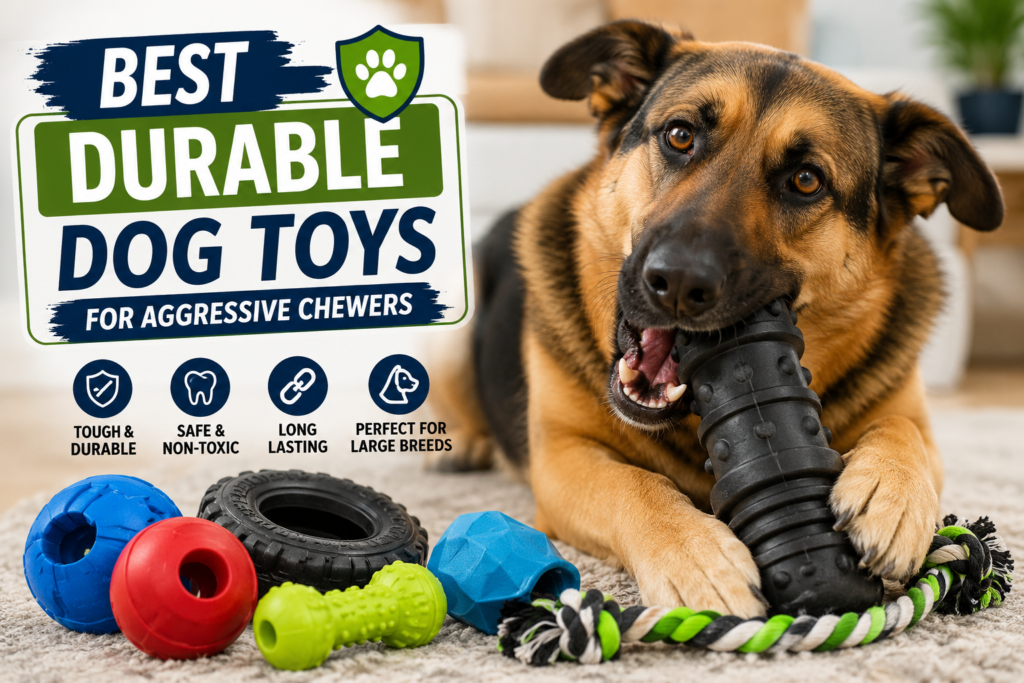
Best Durable Dog Toys for Aggressive Chewers
If your dog can destroy a new toy in minutes, you already know that choosing a durable dog toy is about more than saving money. A ripped plush toy can quickly become a pile of stuffing, while a broken toy can create choking or swallowing hazards.
The good news is that there are better options for powerful chewers. The best durable dog toys for aggressive chewers are designed around appropriate materials, size, shape, and your dog’s individual chewing style.
However, “indestructible” should not be taken literally. No dog toy is completely indestructible, particularly when a determined large dog is allowed to chew on it for long periods without supervision. Veterinary guidance also emphasizes inspecting toys regularly and removing damaged ones. VCA Animal Hospital
In this guide, we’ll explain what makes a dog toy genuinely durable, which features to look for, what to avoid, and how to choose a toy that matches your dog’s size and chewing habits.
Why Durable Dog Toys Matter for Aggressive Chewers
Some dogs gently carry toys around the house. Others immediately bite, pull, shake, and try to tear them apart.
A strong chewing habit isn’t necessarily a sign that something is wrong. Dogs naturally use their mouths to explore and interact with their environment. Chewing can also provide stimulation and an appropriate outlet for behaviors that might otherwise become destructive. AAHA
The problem starts when a toy isn’t appropriate for the dog’s chewing style.
A weak toy can:
- Break into small pieces
- Become a choking hazard
- Be swallowed and potentially cause an intestinal blockage
- Leave exposed stuffing or fibers
- Develop sharp or broken edges
- Become damaged quickly
- Waste money through frequent replacement
That’s why durability and safety need to be considered together.
What Makes the Best Durable Dog Toys for Aggressive Chewers?
Durability isn’t simply about finding the hardest toy available. In fact, extremely hard objects can damage a dog’s teeth.
Instead, look for a combination of strength, appropriate flexibility, size, construction, and safety.
1. Strong, Appropriate Materials
Common materials used in durable dog toys include:
- Tough rubber
- Reinforced rubber compounds
- Durable nylon
- Heavy-duty fabric
- Multi-layer construction
- Thick rope, depending on the dog’s chewing behavior
For many dogs, sturdy rubber is particularly useful because it can provide resistance without necessarily being as rigid as extremely hard objects.
VCA recommends avoiding chew toys that are excessively hard because they may damage or fracture teeth. VCA Animal Hospital
2. The Right Size
Size is just as important as material.
A toy that’s too small may be easier for a large dog to swallow or become lodged in the throat. Veterinary guidance recommends choosing a toy that cannot fit entirely inside the dog’s mouth. AMERICAN KENNEL CLUB
For a powerful chewer, don’t automatically choose the smallest size because it looks easier to carry.
Consider:
- Your dog’s weight
- Jaw size
- Breed and body size
- Chewing strength
- Whether your dog tends to swallow pieces
When in doubt, ask your veterinarian about an appropriate size.
3. Minimal Removable Parts
Aggressive chewers don’t need many decorations.
Avoid toys with easily removable:
- Plastic eyes
- Buttons
- Ribbons
- Loose stitching
- Small attachments
- Decorative pieces
VCA specifically recommends choosing toys without removable parts that can easily be swallowed. VCA Animal Hospital
4. A Design That Matches the Dog
A toy can be extremely durable and still be a poor choice if your dog doesn’t enjoy using it.
For example, a dog that loves chewing may prefer a sturdy rubber chew toy, while a food-motivated dog may get more use from a durable treat-dispensing toy.
The best choice isn’t necessarily the strongest toy on the shelf. It’s the one that combines durability with an activity your dog actually enjoys.
Types of Durable Dog Toys for Aggressive Chewers
There isn’t one perfect toy for every dog. Different designs serve different purposes.
Durable Rubber Chew Toys
Rubber toys are popular among owners looking for durable dog toys for power chewers.
They can work well for dogs that enjoy repetitive chewing and may also be designed to hold treats or food.
Look for:
- Thick construction
- Appropriate size
- Minimal detachable components
- Some flexibility
- A design that is easy to clean
Inspect the toy frequently for deep cracks, chunks, or damaged areas.
Heavy-Duty Treat-Dispensing Toys
These toys combine chewing with food-based enrichment.
Instead of simply chewing a toy, your dog has to work out how to access the food inside. That can make the activity more mentally engaging.
They’re particularly useful for dogs that become bored easily.
Tough Fetch Toys
If your dog enjoys chasing and retrieving, consider durable balls and other fetch toys designed for dogs.
But don’t choose a ball based only on toughness. It must also be large enough that your dog can’t accidentally swallow it.
Rope Toys
Rope toys can be useful for interactive games such as tug and fetch.
However, they’re not automatically suitable for every aggressive chewer. Once the rope becomes heavily frayed or your dog starts pulling off and swallowing fibers, it’s time to remove it.
Durable Puzzle Toys
Puzzle and enrichment toys can provide mental stimulation while reducing the emphasis on destructive chewing.
For food-motivated dogs, they’re particularly useful because they turn playtime into a problem-solving activity.
Indestructible Dog Toys for Aggressive Chewers: Are They Really Indestructible?
You’ll often see the term indestructible dog toys for aggressive chewers used in product descriptions.
Treat that word as marketing language rather than a guarantee.
A powerful dog may eventually damage even a very well-made toy. Instead of asking, “Can my dog destroy this?” ask:
“Is this toy strong enough for my dog’s chewing behavior, and can I safely monitor its condition?”
That’s a much more useful approach.
VCA notes that individual dogs vary considerably in how aggressively they destroy toys, and recommends selecting toys that can withstand your particular dog’s bite and chewing behavior. VCA Animal Hospital
Best Chew Toys for Aggressive Chewers: What to Look For
When comparing the best chew toys for aggressive chewers, consider these factors.
Durability
The toy should resist tearing, cracking, and breaking under normal use.
Flexibility
Extremely hard doesn’t automatically mean better. Some veterinary guidance recommends avoiding objects that are so hard they can damage teeth. VCA Animal Hospital
Size
Choose an appropriate size for your dog’s mouth and body.
Shape
A good shape should be easy for the dog to hold and difficult to swallow.
Cleanability
Food-filled toys should be easy to wash thoroughly.
Purpose
Decide whether you need a toy primarily for:
- Chewing
- Fetch
- Tug
- Treat dispensing
- Mental enrichment
Durable Dog Toys for Large Dogs vs. Small Dogs
Large dogs often require toys with more substantial dimensions and construction.
A toy designed for a small dog may not withstand the jaw strength or playing style of a large breed.
For heavy duty dog toys for large dogs, pay particular attention to:
- Overall dimensions
- Material thickness
- Weight
- Construction quality
- Whether the toy can fit entirely into the dog’s mouth
- Manufacturer size recommendations
At the same time, don’t assume every large dog is an aggressive chewer. Individual chewing behavior matters just as much as breed or size.
Comparison Table: Which Toy Type Is Best?
| Toy Type | Best For | Durability Potential | Mental Stimulation | Maintenance |
| Tough rubber chew toy | Heavy chewers | High | Medium | Easy |
| Treat-dispensing toy | Food-motivated dogs | High | High | Moderate |
| Durable fetch ball | Active dogs | Medium–High | Medium | Easy |
| Rope toy | Tug and interactive play | Medium | Medium | Moderate |
| Puzzle toy | Bored or food-driven dogs | Medium–High | High | Moderate |
| Plush toy | Gentle play | Low–Medium | Medium | Easy |
Best overall approach: rotate several appropriate toy types instead of relying on one toy for every activity.
Benefits of Durable Dog Toys
Choosing the right durable toy can offer several advantages.
Longer-Lasting Play
A stronger toy may withstand repeated chewing better than an inexpensive soft toy.
Better Value
If your dog destroys toys quickly, investing in better construction can reduce how frequently you need replacements.
Appropriate Chewing Outlet
Providing an appropriate chew can help redirect your dog’s attention away from furniture, shoes, and other household objects.
Mental Enrichment
Treat-dispensing and puzzle designs can make dogs work for food, adding a problem-solving component to play. VCA recommends appropriate enrichment activities as an outlet for natural behaviors. VCA Animal Hospital
More Interactive Play
Some durable toys can be used for fetch, tug, chewing, or food enrichment, giving one product multiple purposes.
Drawbacks and Things to Consider
Durable toys aren’t automatically risk-free.
No Toy Is Truly Indestructible
A determined power chewer can eventually damage almost anything.
Very Hard Isn’t Always Better
Extremely hard chews can damage or fracture teeth. Several veterinary sources recommend caution with very hard chewing objects. VCA Animal Hospital
Damaged Toys Must Be Replaced
A toy that was safe when new may become unsafe after months of chewing.
Supervision Still Matters
Even a high-quality toy can break unexpectedly.
If your dog starts removing chunks, stop the play session and inspect the toy.
How to Choose the Right Durable Dog Toy
Step 1: Identify Your Dog’s Chewing Style
Ask yourself:
- Does my dog gently chew or immediately destroy?
- Does my dog swallow pieces?
- Does my dog mainly chew, tug, or fetch?
- Does my dog prefer rubber, fabric, or food-based toys?
This information is more useful than simply labeling your dog an “aggressive chewer.”
Step 2: Choose the Appropriate Size
Never choose a toy simply because it’s inexpensive or easy to carry.
Check the manufacturer’s size recommendations and consider your dog’s jaw size.
Step 3: Check the Construction
Look for:
- Thick material
- Strong seams
- No easily detachable pieces
- Secure construction
- A shape appropriate for chewing
Step 4: Consider Your Budget
You don’t necessarily need the most expensive toy.
A better approach is to compare price against expected lifespan, safety, construction, and usefulness.
A moderately priced toy that lasts several weeks or months may provide better value than a cheap toy destroyed in one afternoon.
Step 5: Think About Maintenance
If the toy holds food, make sure it can be cleaned properly.
Inspect it regularly and follow the manufacturer’s cleaning instructions.
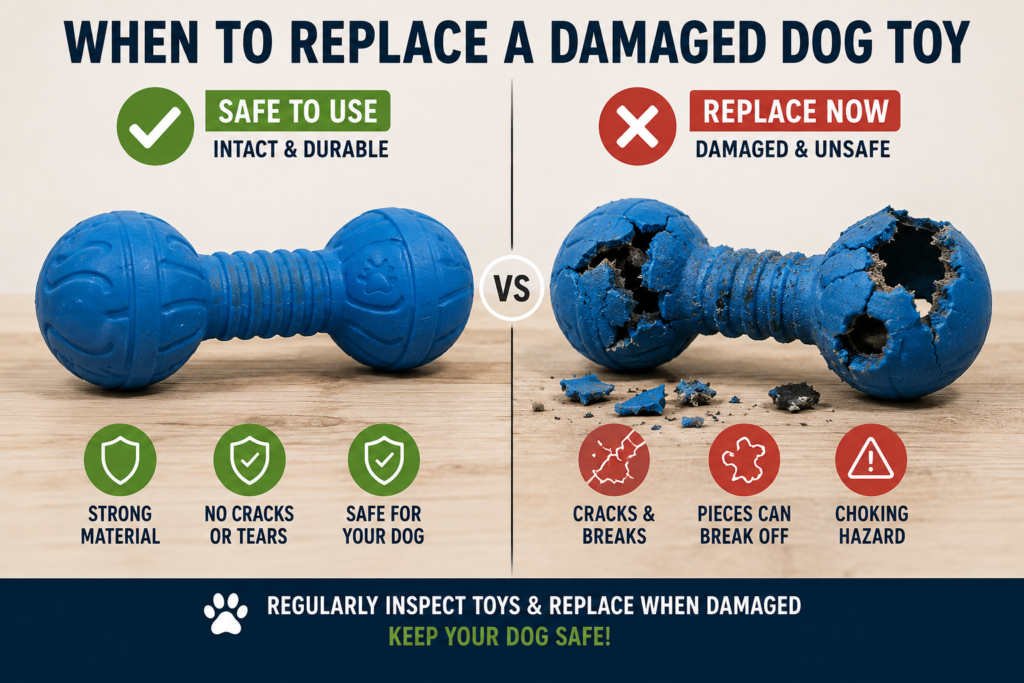
Step 6: Replace Damaged Toys
Don’t wait until the toy completely falls apart.
Remove it when you notice:
- Deep cracks
- Large tears
- Missing chunks
- Loose components
- Exposed stuffing
- Severely frayed rope
- Sharp broken edges
VCA specifically recommends retiring toys when rubber breaks, stuffing becomes exposed, or rope becomes significantly frayed. VCA Animal Hospital
Expert Tips for Dogs That Destroy Toys
Rotate Toys
Instead of leaving every toy available all day, rotate several appropriate toys.
This can make old toys feel more interesting again.
Use Food-Based Enrichment
For food-motivated dogs, durable treat toys can provide both physical and mental activity.
Supervise New Toys
The first few play sessions are particularly important.
Watch how your dog interacts with the toy. A product that works well for one dog may not be appropriate for another.
Inspect Before Every Use
Spend a few seconds checking for damage.
This simple habit can help you catch problems before your dog swallows a broken piece.
Teach “Drop It”
A reliable “drop it” cue can make it easier to remove a damaged or inappropriate object from your dog’s mouth.
Don’t Reward Destruction
If your dog learns that ripping apart every toy produces attention, you may unintentionally reinforce the behavior.
Redirect destructive chewing toward an appropriate toy instead.
Common Mistakes When Buying Tough Dog Toys
Choosing the Hardest Toy Possible
Hardness and durability aren’t the same thing.
A toy that’s too hard can potentially damage teeth.
Buying the Wrong Size
A toy that’s too small can present a choking risk.
Always consider your dog’s mouth and overall size.
Assuming “Indestructible” Means Unbreakable
No manufacturer can realistically guarantee that every toy will survive every dog.
Ignoring Damage
Once a toy starts breaking apart, its original safety profile has changed.
Leaving Every Toy Unsupervised
Some dogs can safely play alone with particular toys, while others immediately destroy and swallow them.
Know your dog.
Buying Based Only on Appearance
Bright colors and interesting shapes may attract humans more than dogs.
Think about what your dog actually likes to do.
Frequently Asked Questions
1. What are the best durable dog toys for aggressive chewers?
The best choice depends on your dog’s size, chewing strength, and preferred activity. Durable rubber chew toys, appropriately sized treat-dispensing toys, and sturdy enrichment toys can be good options when they’re suitable for the individual dog.
2. Are indestructible dog toys for aggressive chewers really indestructible?
No. “Indestructible” should generally be understood as a durability claim rather than a guarantee. Strong dogs can eventually damage even highly durable toys.
3. What is the safest material for aggressive chewers?
There isn’t one universally safest material for every dog. Look for appropriately durable construction with some suitable flexibility, and avoid toys that are excessively hard or easily broken into pieces. VCA Animal Hospital
4. What are the best chew toys for aggressive chewers?
Durable rubber chew toys and appropriately designed enrichment toys are common choices. The best option depends on the dog’s size, chewing behavior, and whether the toy will be used for chewing, food enrichment, or interactive play.
5. Are hard nylon toys safe for dogs?
Not necessarily. Some hard materials may be too rigid for certain dogs and can contribute to tooth damage. VCA recommends caution with toys that are too hard to indent or bend. VCA Animal Hospital
6. What are the best heavy duty dog toys for large dogs?
Look for appropriately sized toys made with durable construction and designed for large or powerful dogs. The toy should not be small enough to fit entirely inside the dog’s mouth.
7. How often should I replace a durable dog toy?
There isn’t a universal replacement schedule. Inspect the toy regularly and replace it immediately when it becomes damaged, develops deep cracks, loses pieces, or begins shedding material.
8. Can aggressive chewers have rope toys?
Some can, particularly for supervised tug or interactive play. However, if your dog pulls off and swallows rope fibers, discontinue use and choose another type of toy.
9. Are tough dog toys for large breeds better than regular dog toys?
They may be more appropriate for larger or stronger dogs because they’re generally designed around greater physical demands. However, the correct size and construction still depend on the individual dog’s chewing behavior.
10. Should I let my dog chew a new toy without supervision?
It’s better to supervise initially. You can learn whether your dog is gently using the toy or immediately trying to remove and swallow pieces. Veterinary guidance emphasizes supervision because no chew toy is completely risk-free. VCA Animal Hospital
Final Verdict
Finding the best durable dog toys for aggressive chewers isn’t about finding a toy that claims to be indestructible.
The smarter approach is to match the toy to your dog’s size, chewing strength, play style, and behavior.
For many power chewers, durable rubber and appropriately constructed enrichment toys can provide a useful combination of strength and engagement. Large dogs should receive appropriately sized toys, while dogs that quickly destroy or swallow pieces require particularly careful supervision.
Most importantly, remember that durability does not replace safety. Check toys regularly, remove damaged products, and speak with your veterinarian if you’re unsure whether a particular chew is appropriate for your dog. Veterinary organizations caution that excessively hard chews can damage teeth and that broken pieces can create choking or gastrointestinal risks. VCA Animal Hospital
Looking for Durable Dog Toys?
If you’re looking for tough, practical toys for a powerful chewer, explore the dog toy collection at Al Falah Trader and compare products based on size, construction, intended use, and your dog’s chewing style.
Choose durability—but always put your dog’s safety first.
Read More Pet Care Tips/Articles from Al Falah Trader
If you found this guide helpful, you might also enjoy these Blogs/articles:
Best Interactive Dog Toys for Mental Stimulation
Best Dog Toys: Safe, Fun, and Durable Picks for Every Dog
How to Choose the Right Dog Bed Size for Maximum Comfort
Best Orthopedic Dog Beds for Comfort and Joint Support
Daily Dog Care Checklist: Essential Tasks for a Healthy Dog
Recommended Products
Memory Foam Dog Beds for Maximum Comfort & Support – Shop Now
Best Heated Dog Beds for Winter – Shop Now
Plush Calming Dog Bed – Soft Pet Nest Bed for Dogs & Cats – Shop Now
Princess Dog Bed – Cozy Fantasy Pet Nest Bed for Dogs & Cats – Shop Now
Dog Potty Training in 7 Days – E-books
Durable Cactus Dog Chew Toy – Interactive Toy for Aggressive Chewers & Puppies – Shop Now
Durable Dog Toys For Aggressive Chewers Tough Interactive Dog Toys For Large Dogs Birthday Dog Chew Toy Teething Toys Treat Dispensing Dog Toy – Shop Now
Authoritative External Resources
For readers who want to learn more about canine health and behavior, consider linking to:
- American Veterinary Medical Association (AVMA)
- American Kennel Club (AKC)
- American Animal Hospital Association (AAHA)
Editorial note:
Interactive toys are enrichment tools, not medical treatment. If a dog develops sudden destructive behavior, unusual eating, severe anxiety, or another significant behavior change, a veterinarian can help determine whether an underlying medical or behavioral issue needs attention.