
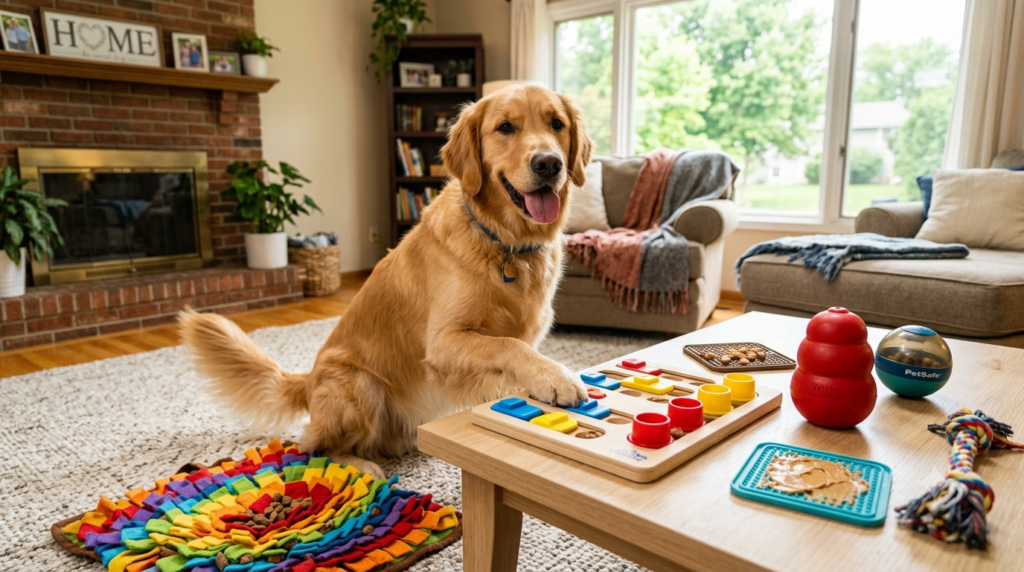
Best Puzzle Toys for Dogs: Mental Stimulation & Enrichment Guide
A dog can have plenty of toys and still be bored.
A regular ball or plush toy may provide entertainment, but puzzle toys ask your dog to think, sniff, manipulate, search, and solve a problem to reach a reward. That extra mental work can make playtime more engaging and turn an ordinary meal into an enrichment activity.
The best puzzle toys for dogs aren’t necessarily the most complicated ones. The right choice depends on your dog’s age, size, chewing habits, food motivation, experience, and frustration tolerance.
In this guide, we’ll explain how puzzle toys work, the different types available, which dogs may benefit from them, what to look for when buying one, and how to introduce a new puzzle without making it unnecessarily difficult.
Why Puzzle Toys Matter for Dogs
Dogs need more than physical exercise. Their daily lives also involve natural behaviors such as sniffing, exploring, foraging, chewing, playing, and solving simple problems.
Food puzzles and other enrichment activities can provide opportunities for some of these behaviors while making dogs work for food or rewards. Veterinary guidance from VCA Animal Hospitals notes that food-based enrichment can encourage foraging and other natural behaviors while providing mental engagement.
This is particularly useful for dogs that spend significant time indoors.
For example, instead of putting your dog’s entire meal into a bowl, you could use part of the meal in a dog puzzle feeder or treat-dispensing toy. Your dog then has to interact with the toy to access the food.
Mental stimulation vs. physical exercise
Puzzle toys shouldn’t replace walks, play, training, or other physical activities.
Think of them as another piece of the daily routine:
- Walks: physical exercise and sensory exploration
- Training: learning and problem-solving
- Puzzle toys: mental work and food enrichment
- Sniffing games: scent enrichment
- Interactive play: bonding and physical activity
- Chew toys: appropriate chewing outlet
A well-rounded routine combines physical and mental exercise rather than relying on one activity.
What Are Puzzle Toys for Dogs?
Puzzle toys are toys that require a dog to perform an action or solve a simple challenge to access a reward.
The reward might be:
- Kibble
- Small treats
- A favorite toy
- Wet food
- A frozen food filling
- A hidden squeaker or plush toy
Some puzzles involve sliding compartments. Others require pushing, rolling, lifting, sniffing, licking, or searching.
The American Kennel Club describes puzzle toys as devices that can hold food or treats while providing a physical and mental challenge.
The important thing isn’t how complicated the toy looks to a person. It’s whether the challenge is appropriate for your individual dog.
Types of Puzzle Toys for Dogs
There isn’t one universal “best” puzzle toy. Different designs suit different dogs.
1. Food Puzzle Toys
Food puzzle toys for dogs turn mealtime into an activity.
Instead of receiving food immediately, your dog has to manipulate the toy or search for food hidden inside it.
These can be especially useful for food-motivated dogs.
You can often use some of your dog’s normal kibble rather than adding a large quantity of extra treats. This can make enrichment easier to incorporate into the daily feeding routine.
2. Treat-Dispensing Toys
Treat dispensing toys release small amounts of food when a dog pushes, rolls, nudges, or manipulates them.
A dog treat ball is a common example.
These toys can encourage movement as well as problem-solving, although some dogs quickly learn how to empty them.
For dogs that master simple puzzles quickly, look for adjustable or more challenging designs rather than continually adding more treats.
3. Puzzle Feeders
A puzzle feeder for dogs slows access to food by requiring your dog to interact with the feeder.
This can be helpful for dogs that finish meals extremely quickly. Food puzzles can also provide mental stimulation while making feeding more engaging.
However, difficulty should be increased gradually. A dog that becomes frustrated may simply give up instead of learning.
4. Snuffle Mats
A snuffle mat for dogs uses fabric sections or folds where you can hide kibble or small treats.
Instead of relying primarily on paws or teeth, your dog uses its nose to locate the food.
This makes snuffle mats particularly interesting for dogs that naturally enjoy sniffing and searching. AKC notes that snuffle mats can provide mental enrichment by encouraging dogs to forage with their sense of smell.
Use dry food or treats that are appropriate for the mat, and clean the mat regularly.
5. Lick Mats
A lick mat for dogs provides a textured surface where you spread an appropriate soft food.
Licking takes time and can make a simple treat last longer. Depending on the product and food used, lick mats can also be useful for enrichment during quiet periods.
Because wet foods can leave residue, cleaning is especially important.
6. Puzzle Boards
A dog puzzle board typically contains compartments, sliders, lids, or movable pieces.
These can offer more structured problem-solving than a simple treat ball.
They’re often a good choice for dogs that already understand basic food puzzles and are ready for additional challenges.
7. Hide-and-Seek Puzzle Toys
Some stuffed puzzle toys for dogs involve hiding smaller toys inside a larger toy.
Your dog searches for and removes the hidden pieces.
These can be entertaining for dogs that enjoy retrieving, searching, or carrying objects, but they’re not necessarily appropriate for aggressive chewers.
Best Puzzle Toys for Different Dogs
The “best” option changes considerably depending on the dog.
Best Puzzle Toys for Puppies
Puppies are still learning how objects work, so start with easy puzzle toys for dogs rather than advanced designs.
Look for:
- Simple compartments
- Large, easy-to-access openings
- Puppy-appropriate materials
- Appropriate size
- Easy cleaning
- Low frustration
Puzzle toys can give puppies opportunities to explore and practice problem-solving. AKC also recommends puzzle toys as one way puppies can engage their brains and work for rewards.
Avoid assuming that a puppy needs the hardest available puzzle.
The goal initially is understanding and success, not difficulty.
Best Puzzle Toys for Senior Dogs
Senior dogs may still enjoy puzzle games, but their physical abilities and preferences can change.
Consider:
- Easier-to-manipulate pieces
- Larger openings
- Non-slip bases
- Low-impact activities
- Sniffing-based enrichment
- Toys that don’t require excessive force
A senior dog that struggles with a complicated slider may enjoy a simple snuffle mat or food puzzle much more.
VCA notes that regular enriching activities and puzzle-solving can contribute to the well-being of senior pets.
Best Puzzle Toys for Large Dogs
Large dogs need appropriately sized toys.
A toy that’s too small can create a safety concern, while a lightweight puzzle may be easy for a powerful dog to flip or destroy.
Look for:
- Appropriate dimensions
- Strong construction
- Stable bases
- Durable materials
- Openings suitable for the dog’s food size
Best Puzzle Toys for Small Dogs
Small dogs generally need puzzles designed for their size.
Avoid choosing a toy simply because it has excellent reviews. Check the manufacturer’s size recommendations and make sure compartments and pieces are appropriate for your dog.
Best Puzzle Toys for Aggressive Chewers
This category requires extra caution.
Many enrichment puzzles are designed for interaction rather than heavy chewing. A fabric hide-and-seek toy may be entertaining for one dog and destroyed within minutes by another.
If your dog aggressively chews toys, prioritize appropriately durable products and supervise the first few sessions. AKC specifically recommends matching toy durability to the dog’s jaw power and choosing an appropriate size.
Puzzle Toy Difficulty: Easy, Moderate, or Advanced?
One of the biggest mistakes owners make is buying an advanced puzzle because it looks more impressive.
Your dog doesn’t care how impressive the toy looks.
Beginner puzzle toys
Good for dogs new to puzzles.
Examples include:
- Open treat compartments
- Simple treat balls
- Easy snuffle mats
- Basic food-filled toys
Intermediate puzzles
Once your dog understands the concept, try:
- Sliding compartments
- Multiple hiding locations
- Simple rotating pieces
- More difficult treat access
Advanced puzzles
For experienced problem-solvers:
- Multiple steps
- Several compartments
- Sequential actions
- Smaller reward locations
- Adjustable difficulty
The progression should be gradual.
If your dog immediately solves a puzzle, increase the challenge slightly. If your dog walks away, gets frantic, or repeatedly fails, make it easier.
Benefits of Puzzle and Enrichment Toys
1. They provide mental exercise
Mental work can be valuable when your dog has already had physical activity but still needs something engaging to do.
Puzzle toys encourage dogs to investigate and solve problems rather than simply consume a reward.
2. They can make meals more engaging
A bowl provides food quickly.
A food puzzle creates an activity around getting that food.
This can be a simple way to add food enrichment for dogs without necessarily adding another activity to your schedule.
3. They encourage natural foraging behavior
Searching for food is a natural behavior.
Snuffle mats and food puzzles allow dogs to use their senses and work toward food rather than receiving everything immediately.
4. They can help with boredom
Puzzle toys can be useful boredom busters for dogs, particularly when weather, schedules, or other circumstances limit normal activities.
AKC recommends interactive games, scent activities, and puzzle toys as ways to provide dogs with additional mental engagement.
5. They can slow down eating
Some food puzzles require dogs to work gradually for small amounts of food.
That may slow down mealtime compared with eating from a conventional bowl. ASPCA and VCA both discuss food puzzles as enrichment tools that can make feeding more interactive.
6. They give owners another training opportunity
You can teach your dog how to interact with a new puzzle.
At first, reward small successes. Over time, allow your dog to figure out more of the process independently.
Can Puzzle Toys Help Dogs Home Alone?
They can provide an activity while you’re busy, but they shouldn’t be treated as a solution to every alone-time problem.
For some dogs, a food-filled or treat-dispensing toy can make part of their alone time more engaging.
However, dogs with significant separation-related distress may need a broader behavior-management plan rather than simply being given a puzzle toy.
If your dog panics, attempts to escape, destroys doors or windows, vocalizes excessively, or shows other serious distress when alone, talk with your veterinarian or a qualified behavior professional.
Also, don’t assume a toy is safe for unsupervised use simply because it is marketed as a dog toy.
Buying Guide: How to Choose the Right Puzzle Toy
1. Match the difficulty to your dog
Start easier than you think.
Your dog should have enough success to understand the game before you increase the challenge.
2. Choose the correct size
A puzzle should be appropriate for your dog’s size and food.
Avoid toys that could potentially be swallowed or become lodged in your dog’s mouth.
VCA recommends selecting appropriately sized and durable enrichment toys and supervising initial use.
3. Consider the material
Common materials include:
- Rubber
- Food-grade plastic
- Fabric
- Silicone
- Nylon
The best material depends on the intended use.
A soft snuffle mat has a very different purpose from a durable chew-oriented toy.
4. Think about your dog’s chewing style
A gentle player and an aggressive chewer shouldn’t necessarily receive the same toy.
If your dog immediately tries to chew through puzzle components, choose a design intended to withstand that behavior—or select a different type of enrichment.
5. Look for easy cleaning
Food residue can collect inside small compartments.
Removable parts, washable fabrics, and dishwasher-safe components can make maintenance considerably easier.
Always follow the manufacturer’s cleaning instructions.
6. Consider adjustability
Adjustable difficulty is valuable because your dog can learn.
Instead of buying a new toy every time your dog solves a puzzle, you may be able to increase the challenge with the same product.
7. Check the warranty
Not every dog toy includes a warranty.
If a manufacturer offers one, read its conditions carefully. Understand whether it covers defects, normal wear, chewing damage, or other issues.
Don’t assume a warranty covers destruction caused by normal use.
Puzzle Toy Comparison
| Puzzle Type | Mental Challenge | Food-Based | Best For | Difficulty |
| Snuffle Mat | Moderate | Yes | Sniffing dogs | Beginner–Intermediate |
| Treat Ball | Moderate | Yes | Active food-motivated dogs | Beginner–Intermediate |
| Puzzle Feeder | Moderate | Yes | Mealtime enrichment | Beginner–Intermediate |
| Lick Mat | Low–Moderate | Yes | Calm enrichment | Beginner |
| Puzzle Board | High | Usually | Problem-solving dogs | Intermediate–Advanced |
| Hide-and-Seek Toy | Moderate | Usually No | Searching/play | Beginner–Intermediate |
| Multi-Step Puzzle | High | Usually | Experienced dogs | Advanced |
No single category wins for every dog. A food-motivated Labrador may love a treat-dispensing ball, while a scent-driven dog may get much more enjoyment from a snuffle mat.
How to Introduce a Puzzle Toy
Don’t simply put an advanced puzzle on the floor and expect your dog to understand it.
Try this approach:
- Start with a simple puzzle.
- Put an obvious reward in an easy-to-access location.
- Let your dog investigate.
- Reward successful interaction.
- Avoid solving the entire puzzle for your dog.
- Increase difficulty gradually.
- Stop while your dog is still interested.
If your dog doesn’t understand the toy, make the first reward extremely easy to obtain.
VCA recommends demonstrating how food-filled toys work when necessary and choosing a difficulty level appropriate for the individual pet.
Expert Tips for Better Enrichment
Use your dog’s normal food
You don’t always need extra treats.
Using a portion of your dog’s normal daily food allowance in a puzzle can turn mealtime into enrichment while helping you keep track of calories. VCA specifically recommends using part of a pet’s regular food for food puzzles when appropriate.
Rotate toys
Don’t put every toy out every day.
Keep a small selection available and rotate others periodically. A familiar toy can become interesting again after some time away.
Combine physical and mental activities
Try:
Walk → sniffing → meal puzzle → rest
This creates a more varied routine than simply adding more toys.
Watch your dog’s body language
Look for signs of enjoyment such as:
- Curious investigation
- Calm persistence
- Sniffing
- Gentle manipulation
- Returning to the puzzle
If your dog becomes extremely frustrated, repeatedly vocalizes, or abandons the toy, reduce the difficulty.
Supervise new toys
The first few sessions are especially important.
Watch how your dog interacts with the toy. A product that works perfectly for one dog may not be appropriate for another.
Common Puzzle Toy Mistakes
Choosing difficulty based on the owner’s expectations
Harder isn’t automatically better.
A puzzle that is too difficult can create frustration rather than useful enrichment.
Leaving an unfamiliar toy unattended
Always learn how your dog interacts with a new product before considering whether it is appropriate for unsupervised use.
Ignoring chewing behavior
A puzzle designed for food manipulation isn’t necessarily a chew toy.
Adding too many treats
Puzzle toys should fit into your dog’s overall diet.
Consider using regular kibble or reducing other treats when appropriate.
Never changing the enrichment routine
Dogs can lose interest when every day is exactly the same.
Rotate puzzles and combine them with walks, training, sniffing, play, and other dog enrichment activities.
Expecting puzzles to solve behavior problems
Puzzle toys can provide useful mental enrichment, but they aren’t a substitute for veterinary care, training, or professional behavior support when a dog has a significant behavioral problem.
Frequently Asked Questions
1. Do puzzle toys mentally stimulate dogs?
Yes. Puzzle toys require dogs to investigate, manipulate objects, search for rewards, or solve simple problems. The amount of mental stimulation depends on the toy and how challenging it is for that individual dog.
2. Are puzzle toys good for dogs?
They can be an excellent enrichment option when the toy is appropriately sized, durable enough for the dog, and matched to its skill level. They work best as part of a broader routine that includes exercise, play, training, and rest.
3. Are puzzle toys good for puppies?
Yes, provided the puzzle is puppy-appropriate and supervised. Start with simple designs that allow easy success rather than advanced puzzles that may frustrate a young dog.
4. How do puzzle toys help dogs?
They can encourage behaviors such as searching, sniffing, foraging, manipulating objects, and problem-solving. Food puzzles can also make mealtime more interactive.
5. How much mental stimulation does a dog need?
There isn’t one universal number that applies to every dog. Age, breed, personality, health, exercise level, and lifestyle all influence individual needs.
Rather than focusing on a fixed number of minutes, watch your dog’s behavior and provide a varied combination of exercise, training, play, sniffing, and enrichment.
6. How often should dogs use puzzle toys?
Many dogs can use them regularly, provided the activity is appropriate and doesn’t replace essential exercise or social interaction. Start with short sessions and adjust based on your dog’s interest and ability.
7. How long should a dog play with a puzzle toy?
There’s no single ideal duration. Some dogs may solve a simple puzzle quickly, while others may spend longer investigating a more complex one. End the session if your dog becomes frustrated or loses interest.
8. Can puzzle toys help with dog boredom?
They can. Puzzle toys provide an additional activity that requires engagement, while scent games and interactive play can provide other forms of enrichment.
9. What is the best puzzle toy for a dog?
The best puzzle toy is the one that matches your dog’s size, chewing habits, food motivation, experience, and preferred type of play. A snuffle mat may be ideal for a scent-driven dog, while another dog may prefer a treat ball or puzzle board.
10. Are puzzle toys safe for dogs?
They can be when appropriately designed and used correctly. Choose the right size, inspect the toy regularly, supervise initial use, and remove damaged pieces. If your dog tries to destroy or swallow parts of a toy, discontinue its use.
Final Verdict: Which Puzzle Toy Should You Choose?
The best puzzle toys for dogs aren’t necessarily the most expensive, complicated, or highly rated products.
The better question is:
What type of challenge does my dog actually enjoy?
For a beginner, start with an easy food puzzle, treat ball, or snuffle mat. For experienced problem-solvers, consider a puzzle board or adjustable, multi-step design. Puppies generally need simple, appropriately sized options, while senior dogs may benefit from gentler puzzles that don’t require excessive physical effort.
Most importantly, choose safety and suitability over novelty.
Puzzle toys work best when they’re part of a complete enrichment routine that includes walks, sniffing, training, play, social interaction, and adequate rest.
At Al Falah Trader, we’re focused on helping dog owners make practical purchasing decisions—not simply adding another toy to the toy box.
Explore our dog toy and pet essentials collection to find enrichment products that can help keep your dog engaged, active, and happily challenged.
Read More Pet Care Tips/Articles from Al Falah Trader
If you found this guide helpful, you might also enjoy these Blogs/articles:
Best Dog Toys: Safe, Fun, and Durable Picks for Every Dog
Best Durable Dog Toys for Aggressive Chewers
Best Interactive Dog Toys for Mental Stimulation
How Much Sleep Do Dogs Need? A Complete Age-by-Age Guide
How to Keep Your Dog Healthy: A Complete Care Guide
Recommended Products
Memory Foam Dog Beds for Maximum Comfort & Support – Shop Now
Best Heated Dog Beds for Winter – Shop Now
Plush Calming Dog Bed – Soft Pet Nest Bed for Dogs & Cats – Shop Now
Princess Dog Bed – Cozy Fantasy Pet Nest Bed for Dogs & Cats – Shop Now
Dog Potty Training in 7 Days – E-books
Durable Cactus Dog Chew Toy – Interactive Toy for Aggressive Chewers & Puppies – Shop Now
Durable Dog Toys For Aggressive Chewers Tough Interactive Dog Toys For Large Dogs Birthday Dog Chew Toy Teething Toys Treat Dispensing Dog Toy – Shop Now
Authoritative External Resources
For readers who want to learn more about canine health and behavior, consider linking to:
- American Veterinary Medical Association (AVMA)
- American Kennel Club (AKC)
- American Animal Hospital Association (AAHA)
Editorial note:
Interactive toys are enrichment tools, not medical treatment. If a dog develops sudden destructive behavior, unusual eating, severe anxiety, or another significant behavior change, a veterinarian can help determine whether an underlying medical or behavioral issue needs attention.