
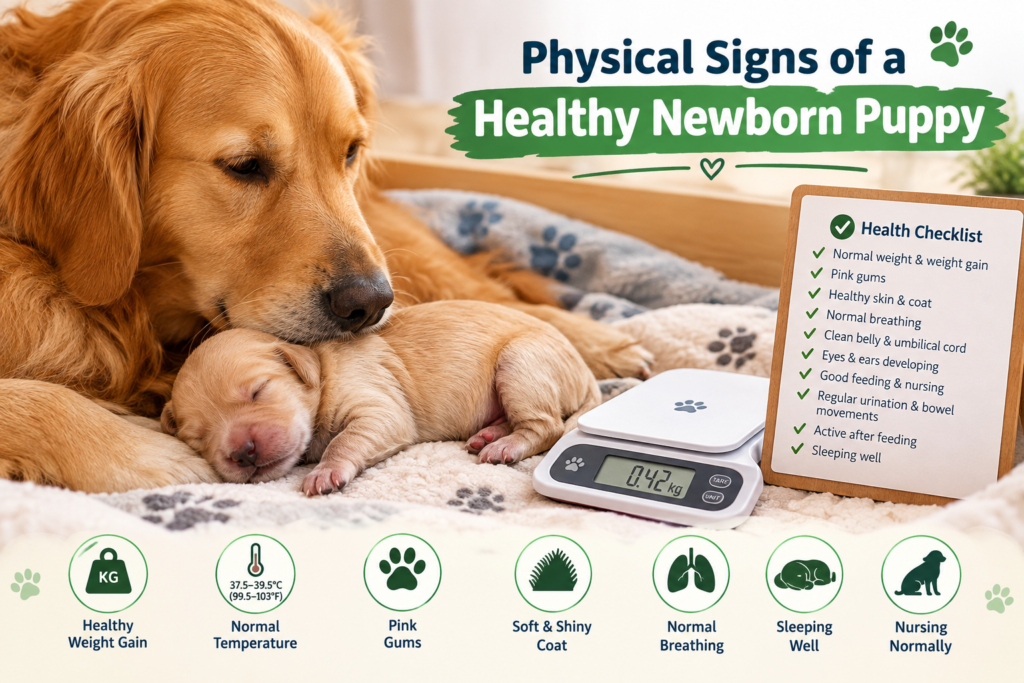
A healthy newborn puppy is generally warm, nurses effectively, gains weight steadily, has pink and moist gums, breathes comfortably, moves appropriately for its age, and sleeps quietly after feeding. Consistent weight gain and normal nursing are especially useful indicators of healthy development.
Introduction
A newborn puppy can look tiny, fragile, and surprisingly sleepy, so it is not always easy to know whether everything is going well. During the first few weeks of life, small changes in feeding, temperature, weight, or behavior can become important quickly.
Knowing the physical signs of a healthy newborn puppy can help you monitor a litter and recognize potential problems before they become serious. A healthy neonate generally stays warm, nurses effectively, gains weight steadily, has pink and moist mucous membranes, breathes comfortably, and settles quietly after feeding.
However, newborn puppies are not simply smaller versions of adult dogs. They have immature systems and cannot regulate their body temperature normally during the early weeks of life. They are also particularly vulnerable to dehydration, low blood sugar, infection, and inadequate nutrition.
This guide explains what a healthy newborn puppy should generally look and act like, what you can monitor at home, and which signs should prompt a call to your veterinarian.
Important: This article is educational and is not a substitute for veterinary care. If a newborn puppy is cold, weak, struggling to breathe, unable to nurse, repeatedly vomiting, having persistent diarrhea, or rapidly becoming less responsive, contact a veterinarian promptly.
Why Understanding Newborn Puppy Health Matters
The first days of a puppy’s life are a critical period. A puppy that is healthy at birth can still develop problems if it becomes chilled, does not receive enough milk, becomes dehydrated, or develops an infection.
Veterinary guidance recommends monitoring newborn puppies for several basic indicators: warmth, nursing, weight gain, elimination, vigor, mucous membrane color, and normal respiration.
For a new owner or breeder, the goal isn’t to diagnose a disease at home. Instead, it is to recognize healthy newborn puppy signs and notice changes from one check to the next.
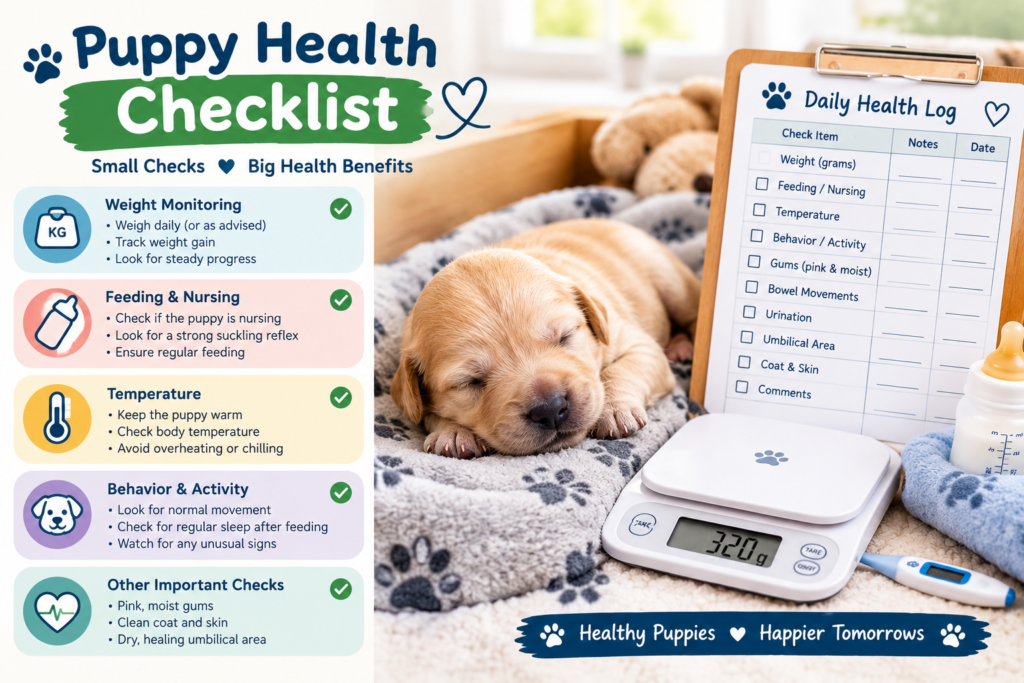
A simple daily record can be extremely useful. Record each puppy’s weight and note whether it is nursing normally, staying warm, and behaving normally for its age.
10 Physical Signs of a Healthy Newborn Puppy
1. Steady Weight Gain
One of the most useful newborn puppy health signs is consistent weight gain.
Birth weights vary considerably by breed, litter size, and individual puppy, so there isn’t one “correct” newborn puppy normal weight for every dog. Instead of comparing a Chihuahua puppy with a Great Dane puppy, track each puppy against its own starting weight.
Veterinary references generally recommend regular weighing because failure to gain weight can be an early indication that something is wrong. Merck Veterinary Manual notes that healthy neonates should gain weight steadily, while VCA reports that puppies commonly gain around 5–10% of body weight daily.
A practical monitoring routine is:
- Weigh the puppy after birth once it is dry.
- Record the weight.
- Continue weighing regularly, often daily during the early period.
- Use the same scale and similar conditions whenever possible.
- Look for a consistent upward trend.
Some veterinary guidance notes that a small amount of weight loss can occur during the first day, but continued weight loss or failure to gain deserves veterinary attention.
2. Effective Nursing and a Strong Suckling Reflex
A healthy newborn puppy should show interest in nursing and have a functional newborn puppy suckling reflex.
The puppy should be able to locate the mother, root toward her, latch onto a teat, and suckle. After feeding, it will generally settle down rather than remaining persistently restless.
If you are wondering how to tell if a newborn puppy is getting enough milk, don’t rely on one observation. Look at the whole picture:
- The puppy nurses regularly.
- It has a good suckling reflex.
- It remains warm.
- Its weight increases consistently.
- It settles and sleeps after feeding.
- It is not continuously crying or becoming progressively weaker.
Merck identifies nursing and weight gain as key components of neonatal health.
3. Warm Body and Appropriate Temperature
Temperature is one of the most important aspects of newborn puppy care.
Newborn puppies cannot regulate body temperature effectively because their thermoregulatory systems are immature. Becoming chilled can interfere with nursing, digestion, and immune function.
Therefore, a puppy that feels comfortably warm and remains warm with appropriate environmental support is generally a better sign than one that feels noticeably cold.
However, don’t assume that making the puppy extremely hot is better. Both chilling and overheating can be dangerous.
If you’re using supplemental heat, provide a safe arrangement where puppies cannot become trapped against a hot surface and, when appropriate, can move away from the heat source.
For questions about a newborn puppy normal temperature, use your veterinarian’s recommended measurement method and age-specific reference range rather than relying only on touch.
4. Pink, Moist Gums and Mucous Membranes
Healthy mucous membranes are another useful observation.
A normal newborn puppy should generally have moist, pink mucous membranes. Merck specifically lists pink and moist mucous membranes as part of the physical examination of a healthy neonate.
This means newborn puppy pink gums can be a reassuring observation when combined with normal nursing, activity, breathing, and weight gain.
Very pale, gray, blue, or otherwise abnormal-looking mucous membranes can indicate a serious problem and should not be ignored.
If you are unsure what normal gums look like, ask your veterinarian to demonstrate during an examination.
5. Comfortable, Regular Breathing
A healthy puppy should be breathing normally without obvious struggle.
During your routine observations, watch for:
- Smooth breathing
- No obvious gasping
- No persistent open-mouth breathing
- No repeated choking or coughing
- No pronounced effort from the chest or abdomen
- No blue or gray mucous membranes
Newborn puppy normal breathing can look different from an adult dog’s breathing, so avoid trying to diagnose respiratory problems by comparing the puppy with an adult dog.
Difficulty breathing is a warning sign. Merck lists dyspnea, or difficult breathing, among signs associated with serious neonatal illness.
6. A Clean, Full-Looking Coat
A healthy puppy’s coat should generally look clean and reasonably full for its breed and age.
The healthy puppy coat itself is not a diagnosis, but changes such as widespread redness, sores, unusual hair loss, or a consistently dirty, neglected appearance can warrant closer attention.
VCA recommends assessing a young puppy’s coat for healthy appearance and checking for sores, bald spots, or redness when evaluating overall health.
Newborn puppies also depend heavily on their mother for grooming. If the mother is not cleaning the litter appropriately, discuss care with your veterinarian.
7. A Soft, Comfortable Belly
A newborn puppy’s abdomen should not appear painfully swollen or feel unusually tense.
A healthy puppy belly is generally soft rather than severely distended. A slightly rounded abdomen after nursing can be normal, but significant abdominal enlargement, pain, repeated vomiting, or persistent digestive problems are reasons to contact a veterinarian.
Don’t press hard on a newborn puppy’s abdomen while trying to assess it. These puppies are extremely delicate.
8. A Normal Umbilical Area
The umbilical area deserves regular observation during the first days of life.
A healthy newborn puppy umbilical cord should dry and heal without obvious swelling, pus, foul odor, or increasing redness around the area.
Merck describes a normal umbilicus as dry without surrounding redness.
Avoid applying household products, essential oils, or medications to the umbilical area unless your veterinarian specifically recommends them.
9. Normal Movement and Reflexes
Newborn puppies cannot walk normally yet, but they should still show appropriate neonatal movement.
Healthy puppies may squirm, crawl, root, and attempt to orient themselves toward their mother. Merck describes normal neonates as having vigor, spontaneous movement, rooting, suckle attempts, and the ability to attempt to right themselves.
This is why newborn puppy physical development should be judged according to age.
For example, a puppy that cannot walk at a few days old is not necessarily abnormal. Puppies develop these skills gradually.
10. Quiet Sleep After Feeding
One of the most reassuring behavioral patterns is a cycle of nursing followed by quiet sleep.
During the first couple of weeks, newborn puppies spend much of their time eating and sleeping. VCA notes that puppies should eat or sleep for most of the first two weeks.
Therefore, newborn puppy sleeping a lot can be completely normal when the puppy is also warm, nursing, gaining weight, and otherwise responsive.
The concern is not simply “sleeping a lot.” The concern is a puppy that becomes unusually difficult to stimulate, stops nursing, feels cold, or shows a clear decline from its normal behavior.
What Does a Healthy Newborn Puppy Look Like?
When you put the individual signs together, what should a healthy newborn puppy look like?
A generally healthy neonate will:
- Feel appropriately warm.
- Have a moist, pink mouth and gums.
- Nurse effectively.
- Have a functional suckling reflex.
- Gain weight consistently.
- Have a clean-looking coat.
- Have a healing umbilical area.
- Breathe without obvious difficulty.
- Move, squirm, root, and respond appropriately.
- Sleep quietly after nursing.
- Remain close to the mother and littermates.
No single characteristic proves that a puppy is healthy. The overall pattern is much more useful.
Feeding and Elimination: Signs Everything Is Working
How Can You Tell If a Puppy Is Getting Enough Milk?
Weight gain is one of the most useful objective indicators.
A puppy may appear to nurse successfully, but if it repeatedly fails to gain weight, something may be wrong with milk intake, nursing ability, health, or the mother.
Watch for:
- Strong nursing behavior.
- Regular feeding.
- A satisfied, quiet puppy after nursing.
- Consistent weight gain.
- Normal warmth and activity.
If the mother has inadequate milk production or a puppy cannot nurse effectively, veterinary guidance may be needed regarding supplemental feeding.
Newborn Puppy Urination and Bowel Movements
Very young puppies depend on their mother for stimulation of urination and defecation.
If the mother is not providing adequate stimulation, ask a veterinarian how to safely assist the puppies. The exact approach matters because newborn puppies are delicate.
Changes in newborn puppy stool color, persistent diarrhea, constipation, or other abnormal elimination should be discussed with a veterinarian rather than treated casually at home.
Healthy vs. Concerning Newborn Puppy Signs
| Observation | Generally Reassuring | Needs Attention |
| Nursing | Strong, regular nursing | Refuses or cannot nurse |
| Weight | Steady gain | Continued loss or no gain |
| Temperature | Warm and appropriately supported | Feels cold or remains chilled |
| Gums | Moist and pink | Pale, gray, blue, or abnormal |
| Breathing | Comfortable | Labored, noisy, or difficult |
| Behavior | Roots, squirms, sleeps after feeding | Weak, unresponsive, or persistently distressed |
| Abdomen | Soft and comfortable | Severe swelling or pain |
| Umbilicus | Drying and healing | Increasing redness, swelling, pus, odor |
| Coat | Clean and reasonably full | Sores, significant redness, hair loss |
| Crying | Brief vocalization can occur | Persistent or unusual crying |
This table is a screening guide, not a diagnostic tool.
Warning Signs: When to Worry About a Newborn Puppy
Newborn puppies can deteriorate quickly. Merck notes that neonatal illness may involve reduced weight gain, failure to suckle, persistent diarrhea, unusual vocalization, abdominal problems, hypothermia, breathing difficulty, vomiting, and other serious signs.
Contact a veterinarian promptly if you notice:
- Newborn puppy not nursing
- Newborn puppy not gaining weight
- Persistent or unusual crying
- Newborn puppy difficulty breathing
- A puppy that feels cold
- Severe weakness or newborn puppy lethargy
- Pale, gray, or blue gums
- Persistent vomiting or diarrhea
- Significant abdominal swelling
- Signs of dehydration
- Discharge, swelling, or worsening redness around the umbilicus
- A puppy becoming less responsive
- Sudden deterioration
Signs of an Unhealthy Newborn Puppy Should Not Be Ignored
One concerning sign does not always mean the puppy has a specific disease. Nevertheless, newborns have very little reserve, so waiting too long can be risky.
For example, a puppy that is newborn puppy crying constantly may be hungry, cold, separated from the mother, uncomfortable, or ill. Rather than assuming it simply “wants attention,” check warmth, nursing, weight, and the mother and litter, then contact your veterinarian if the problem continues.
Simple Daily Newborn Puppy Health Checklist
If you’re caring for a litter, a simple record can make changes easier to spot.
Check Each Puppy
Morning
- Record weight.
- Check warmth.
- Observe nursing.
- Look at the mouth and gums.
- Check the umbilical area.
- Observe breathing.
During the day
- Watch whether each puppy gets access to nursing.
- Look for unusual crying or isolation.
- Observe the mother and her milk supply.
- Check the bedding and environment.
Evening
- Recheck weight according to your veterinarian’s recommended schedule.
- Compare today’s behavior with previous observations.
- Record anything unusual.
Daily monitoring is particularly valuable because trends are often more informative than a single observation. Merck recommends recording neonatal weights regularly, while AKC also recommends weighing newborn puppies frequently during the first week.
Essential Supplies for Monitoring Newborn Puppies
This topic isn’t a traditional product-buying guide, because the most important “purchase” is appropriate veterinary care. However, a few basic tools can make monitoring easier.
1. Accurate Digital Scale
A small digital scale capable of measuring in grams is useful for tracking newborn puppy weight gain.
Choose one that:
- Measures in small increments.
- Has a stable platform.
- Is easy to clean.
- Allows you to record weights consistently.
2. Safe Thermometer
A suitable pet thermometer can help you monitor temperature when your veterinarian recommends doing so.
Don’t rely on touch alone to determine whether a puppy has a normal temperature.
3. Clean Bedding
Use clean, dry bedding that allows the puppies to remain warm without creating a trapping or overheating hazard.
4. Puppy Health Record
A notebook or spreadsheet can track:
- Birth weight
- Daily weight
- Feeding observations
- Temperature readings when instructed
- Elimination
- Medication prescribed by the veterinarian
- Abnormal observations
Budget Considerations
You don’t need expensive equipment to begin monitoring a healthy litter. A reliable scale, appropriate thermometer, clean bedding, and veterinary contact information are generally more useful than buying unnecessary gadgets.
Materials and Durability
For equipment that comes into contact with newborn puppies, prioritize easy-to-clean, nonporous surfaces and durable construction. Avoid products with small detachable parts that could become hazards.
Maintenance
Clean monitoring equipment according to the manufacturer’s instructions and maintain a clean whelping environment. Never use harsh chemicals around puppies unless they are appropriate for the intended surface and have been safely handled.
Warranty
For electronic equipment such as scales or thermometers, a basic warranty can be useful. However, accuracy and reliability should matter more than a long warranty period.
Benefits of Monitoring Newborn Puppy Health
Regular monitoring provides several practical benefits:
Early Detection
Changes in weight, nursing, warmth, or behavior can provide an early indication that a puppy needs attention.
Better Feeding Decisions
Weight records help determine whether nursing appears adequate and whether veterinary-supervised supplementation may be necessary.
Better Communication With Your Veterinarian
A written record gives your veterinarian objective information instead of relying on memory.
Reduced Guesswork
Instead of asking, “Does this puppy look okay?”, you can compare today’s weight, nursing, temperature, and behavior with previous observations.
Things to Consider and Limitations
Appearance Alone Isn’t Enough
A puppy can look normal and still have a medical problem. That’s why weight, nursing, behavior, and veterinary examinations matter.
Breed and Size Affect Normal Development
A Chihuahua and a Great Dane will not have the same birth weight or physical proportions.
Age Changes What Is Normal
Closed eyes are normal at birth, for example. VCA notes that puppies commonly begin opening their eyes around 7–14 days.
Similarly, newborn puppies are not expected to walk like older puppies.
Don’t Self-Diagnose Serious Problems
Online articles can help you recognize warning signs, but they cannot replace a physical examination.
Expert Tips for Newborn Puppy Care
Tip 1: Track Trends, Not Just Individual Measurements
One weight reading tells you very little. A sequence of readings shows whether the puppy is progressing.
Tip 2: Give Smaller Puppies Extra Attention
In a large litter, stronger puppies may compete more effectively for a teat. Check that every puppy is nursing and gaining weight.
Tip 3: Watch the Mother Too
The puppies’ health depends heavily on the mother. Problems involving her milk supply, mammary glands, or general health can affect the litter.
Tip 4: Keep the Environment Clean and Warm
Newborn puppies are vulnerable to environmental stress and infection, so appropriate hygiene and temperature management are important.
Tip 5: Establish Veterinary Support Early
Don’t wait for an emergency to figure out which veterinarian or emergency clinic you will use.
Common Mistakes to Avoid
Mistake 1: Assuming Sleeping Means Everything Is Fine
Sleep is normal, but a puppy that is unusually difficult to stimulate or stops nursing needs attention.
Mistake 2: Checking Weight Only Once
A birth weight doesn’t tell you whether the puppy continues to thrive.
Mistake 3: Using One Weight Standard for Every Breed
Newborn puppy normal weight varies considerably.
Mistake 4: Ignoring Persistent Crying
Occasional vocalization is normal. Persistent or unusual crying can indicate hunger, cold, discomfort, inadequate milk, or illness.
Mistake 5: Overheating the Puppy
Because newborn puppies need warmth, owners sometimes assume more heat is always better. It isn’t. Supplemental heat must be provided safely.
Mistake 6: Waiting Too Long When a Puppy Is Not Nursing
A newborn puppy has limited energy reserves. Failure to nurse can become serious quickly.
Frequently Asked Questions
1. What are the physical signs of a healthy newborn puppy?
Common reassuring signs include appropriate warmth, effective nursing, a functional suckling reflex, steady weight gain, pink and moist gums, comfortable breathing, normal neonatal movement, a clean coat, and quiet sleep after feeding.
2. How do I know if my newborn puppy is healthy?
Look at the complete picture rather than one sign. A healthy puppy should generally nurse, remain warm, gain weight, move appropriately for its age, and settle after feeding. Regular veterinary examinations are also important.
3. How much should a newborn puppy weigh?
There is no single healthy newborn puppy weight for all dogs. Birth weight depends heavily on breed, adult size, litter size, and individual development. Tracking the puppy’s own weight over time is more useful than comparing it with an unrelated breed.
4. How much weight should a newborn puppy gain?
Veterinary sources commonly describe healthy neonatal puppies as gaining weight consistently, with VCA citing approximately 5–10% of body weight per day in normal circumstances. Individual expectations can vary, so your veterinarian should interpret the puppy’s trend.
5. How can I tell if my newborn puppy is getting enough milk?
Look for effective nursing, a good suckling reflex, quiet behavior after feeding, and consistent weight gain. If a puppy repeatedly struggles to nurse or fails to gain weight, contact your veterinarian.
6. Is it normal for newborn puppies to sleep all day?
Newborn puppies sleep a great deal. During the first two weeks, eating and sleeping make up most of their routine. The important distinction is whether the puppy wakes or responds appropriately to feed, nurses effectively, remains warm, and continues gaining weight.
7. Why is my newborn puppy crying constantly?
Persistent crying can have several causes, including inadequate milk, chilling, discomfort, infection, or another medical problem. Check the puppy’s warmth and nursing, but contact your veterinarian if the crying continues or is accompanied by weakness or other abnormal signs.
8. When should a newborn puppy see a veterinarian?
Newborn puppies benefit from appropriate veterinary evaluation, especially if there are concerns about birth, weight gain, nursing, temperature, breathing, or physical abnormalities. Urgent veterinary care is appropriate for serious warning signs such as breathing difficulty, profound weakness, failure to nurse, or abnormal gum color.
9. What should healthy newborn puppy gums look like?
Healthy neonatal mucous membranes are generally moist and pink. Pale, gray, blue, or otherwise abnormal coloration can indicate a serious problem and warrants veterinary attention.
10. When should I worry about a newborn puppy?
Take concerns seriously when a puppy stops nursing, fails to gain weight, becomes cold or weak, cries persistently, has difficulty breathing, develops significant diarrhea or vomiting, or becomes unusually unresponsive. Newborn puppies can deteriorate quickly, so prompt veterinary advice is important. Take concerns seriously when a puppy stops nursing, fails to gain weight, becomes cold or weak, cries persistently, has difficulty breathing, develops significant diarrhea or vomiting, or becomes unusually unresponsive. Newborn puppies can deteriorate quickly, so prompt veterinary advice is important.
Final Verdict
The best way to assess a newborn puppy is to look beyond appearance.
The most useful physical signs of a healthy newborn puppy include steady weight gain, effective nursing, appropriate warmth, pink and moist gums, comfortable breathing, a clean coat, a normally healing umbilical area, age-appropriate movement, and quiet sleep after feeding.
At the same time, remember that newborn puppies can become seriously ill quickly. A puppy that stops nursing, loses weight, feels cold, struggles to breathe, becomes extremely weak, or shows abnormal gum color should receive prompt veterinary attention.
If you’re caring for a newborn litter, a simple daily health record can make a major difference. Consistent observation, good hygiene, safe warmth, adequate nutrition, and professional veterinary support provide a much stronger foundation than trying to diagnose problems from appearance alone.
For more practical dog-care information, explore the Pet Essentials section at Al Falah Trader, where you can find helpful resources and products designed to make everyday pet care easier.
Read More Pet Care Tips/Articles from Al Falah Trader
If you found this guide helpful, you might also enjoy these Blogs/articles:
How Often Should You Feed a Puppy? Complete Feeding Guide
Puppy Essentials Checklist: 35 Must-Haves for New Owners
Puppy Feeding Schedule by Age: Complete Guide
Best Orthopedic Dog Beds for Comfort and Joint Support
Best Dog Toys: Safe, Fun, and Durable Picks for Every Dog
Puppy Vaccination Schedule: Complete First-Year Checklist
Recommended Products
Memory Foam Dog Beds for Maximum Comfort & Support – Shop Now
Best Heated Dog Beds for Winter – Shop Now
Plush Calming Dog Bed – Soft Pet Nest Bed for Dogs & Cats – Shop Now
Princess Dog Bed – Cozy Fantasy Pet Nest Bed for Dogs & Cats – Shop Now
Dog Potty Training in 7 Days – E-books
Durable Cactus Dog Chew Toy – Interactive Toy for Aggressive Chewers & Puppies – Shop Now
Durable Dog Toys For Aggressive Chewers Tough Interactive Dog Toys For Large Dogs Birthday Dog Chew Toy Teething Toys Treat Dispensing Dog Toy – Shop Now
Stainless Steel Cat Water Fountain 7L – Automatic Pet Water Dispenser with Ultra-Quiet Pump – Shop Now
Authoritative External Resources
For readers who want to learn more about canine health and behavior, consider linking to: