
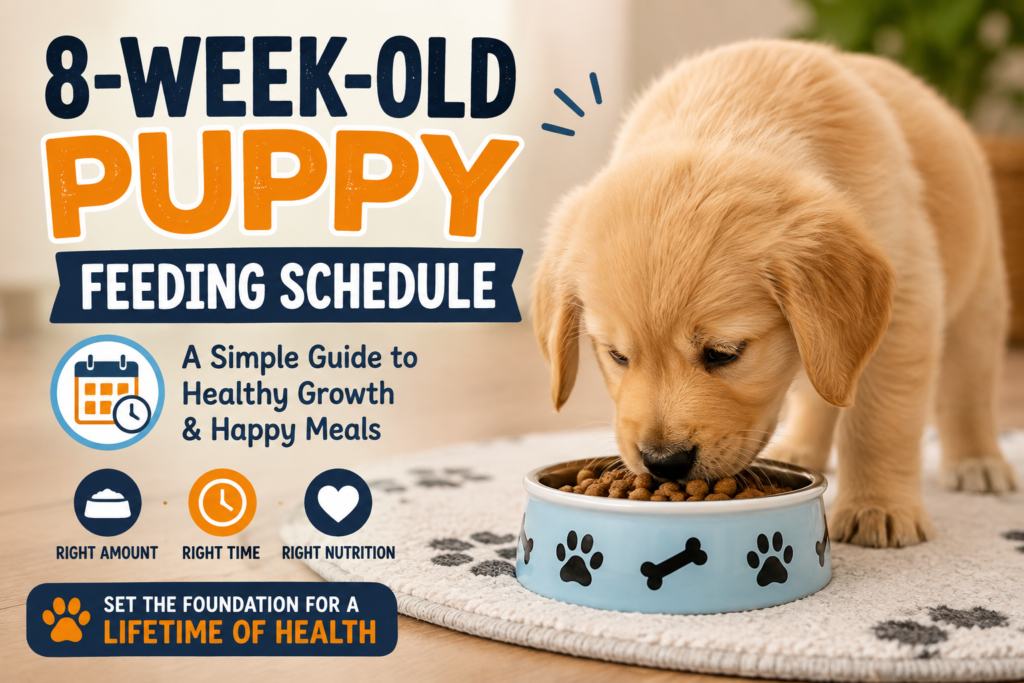
Bringing home a puppy is exciting, but feeding one can quickly become confusing. How many meals should your puppy eat? How much food is enough? And when should you reduce the number of daily meals?
A good puppy feeding schedule by age gives you a starting point for building a consistent routine. Puppies have rapidly changing nutritional needs, so the schedule that works for an 8-week-old puppy may not be appropriate several months later.
This guide explains puppy feeding frequency by age, meal timing, portion considerations, food selection, and common mistakes. It is designed to help U.S. puppy owners create a practical routine while understanding when individualized veterinary advice is important.
Important: Feeding recommendations vary with breed, expected adult size, current weight, body condition, activity, health, and the specific food being fed. Use the feeding directions on your puppy’s food as a starting point and ask your veterinarian for personalized recommendations.
Why a Puppy Feeding Schedule Matters
Puppies are growing rapidly and need adequate energy and nutrients to support development. They also have smaller stomachs than adult dogs, which is one reason younger puppies generally need multiple meals rather than one or two large meals.
A predictable puppy meal schedule can also make everyday life easier.
Regular meals can help you:
- Monitor how much your puppy actually eats
- Establish predictable bathroom routines
- Notice changes in appetite
- Avoid unnecessary overfeeding
- Make training and daily routines easier
- Track your puppy’s growth and body condition
Veterinary guidance also emphasizes that puppies should receive food formulated for growth. AAHA recommends growth-appropriate diets until skeletal maturity, which is typically around one year for many small and medium dogs but can take considerably longer in large and giant breeds.
Puppy Feeding Schedule by Age
There isn’t one universal schedule that works for every puppy. However, age can provide a useful starting framework.
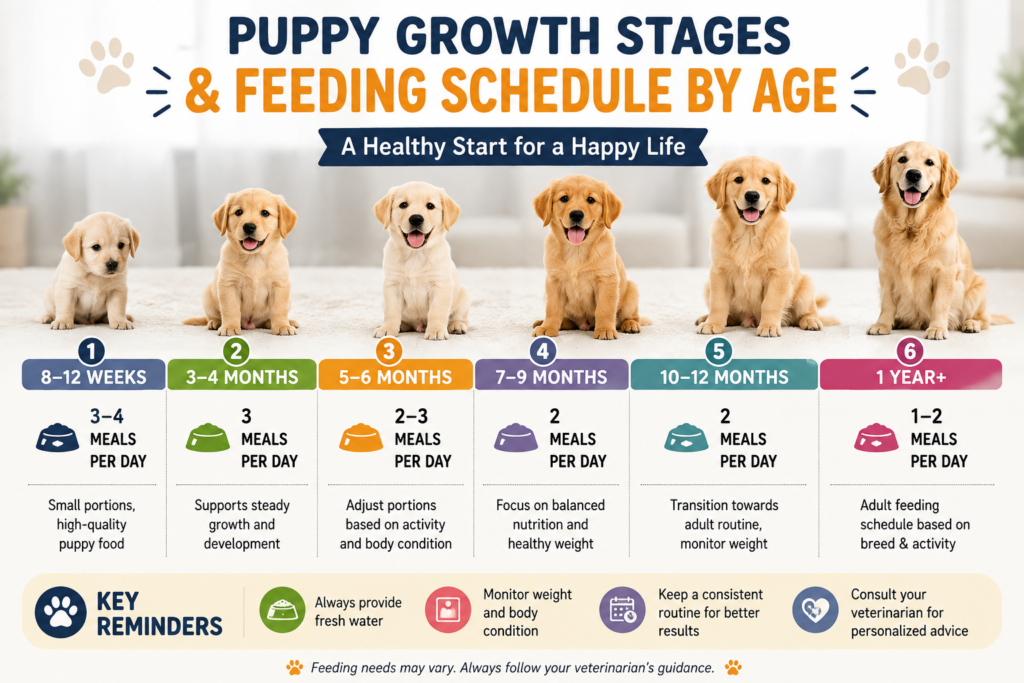
Puppy Feeding Chart by Age
| Puppy Age | Typical Meals Per Day | General Approach |
| 8–12 weeks | 3–4 meals | Small, measured meals spread throughout the day |
| 3–4 months | About 3 meals | Gradually establish a consistent three-meal routine |
| 5–6 months | About 2–3 meals | Many puppies can begin transitioning toward two meals |
| 7–9 months | About 2 meals | Maintain measured portions and monitor body condition |
| 10–12 months | About 2 meals | Continue growth nutrition according to size and development |
| 1 year+ | Usually 1–2 meals | Adult feeding schedule may become appropriate depending on the dog |
These are general guidelines, not medical prescriptions. Merck Veterinary Manual gives a general recommendation of three meals daily from weaning through six months and twice daily from six to twelve months, while noting that small-breed puppies may require more frequent meals.
8–12 Week Puppy Feeding Schedule
An 8 week old puppy feeding schedule generally involves several small meals throughout the day.
At this age, puppies are newly independent from their mother and are learning a completely new routine. Merck notes that puppies can generally leave their mother at around 7–8 weeks and feed themselves by that point.
A practical routine might look like:
- 7:00 AM: Breakfast
- 11:00 AM: Midday meal
- 3:00 PM: Afternoon meal
- 7:00 PM: Dinner
The exact times don’t matter as much as maintaining reasonable consistency.
For very young or particularly small puppies, your veterinarian may recommend more frequent meals. Some veterinary guidance uses four meals per day for puppies around 5–12 weeks, while other general recommendations use three meals.
How Many Times Should an 8-Week-Old Puppy Eat?
Many 8-week-old puppies do well with three to four measured meals per day, depending on their size, food, appetite, and veterinary recommendations.
Toy and very small breeds deserve particular attention because they can have different nutritional and feeding needs.
If your puppy repeatedly refuses meals, seems unusually weak, vomits, develops diarrhea, or isn’t gaining appropriately, contact your veterinarian rather than simply changing the feeding schedule.
3–4 Month Puppy Feeding Schedule
At three months, many puppies can settle into a three-meal daily routine.
For example:
- Morning
- Early afternoon
- Evening
A puppy feeding schedule 3 months old doesn’t need to follow an exact clock. Instead, aim for meals distributed reasonably throughout the waking day.
By four months, some puppies begin showing less interest in one meal. This can be a sign that their feeding routine may be ready for adjustment, but don’t reduce meals solely because of age.
VCA notes that puppies may gradually drop meals as they mature, with individual appetite and growth helping determine when a meal should be removed.
5–6 Month Puppy Feeding Schedule
Around five to six months, many puppies can transition toward two or three meals per day.
Merck’s general recommendation is three meals daily until six months, followed by twice-daily feeding from six to twelve months.
However, the transition should be based on the individual puppy.
If your puppy is thriving on three meals, there is no need to rush the change. Your veterinarian can help determine whether two meals are appropriate based on growth, breed, body condition, and health.
7–9 Month Puppy Feeding Schedule
For many puppies, the 7–9 month feeding schedule can be simplified to two meals per day.
A common routine is:
- Morning: First meal
- Evening: Second meal
At this stage, portion control becomes increasingly important. A puppy can continue gaining weight even when its growth rate begins slowing.
AAHA recommends monitoring body condition and adjusting feeding amounts rather than assuming the amount printed on a food package is an absolute requirement.
10–12 Month Puppy Feeding Schedule
A puppy feeding schedule 10 months old may look very similar to an adult dog’s schedule, but the diet itself may still need to be formulated for growth.
This distinction matters.
Meal frequency and food life stage are not the same thing.
A puppy eating twice a day doesn’t automatically mean it’s ready for adult food.
Small and medium dogs often approach skeletal maturity around one year, while large and giant breeds can continue growing substantially longer.
How Often Should You Feed a Puppy?
So, how often should you feed a puppy?
As a general starting point:
- Young puppies: 3–4 meals per day
- Around 3–6 months: about 3 meals per day
- Around 6–12 months: about 2 meals per day
Breed and size can change the recommendation. Small-breed puppies may need more frequent feeding, while large-breed puppies require careful control of growth and calorie intake.
The goal isn’t simply to feed the puppy as much as possible. Rapid or excessive growth can create problems, particularly in large and giant breeds.
How Much Should I Feed My Puppy?
This is where many new owners make mistakes.
There isn’t a single puppy food amount chart that works for every dog. Feeding amounts depend on factors such as:
- Current body weight
- Expected adult weight
- Age
- Breed or size
- Activity level
- Food’s calorie density
- Body condition
- Health status
Start with the feeding instructions provided by the food manufacturer. Then monitor your puppy’s weight and body condition.
AAHA explains that package feeding recommendations are useful starting points but may need adjustment for an individual pet.
Example
Suppose a puppy food recommends a certain daily amount for a puppy’s expected adult weight.
Don’t automatically add extra food because your puppy seems enthusiastic at mealtime. Instead, divide the recommended daily amount between the number of meals you’re feeding.
For example:
Daily amount ÷ 3 meals = approximate amount per meal.
Your veterinarian can help determine whether that amount should be adjusted.
Should Puppies Eat 3 Times a Day?
For many young puppies, yes.
Three meals can make it easier to distribute food throughout the day without requiring a very large meal at once.
However, younger or very small puppies may need four meals, while older puppies can often transition to two.
The important point is to adjust the routine gradually rather than following an age number blindly.
When Should Puppies Go From 3 Meals to 2?
Many puppies can transition toward two meals around six months, but there is no universal deadline.
Consider:
- Is your puppy maintaining an appropriate body condition?
- Is your puppy consistently eating its meals?
- Is growth progressing normally?
- Is the puppy’s breed and adult size compatible with the change?
- Has your veterinarian recommended a different schedule?
Merck’s general guidance supports twice-daily feeding from six to twelve months, but individualization is important.
What Kind of Food Should a Puppy Eat?
A puppy needs more than simply “dog food.”
Choose a complete and balanced food appropriate for growth. The nutritional needs of a growing puppy differ from those of an adult dog.
When shopping for the best puppy food, look for a nutritional adequacy statement indicating that the food is appropriate for growth. Large- and giant-breed puppies may need food specifically formulated for their size.
Large-Breed Puppies Need Extra Attention
Large and giant breeds grow for longer periods and have particular nutritional considerations.
AAHA warns against excessive calcium intake and emphasizes maintaining appropriate body condition during growth.
Don’t add calcium or other supplements to a complete puppy diet unless your veterinarian recommends them.
When Do Puppies Start Eating Solid Food?
Puppies begin transitioning from their mother’s milk to solid food during early puppyhood.
By approximately 7–8 weeks, puppies are generally capable of feeding themselves.
If you’re caring for a puppy that is younger than the normal adoption age, orphaned, or having trouble transitioning to food, veterinary guidance is particularly important.
Puppy Feeding Schedule After Weaning
After weaning, establish consistent meal times and gradually adjust the number of meals as the puppy matures.
Avoid making frequent unnecessary food changes. If you need to change diets, transition gradually to reduce the likelihood of digestive upset. AAHA recommends a gradual transition over a week or longer when changing foods.
Should Puppies Have Food Available All Day?
Free-choice feeding means leaving food available throughout the day.
Although this may work for some dogs, it makes it harder to know exactly how much the puppy has eaten and can encourage overeating in dogs that don’t self-regulate.
Meal feeding gives you greater control over daily portions.
AAHA’s feeding guidance recommends measured meal feeding rather than unrestricted access for growing puppies, with amounts adjusted according to body condition.
What Time Should I Feed My Puppy?
There is no magic feeding time.
The best schedule is one that:
- Fits your household
- Provides reasonably consistent meal times
- Leaves enough time between meals
- Works with bathroom breaks
- Allows you to monitor appetite
For example:
| Time | Meal |
| 7:00 AM | Breakfast |
| 12:00 PM | Lunch |
| 5:00 PM | Dinner |
For a younger puppy requiring four meals, an additional afternoon meal can be added.
Consistency is generally more useful than obsessing over a particular clock time.
Should I Feed My Puppy Before or After a Walk?
Avoid making large meals immediately around intense exercise.
For everyday puppy routines, many owners find it easier to schedule meals and activity with enough separation to allow the puppy to digest comfortably.
The appropriate timing can depend on the puppy, breed, exercise intensity, and health status. Large and giant breeds deserve particular caution around feeding and strenuous activity because they have a higher risk of certain stomach-related emergencies.
If your dog is a large or giant breed, ask your veterinarian for a feeding and exercise routine tailored to the dog’s needs.
Puppy Feeding Supplies: What Do You Actually Need?
You don’t need a complicated feeding station to feed a puppy properly.
Useful Puppy Feeding Supplies
1. Puppy Food Bowl
Choose a bowl that is stable, appropriately sized, and easy to clean.
2. Puppy Water Bowl
Fresh water should be readily available. A heavier or non-slip bowl can be useful for enthusiastic puppies.
3. Puppy Feeding Mat
A washable mat can help protect your floor from spilled food and water.
4. Puppy Food Storage Container
An airtight, food-safe container can make storing dry food easier while helping keep the food fresh.
5. Puppy Slow Feeder Bowl
A slow feeder may be useful for puppies that consistently gulp their food. However, introduce it gradually and make sure the design isn’t frustrating or difficult for the puppy to use.
Buying Guide: Choosing Puppy Feeding Supplies
If you’re setting up a puppy feeding area, focus on practicality rather than buying every accessory available.
Who Should Buy Them?
Feeding accessories can be particularly useful for:
- First-time puppy owners
- Puppies that spill water
- Dogs that eat too quickly
- Households with messy eaters
- Owners who want an organized feeding station
Materials
Look for materials that are:
- Food-safe
- Durable
- Easy to wash
- Resistant to cracking
- Suitable for everyday use
Stainless steel is a popular choice for bowls because it is durable and relatively easy to clean.
Durability
Puppies chew.
Avoid flimsy accessories that can crack, splinter, or become damaged easily. Choose sturdy products designed for regular pet use.
Ease of Use
A good feeding accessory should make your routine simpler, not more complicated.
Look for bowls that are easy to fill, carry, wash, and inspect.
Maintenance
Wash food and water bowls regularly. Don’t let old food residue accumulate around the feeding area.
Budget
You don’t need to spend a lot to create an effective puppy feeding setup. Start with the essentials and add specialized products only when your puppy’s behavior or routine makes them useful.
Warranty
For electronic or more complex feeding products, check the manufacturer’s warranty and return policy before purchasing.
Benefits of a Consistent Puppy Feeding Schedule
A consistent routine offers several practical benefits.
Easier Portion Control
Measured meals make it easier to determine how much your puppy consumes.
Better Appetite Monitoring
If your puppy normally finishes every meal and suddenly refuses food, you’ll notice the change quickly.
Predictable Bathroom Routine
Young puppies often need to eliminate after eating, so predictable meals can make house training easier.
Easier Training
Small portions of the puppy’s daily food allowance can sometimes be incorporated into training, reducing the need for excessive treats.
Better Weight Management
Portion-controlled feeding can help prevent accidental overfeeding.
Drawbacks and Things to Consider
A feeding schedule isn’t completely one-size-fits-all.
Puppies Grow at Different Rates
Two puppies of the same age can have very different nutritional requirements.
Breed Matters
A Chihuahua puppy and a Great Dane puppy should not automatically receive the same feeding approach.
Food Calories Differ
One cup of one food may contain considerably more calories than one cup of another.
Health Conditions Change the Plan
Digestive problems, parasites, allergies, poor growth, and other medical issues can all affect feeding requirements.
Appetite Changes Can Matter
Don’t assume that every change in appetite is simply a behavioral issue. VCA notes that appetite changes in puppies can sometimes have medical causes.
Expert Tips for Feeding Puppies
1. Measure Food Instead of Guessing
A measuring cup is better than estimating portions by eye. For some dogs, a kitchen scale can provide even greater accuracy.
2. Monitor Body Condition
Don’t judge feeding solely by how much your puppy begs for food.
A healthy body condition is more useful than a puppy’s enthusiasm at mealtime.
3. Count Treats
Treat calories matter too. VCA recommends keeping treats to no more than 10% of a puppy’s daily calories.
4. Don’t Add Supplements Without Advice
A complete and balanced puppy food is designed to provide the necessary nutrients. Extra calcium or other supplements can be inappropriate, especially for growing large-breed puppies.
5. Weigh Your Puppy Regularly
Regular weight checks help you identify whether growth is progressing as expected.
6. Keep a Simple Feeding Log
For a new puppy, record:
- Meal time
- Food amount
- Treats
- Weight
- Appetite
- Digestive changes
This can be extremely useful when discussing your puppy’s nutrition with your veterinarian.
Common Puppy Feeding Mistakes
Feeding Too Much
A puppy looking hungry doesn’t necessarily mean it needs more food.
Changing Food Too Frequently
Constant food changes can make digestive problems more difficult to identify.
Leaving Food Out All Day
Free feeding makes portion control more difficult for puppies that overeat.
Ignoring Breed Size
Large-breed puppies have different growth considerations than toy breeds.
Adding Unnecessary Supplements
More nutrients aren’t automatically better.
Forgetting Treat Calories
Training treats can add up quickly.
Using the Food Label as an Absolute Rule
Food labels provide useful starting guidance, but individual puppies may need adjustments based on body condition and growth.
Frequently Asked Questions
1. How many times a day should a puppy eat?
Young puppies generally need three to four meals per day. As they mature, many can transition to three meals and eventually two meals daily. Breed, size, health, and individual development can change the recommendation.
2. How many times should a 3-month-old puppy eat?
Three meals per day is a common starting point for a 3-month-old puppy. The exact amount should be based on the food’s feeding directions and your puppy’s individual needs.
3. How many times should a 6-month-old puppy eat?
Many six-month-old puppies can begin transitioning to two meals daily, although some may continue doing well with three meals. Merck’s general guidance recommends three meals through six months and two meals from six to twelve months.
4. How much food should a puppy eat?
The correct amount depends on age, current weight, expected adult size, activity, food calorie density, and body condition. Use the food manufacturer’s instructions as a starting point and discuss adjustments with your veterinarian.
5. Can puppies eat at night?
Most puppies don’t need a scheduled overnight meal once they are eating normally during the day, but very young, very small, or medically vulnerable puppies may have different needs. Ask your veterinarian if you’re concerned about overnight feeding.
6. When can puppies eat twice a day?
Many puppies can transition to two meals around six months, but there is no universal rule. Large breeds may have different nutritional requirements and should be evaluated individually.
7. Should I feed my puppy at the same time every day?
A consistent schedule is helpful for establishing a routine, monitoring appetite, and coordinating bathroom breaks. The exact clock time is less important than maintaining a practical routine.
8. When should puppies stop eating puppy food?
It depends on their expected adult size and when they reach skeletal maturity. Many small and medium dogs transition around one year, while large and giant breeds can require growth nutrition longer.
9. Should puppies have food available all day?
Not necessarily. Measured meal feeding makes it easier to control portions and monitor appetite. Free-choice feeding can cause some dogs to overeat.
10. What should I do if my puppy suddenly stops eating?
Don’t automatically assume your puppy is being picky. A sudden appetite change can have medical causes. If your puppy refuses food, especially alongside vomiting, diarrhea, weakness, lethargy, or other concerning symptoms, contact your veterinarian promptly.
Final Verdict
A good puppy feeding schedule by age is about more than simply deciding whether your puppy eats two, three, or four times per day.
The most important factors are appropriate growth nutrition, measured portions, consistent meals, regular weight monitoring, and adjustments based on your puppy’s individual development.
As a broad guide, young puppies commonly need three to four meals daily, many puppies move toward three meals during the middle puppy months, and twice-daily feeding often becomes appropriate around six months and beyond. However, your puppy’s breed, adult size, health, body condition, and food should always be considered.
If you’re unsure whether your puppy is eating too much, too little, growing too quickly, or ready to change food, your veterinarian is the best person to help create an individualized plan.
Build a Better Puppy Feeding Setup
Once you’ve established the right puppy meal schedule, the right feeding equipment can make the routine much easier.
Explore puppy feeding supplies such as food bowls, water bowls, feeding mats, slow-feeder options, and practical pet accessories at Al Falah Trader.
A simple, organized feeding station can make those early puppy months cleaner and more manageable.
Read More Pet Care Tips/Articles from Al Falah Trader
If you found this guide helpful, you might also enjoy these Blogs/articles:
Puppy Essentials Checklist: 35 Must-Haves for New Owners
Best Orthopedic Dog Beds for Comfort and Joint Support
Best Dog Toys: Safe, Fun, and Durable Picks for Every Dog
Best Durable Dog Toys for Aggressive Chewers
Best Dog Water Fountain: Buying Guide
How Much Sleep Do Dogs Need? A Complete Age-by-Age Guide
How to Keep Your Dog Healthy: A Complete Care Guide
Best Interactive Dog Toys for Large Dogs
Recommended Products
Memory Foam Dog Beds for Maximum Comfort & Support – Shop Now
Best Heated Dog Beds for Winter – Shop Now
Plush Calming Dog Bed – Soft Pet Nest Bed for Dogs & Cats – Shop Now
Princess Dog Bed – Cozy Fantasy Pet Nest Bed for Dogs & Cats – Shop Now
Dog Potty Training in 7 Days – E-books
Durable Cactus Dog Chew Toy – Interactive Toy for Aggressive Chewers & Puppies – Shop Now
Durable Dog Toys For Aggressive Chewers Tough Interactive Dog Toys For Large Dogs Birthday Dog Chew Toy Teething Toys Treat Dispensing Dog Toy – Shop Now
Stainless Steel Cat Water Fountain 7L – Automatic Pet Water Dispenser with Ultra-Quiet Pump – Shop Now
Authoritative External Resources
For readers who want to learn more about canine health and behavior, consider linking to: