
Introduction
Bringing home a puppy is exciting, but feeding can quickly become confusing. How many meals does a puppy need? How much food should go into each bowl? And when should you move from three or four meals to two?
So, how often should you feed a puppy? The answer depends mainly on age, size, breed, growth rate, health, and the type of food you are feeding.
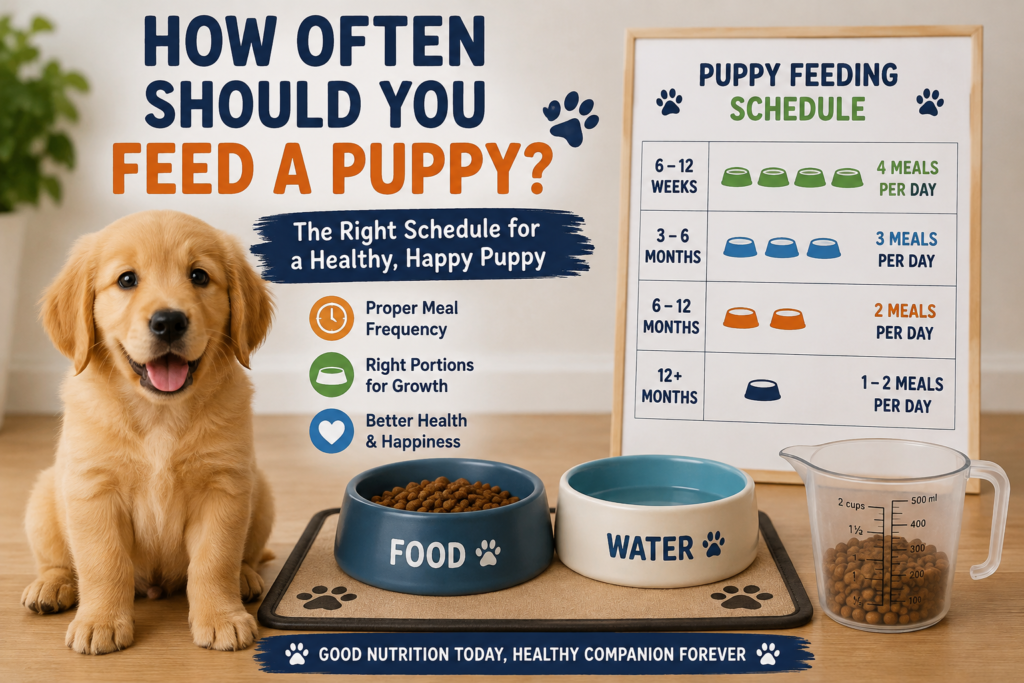
As a general guide, young puppies need several small meals throughout the day. Merck Veterinary Manual recommends four meals daily for puppies from 6–12 weeks, three meals from 3–6 months, and two meals from 6–12 months. However, individual puppies—especially toy and large-breed puppies—may need a schedule adjusted by a veterinarian.
The goal isn’t simply to fill your puppy’s bowl. A good feeding routine provides appropriate nutrition while helping your puppy maintain healthy growth and body condition.
Why Your Puppy’s Feeding Schedule Matters
Puppies are growing rapidly, so their nutritional needs are different from those of adult dogs. They need a complete and balanced diet formulated for growth, with appropriate levels of calories, protein, fat, vitamins, and minerals.
Meal frequency also matters because a young puppy has a relatively small stomach. Dividing the recommended daily food into several meals can make it easier for the puppy to consume what it needs without receiving a huge amount of food at once.
A predictable puppy feeding schedule can also make everyday life easier. Feeding at consistent times can help you anticipate when your puppy needs a potty break, which can be particularly useful during house training.
Most importantly, feeding should support controlled, healthy growth rather than rapid weight gain. Overfeeding growing puppies can increase the risk of excessive weight and developmental problems.
How Many Times a Day Should a Puppy Eat?
There isn’t one schedule that works for every puppy. Age provides the starting point, while breed size, health, activity, and body condition help determine whether adjustments are necessary.
A practical general guide is:
| Puppy Age | Typical Meals Per Day | General Approach |
| 6–12 weeks | 4 | Small, evenly divided meals |
| 3–6 months | 3 | Three regular meals |
| 6–12 months | 2 | Two measured meals |
| 12+ months | 1–2 | Usually an adult feeding routine |
This age-based schedule is consistent with the feeding schedule published by Merck Veterinary Manual.
Some veterinary sources use slightly different transition points. That isn’t necessarily a contradiction. Puppies differ considerably in size and metabolism, so the correct schedule should be adjusted to the individual dog rather than followed blindly.
How Often Should I Feed My Puppy at 8 Weeks?
An 8-week-old puppy is generally still in the stage where several small meals are appropriate. Four meals per day is a common guideline for puppies around this age.
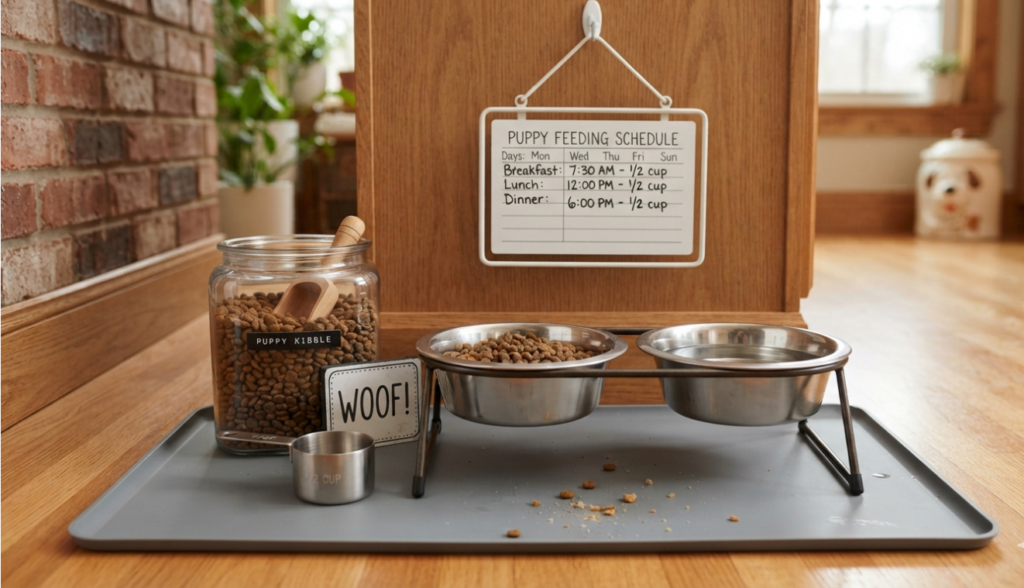
For example, a simple schedule could look like:
- 7:00 a.m. — Breakfast
- 11:00 a.m. — Second meal
- 3:00 p.m. — Third meal
- 7:00 p.m. — Dinner
The exact times don’t have to be identical every day. What matters more is providing appropriately sized portions at reasonably consistent intervals.
How Often to Feed a 4- to 7-Week-Old Puppy
Very young puppies are different from puppies that have already gone home with their new families.
At around 4 weeks, puppies are typically beginning the transition from nursing toward solid food. Weaning should be gradual, and puppies may still depend significantly on their mother. Toy-breed puppies can have additional nutritional considerations.
Therefore, don’t use a standard 8-week puppy feeding schedule for a 4-week-old puppy without veterinary or breeder guidance.
How Often Should I Feed a 2-Month-Old Puppy?
A 2-month-old puppy is approximately 8 weeks old, so several small meals per day are generally appropriate.
Four meals is a common starting point, but your veterinarian may recommend a different schedule based on the puppy’s breed, size, health, and food.
How Often Should I Feed a 3-Month-Old Puppy?
At around 3 months, many puppies can begin moving toward three meals per day. Merck lists three meals daily for puppies from 3–6 months.
However, the transition doesn’t have to happen on a specific birthday. If your puppy is thriving on the existing schedule, discuss the timing of the change with your veterinarian.
How Often Should I Feed a 4- to 5-Month-Old Puppy?
Three meals per day is a common routine at this stage.
Instead of simply adding more food as your puppy grows, use the feeding directions on the puppy-food package as a starting point and monitor your puppy’s body condition. The total daily amount should be divided among the day’s meals rather than giving the full amount at one sitting.
How Often Should I Feed a 6- to 10-Month-Old Puppy?
Many puppies can transition to two meals per day during this period. Merck recommends two daily meals for puppies from 6–12 months.
The timing can vary depending on the dog. Large and giant breeds may continue growing for considerably longer than small breeds, so the transition from puppy food to adult food should not be based solely on the puppy’s calendar age.
How Often Should I Feed a 1-Year-Old Puppy?
Around one year, many dogs are approaching adulthood, but breed size makes a significant difference.
Small dogs can reach maturity earlier, while large and giant breeds may continue growing well beyond their first birthday. Merck notes that some large and giant breeds may not reach skeletal maturity until approximately 10–16 months or later.
Ask your veterinarian when your particular dog should transition from puppy food to adult food.
Puppy Feeding Schedule by Age
If you’re looking for a simple puppy feeding schedule by age and weight, start with age and then adjust portions according to your puppy’s expected adult size, current body condition, activity, and food formulation.
A sample routine might look like this:
8–12 Weeks
Four meals:
- 7:00 a.m.
- 11:00 a.m.
- 3:00 p.m.
- 7:00 p.m.
3–6 Months
Three meals:
- 7:00 a.m.
- 1:00 p.m.
- 7:00 p.m.
6–12 Months
Two meals:
- 7:00 a.m.
- 6:00 p.m.
These are examples, not medical prescriptions. You can shift the times to fit your household routine while keeping the meals reasonably consistent.
How Much Should a Puppy Eat?
Knowing how often to feed a puppy is only half of the equation. You also need to determine the right amount.
There isn’t a universal number of cups that every puppy should eat. Calorie density varies between foods, while puppies vary in expected adult size, metabolism, activity, and growth rate.
Start by checking the feeding instructions on your puppy food. VCA notes that food packaging provides suggested serving amounts based on factors such as weight and, in some cases, activity level. These recommendations are a starting point rather than an absolute prescription.
Then consider:
- Current body weight
- Expected adult weight
- Breed or breed size
- Age
- Activity level
- Food calorie density
- Body condition
- Health status
How Much Food Should a Puppy Eat Per Meal?
Take the puppy’s recommended daily amount and divide it between the number of meals you provide.
For example, if your puppy’s daily feeding amount is 2 cups, and your veterinarian recommends four meals, you could start with approximately ½ cup per meal.
That’s only an example—not a universal feeding recommendation. Different puppy foods can contain very different amounts of calories per cup.
can contain very different amounts of calories per cup.
How Many Cups of Food Should a Puppy Eat?
Avoid choosing a number of cups based solely on your puppy’s age.
One puppy may need considerably more or less food than another of the same age. Instead, use the food manufacturer’s feeding guide as your starting point and monitor growth and body condition.
If your puppy is gaining weight too quickly, appears excessively thin, or isn’t growing as expected, speak with your veterinarian before making major changes.
Puppy Feeding Chart: A Practical Starting Point
Here’s a simplified puppy feeding chart based on meal frequency:
| Age | Meals Per Day | Typical Goal |
| 4–7 weeks | Varies during weaning | Gradual transition to solid food |
| 8–12 weeks | 4 | Small, frequent meals |
| 3–6 months | 3 | Regular three-meal routine |
| 6–12 months | 2 | Transition toward adult-style meal frequency |
| 12+ months | 1–2 | Depends on breed and individual needs |
This chart describes feeding frequency, not the number of cups your puppy should receive.
For the actual portion, use your food’s feeding instructions and your veterinarian’s recommendations.
Puppy Feeding Schedule by Breed and Size
Breed size can change the answer.
Toy and Small-Breed Puppies
Very small puppies can have higher feeding demands relative to their body size and may be more vulnerable to low blood sugar. AKC notes that toy puppies may require more frequent meals during early development.
Don’t assume that a tiny puppy can safely follow the same schedule as a large-breed puppy.
Medium-Breed Puppies
Many medium-sized puppies can follow the general age-based schedule of four meals when very young, followed by three meals and eventually two.
Individual needs still vary, so monitor body condition and growth.
Large and Giant-Breed Puppies
Large-breed puppies need particularly careful nutrition because excessive growth can contribute to skeletal problems. Merck recommends diets specifically formulated for large or giant breeds when appropriate.
For these puppies, don’t simply increase food because the dog looks hungry. Controlled growth and an appropriate complete diet are important.
Should Puppies Eat 3 or 4 Times a Day?
Both can be appropriate depending on age and the individual puppy.
Very young puppies commonly benefit from four smaller meals. As they mature, the daily amount can be divided into three meals and eventually two.
The important point is that meal frequency and total daily food are connected. Switching from four meals to three doesn’t automatically mean your puppy should receive more food each day.
You’re generally redistributing the day’s food, not creating extra calories.
How Long Between Puppy Meals?
A useful approach is to space meals fairly evenly across your puppy’s waking hours.
For example, a four-meal routine could have approximately four-hour gaps. A three-meal routine could have roughly five- to six-hour intervals.
You don’t need to watch the clock to the minute. Consistency is more important than perfection.
If your puppy has a medical condition, unusually low appetite, or is a toy breed with special feeding needs, ask your veterinarian whether shorter intervals are appropriate.
What Time Should I Feed My Puppy?
Choose times that you can realistically maintain.
A practical routine might be:
Morning: shortly after waking and a potty break
Midday: around lunchtime
Afternoon: during the puppy’s active part of the day
Evening: several hours before bedtime
A regular routine can make it easier to predict bathroom needs and notice changes in appetite. VCA notes that consistent feeding schedules can also help with house training.
Should You Leave Food Out All Day?
Usually, scheduled meal feeding is easier to manage than constantly available food for puppies.
Free-choice feeding can make it difficult to know exactly how much your puppy has eaten. It can also encourage overeating in some dogs. VCA specifically cautions that unrestricted feeding can contribute to juvenile obesity and other problems.
Scheduled meals also make it easier to identify a sudden appetite change.
That said, feeding practices can vary between puppies and food types. Follow your veterinarian’s recommendation if your puppy has special nutritional needs.
Can You Overfeed a Puppy?
Yes.
Puppies need plenty of nutrition for growth, but more food isn’t automatically better. Overfeeding can encourage excessive weight gain and overly rapid growth.
Watch your puppy’s body condition rather than assuming an empty bowl means another serving is needed. AKC recommends using the puppy’s body condition as an important guide when determining whether portions need adjustment.
Treats count, too. VCA recommends keeping treats to no more than about 10% of a puppy’s daily calories.
Benefits of a Consistent Puppy Feeding Routine
A reliable feeding routine can provide several practical advantages:
- Makes daily food intake easier to measure
- Helps establish predictable potty breaks
- Makes appetite changes easier to notice
- Prevents accidental overfeeding
- Makes training rewards easier to manage
- Helps multiple family members follow the same routine
- Creates a predictable daily rhythm for the puppy
The biggest benefit is consistency. Your puppy doesn’t need a perfect schedule—it needs an appropriate one that you can actually maintain.
Drawbacks and Things to Consider
A feeding schedule isn’t completely one-size-fits-all.
Puppies Have Different Nutritional Needs
Two puppies of the same age can require different amounts of food because of differences in breed, size, activity, metabolism, and health.
Feeding Charts Are Only Starting Points
Food labels are useful, but they cannot account for every individual dog. VCA recommends using package guidelines as a starting point and adjusting with veterinary guidance when necessary.
Large-Breed Puppies Need Extra Care
Large and giant breeds can have longer growth periods and require appropriately formulated diets. Avoid making major nutritional changes without professional guidance.
Toy Puppies May Need More Frequent Meals
Small puppies can have limited energy reserves. Some toy puppies require more frequent meals than the general schedule suggests.
What to Look for When Buying Puppy Feeding Supplies
You don’t need an expensive collection of accessories to feed a puppy well. A few practical items can make feeding cleaner and easier.
Who Should Buy a Puppy Feeding Set?
A basic feeding setup is useful for:
- First-time puppy owners
- Families adopting a new puppy
- Owners establishing scheduled meals
- Homes with multiple pets
- Puppies that eat too quickly or make a mess
Food and Water Bowls
Choose bowls that are appropriately sized and easy to clean.
Stainless steel is a practical option because it is durable and generally easy to wash. Ceramic can also work when it is designed for pet use and kept free from chips or cracks.
Slow-Feeder Bowls
If your puppy consistently gulps food, a slow feeder may help make meals last longer. However, don’t assume every fast eater needs one. Monitor your puppy and ask your veterinarian if rapid eating is accompanied by vomiting, discomfort, or other concerning symptoms.
Measuring Tools
A measuring cup or kitchen scale can help you serve consistent portions.
This is particularly useful when several people in the household feed the puppy.
Automatic Feeders
An automatic feeder can be convenient if your schedule makes midday meals difficult.
However, it shouldn’t replace monitoring. You still need to ensure the feeder delivers the correct amount and remains clean.
Budget Considerations
You don’t need to spend a lot. Prioritize:
- A complete puppy diet appropriate for your dog’s growth stage
- A clean, appropriately sized food bowl
- A separate water bowl
- A reliable measuring method
- Optional accessories such as a slow feeder or automatic feeder if your puppy actually benefits from them
Expert Tips for Feeding a Puppy
1. Measure the Entire Day’s Food
Instead of repeatedly filling the bowl, measure the puppy’s daily amount first and divide it between meals.
2. Keep Everyone on the Same Plan
If multiple family members feed the puppy, write down the meal times and portions. Otherwise, your puppy may receive breakfast twice.
3. Count Training Treats
Treats are calories. Reduce the regular food appropriately when treats make up a meaningful portion of the day’s intake, while staying within your veterinarian’s guidance.
4. Monitor Body Condition
Don’t judge your puppy’s health solely by the number on a scale. Regular weight checks combined with body-condition assessment provide a better picture.
5. Keep Fresh Water Available
Fresh, clean drinking water should generally be available to puppies throughout the day.
6. Don’t Change Food Abruptly
When changing diets, transition gradually unless your veterinarian tells you otherwise. Sudden dietary changes can cause digestive upset.
7. Treat Appetite Changes Seriously
A puppy suddenly refusing food deserves more attention than an adult dog occasionally skipping a meal. Young puppies should not go for extended periods without eating, particularly if they are very small.
Common Puppy Feeding Mistakes
Avoid these common mistakes when establishing your puppy’s eating routine:
- Feeding based only on hunger: A puppy begging doesn’t necessarily need additional calories.
- Ignoring food calories: One cup of one food may contain very different calories from one cup of another.
- Following the label blindly: Package recommendations are starting points.
- Giving too many treats: Training treats can quietly add substantial calories.
- Free-feeding without monitoring: It makes intake harder to track.
- Using adult food too early: Puppies need nutrition designed for growth.
- Adding supplements unnecessarily: A complete and balanced puppy diet generally doesn’t need extra vitamins or minerals unless your veterinarian recommends them.
- Making large-breed puppies grow as fast as possible: Faster growth isn’t necessarily healthier growth.
- Changing feeding times constantly: A predictable routine is easier for both puppy and owner.
Frequently Asked Questions
1. How often should you feed a puppy?
Young puppies generally need several small meals per day. A common guideline is four meals daily from about 6–12 weeks, three meals from 3–6 months, and two meals from 6–12 months. Individual needs vary.
2. How often should I feed my puppy at 8 weeks?
Four small meals per day is a common starting point for an 8-week-old puppy. Your veterinarian may recommend a different schedule based on breed, size, health, and growth.
3. How much should a puppy eat?
The correct amount depends on the puppy’s age, current weight, expected adult size, activity, health, and food calorie density. Start with the food manufacturer’s feeding guide and adjust with veterinary guidance.
4. Should puppies eat 3 or 4 times a day?
Both can be appropriate. Very young puppies commonly eat four meals, while older puppies can transition to three and eventually two. The transition should reflect the individual puppy rather than an arbitrary date.
5. When can puppies switch to two meals a day?
Many puppies can move to two meals per day around 6 months, although breed size and individual needs matter. Merck lists two meals daily for puppies from 6–12 months.
6. How long can a puppy go without eating?
Young puppies should not be intentionally left without food for extended periods. Very small puppies can be particularly vulnerable to low blood sugar. If a puppy refuses food or misses meals unexpectedly, contact your veterinarian for advice.
7. Should I feed my puppy before or after a walk?
For young puppies, prioritize a predictable routine and avoid intense activity immediately around meals. The ideal timing can vary by dog, so ask your veterinarian if your puppy participates in vigorous exercise or belongs to a large or giant breed.
8. Should I leave food out for my puppy all day?
Scheduled meals are generally easier for monitoring portions and appetite. Free-choice feeding can cause some puppies to overeat and makes it harder to know exactly how much food they consumed.
9. How do I know if I’m feeding my puppy enough?
Track your puppy’s weight and body condition, observe growth, and follow the food’s feeding instructions as a starting point. Your veterinarian can help determine whether portions need to increase or decrease.
10. How much food should a puppy eat at night?
Don’t automatically add a nighttime meal simply because your puppy is awake or begging. The goal is to divide the puppy’s appropriate daily food allowance across the recommended number of meals. Very young or toy-breed puppies may require individualized schedules.
Final Verdict: How Often Should You Feed a Puppy?
So, how often should you feed a puppy?
For a simple starting point, think four meals a day for very young puppies, three meals a day during much of the 3–6 month period, and two meals a day from around 6–12 months. Merck Veterinary Manual provides this as a general feeding schedule, while veterinary and canine nutrition sources emphasize that individual puppies may need adjustments.
The number of meals, however, is only one part of good puppy nutrition. The food must be appropriate for growth, portions should be measured, treats should be controlled, and your puppy’s body condition and growth should be monitored.
If your puppy is unusually small, a large or giant breed, has a medical condition, isn’t eating normally, or isn’t growing as expected, talk with your veterinarian rather than relying on a generic online feeding chart.
Ready to Make Puppy Care Easier?
A good feeding routine is one of the simplest ways to create structure during your puppy’s first year.
At Al Falah Trader, explore our growing selection of puppy and dog essentials, including practical products designed to make feeding, daily care, comfort, and life with your new puppy easier.
Browse Al Falah Trader’s pet essentials and find useful products for your puppy’s everyday routine.
Read More Pet Care Tips/Articles from Al Falah Trader
If you found this guide helpful, you might also enjoy these Blogs/articles:
Puppy Essentials Checklist: 35 Must-Haves for New Owners
Puppy Feeding Schedule by Age: Complete Guide
Best Orthopedic Dog Beds for Comfort and Joint Support
Best Dog Toys: Safe, Fun, and Durable Picks for Every Dog
Best Durable Dog Toys for Aggressive Chewers
Best Dog Water Fountain: Buying Guide
How Much Sleep Do Dogs Need? A Complete Age-by-Age Guide
How to Keep Your Dog Healthy: A Complete Care Guide
Best Interactive Dog Toys for Large Dogs
Recommended Products
Memory Foam Dog Beds for Maximum Comfort & Support – Shop Now
Best Heated Dog Beds for Winter – Shop Now
Plush Calming Dog Bed – Soft Pet Nest Bed for Dogs & Cats – Shop Now
Princess Dog Bed – Cozy Fantasy Pet Nest Bed for Dogs & Cats – Shop Now
Dog Potty Training in 7 Days – E-books
Durable Cactus Dog Chew Toy – Interactive Toy for Aggressive Chewers & Puppies – Shop Now
Durable Dog Toys For Aggressive Chewers Tough Interactive Dog Toys For Large Dogs Birthday Dog Chew Toy Teething Toys Treat Dispensing Dog Toy – Shop Now
Stainless Steel Cat Water Fountain 7L – Automatic Pet Water Dispenser with Ultra-Quiet Pump – Shop Now
Authoritative External Resources
For readers who want to learn more about canine health and behavior, consider linking to: