
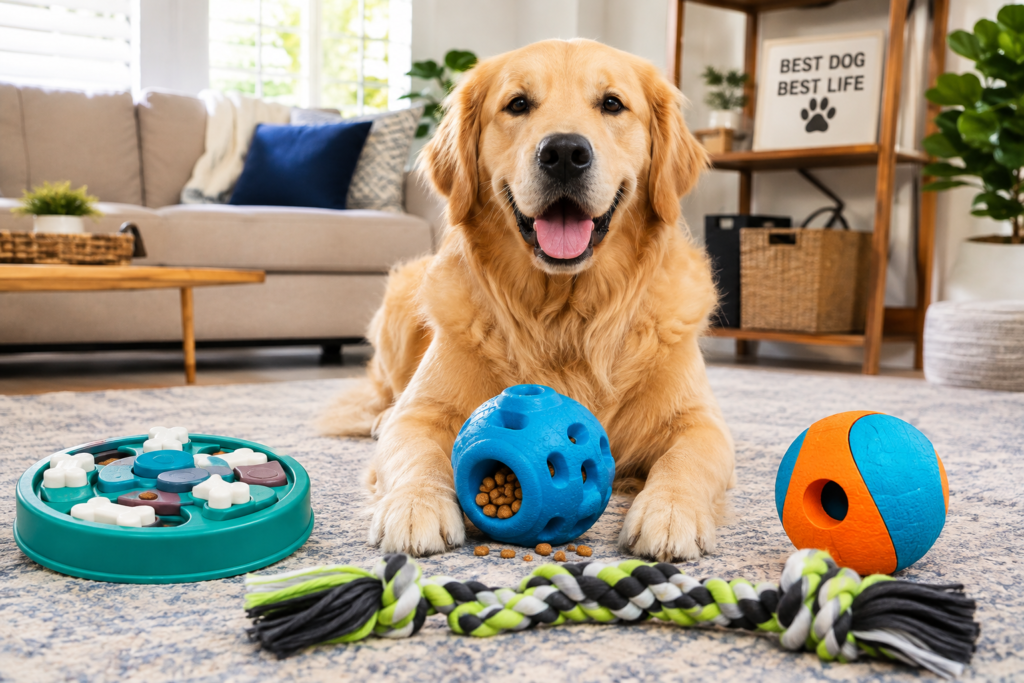
Best Interactive Dog Toys for Large Dogs
Large dogs often need more than a quick game of fetch to stay satisfied. A powerful dog with plenty of energy can become bored when there is little opportunity to sniff, solve problems, chew, explore, or work for food.
That is where interactive dog toys for large dogs can make a real difference. The right toy can turn snack time into a puzzle, playtime into a training opportunity, and downtime into productive mental enrichment.
However, choosing a toy for a Labrador Retriever, German Shepherd, Golden Retriever, Rottweiler, or another large breed isn’t simply about buying the biggest or toughest-looking product. Size, chewing habits, play style, difficulty, materials, and supervision all matter.
In this guide, we’ll explain what to look for in the best interactive dog toys for large dogs, compare the major toy types, and show you how to choose an option that fits your dog’s personality and daily routine.
Why Interactive Toys Matter for Large Dogs
Large dogs can have substantial physical and mental needs. A walk provides valuable exercise, but play and enrichment can add different forms of stimulation, including problem-solving, sniffing, searching, manipulating objects, and working for food.
Veterinary behavior specialists at VCA Animal Hospitals describe foraging and activity toys as ways to provide mental and physical exercise while encouraging natural behaviors such as sniffing, chasing, seeking, licking, chewing, and manipulating objects.
This makes interactive toys useful for more than simply keeping a dog occupied.
For example, instead of putting your dog’s entire meal into a bowl, you might place an appropriate portion into a food-dispensing toy. Your dog then has to interact with the toy to access the food.
Interactive Toys vs. Ordinary Toys
A conventional ball may be excellent for fetch, while an interactive toy generally asks the dog to do something to receive a reward or continue the game.
Interactive toys can involve:
- Solving a puzzle
- Finding hidden treats
- Rolling or pushing a dispenser
- Licking food from a toy
- Chewing an appropriate durable toy
- Chasing a moving object
- Playing tug with a person
- Searching for hidden food
The best option depends on what motivates your dog.
Best Types of Interactive Dog Toys for Large Dogs
There isn’t one perfect toy for every large dog. A food-motivated Beagle-sized personality in a Labrador’s body may love puzzles, while a high-drive German Shepherd might prefer movement and training-based games.
Here are the main categories worth considering.
1. Puzzle Toys for Large Dogs
Puzzle toys for large dogs are designed to make your dog think before receiving a reward.
Some have sliding compartments, rotating pieces, removable covers, or hidden treat areas. Others are relatively simple and rely on your dog pushing, nudging, or manipulating the toy.
Puzzle toys can be particularly useful for dogs that enjoy figuring things out.
Look for:
- A size appropriate for large breeds
- Sturdy construction
- Smooth edges
- Food compartments that are easy to clean
- A difficulty level your dog can actually solve
Start with an easier puzzle. If your dog immediately becomes frustrated, the toy may be too difficult rather than insufficiently entertaining.
VCA recommends adjusting difficulty gradually and watching for frustration. The objective is to keep the dog engaged rather than make the task unnecessarily difficult.
2. Treat-Dispensing Dog Toys
Treat-dispensing toys turn food into an activity.
A large dog may need to push, roll, paw, or manipulate the toy before kibble or treats are released. These can be especially useful when you want to provide toys to keep large dogs busy without relying exclusively on physical play.
They can also help make meals more engaging.
However, remember that treats contain calories. If you’re using food-based toys frequently, account for those calories as part of your dog’s overall daily intake.
3. Durable Interactive Chew Toys
Some large dogs don’t want to solve a puzzle—they want to chew.
For these dogs, durable interactive dog toys can combine chewing with food rewards or other forms of engagement.
Look for appropriately sized products made from materials intended for canine use. Avoid assuming that “indestructible” means literally impossible to damage.
The ASPCA advises choosing chew products according to a dog’s size and chewing habits and replacing products once they become excessively worn or develop pieces that could be swallowed.
4. Interactive Balls
Interactive dog balls can provide both physical and mental activity.
Some are designed for fetch, while others dispense food or move unpredictably. Large dogs that love chasing, retrieving, or carrying objects may respond particularly well to these options.
For large and giant breeds, size is especially important. The American Kennel Club recommends appropriately sized balls and notes that larger dogs may require larger, more durable toys.
5. Interactive Tug Toys
Tug toys are different because they usually work best as interactive toys between the dog and owner.
A durable rope or tug toy can turn five or ten minutes of play into a combination of movement, engagement, and training.
Use tug as a structured game rather than allowing your dog to shred and consume the toy. The AKC recommends supervising tug toys and putting them away when the dog is likely to destroy or eat pieces.
6. Electronic and Automatic Dog Toys
Automatic dog toys can move, roll, make sounds, or otherwise encourage a dog to interact with them.
These may appeal to dogs that enjoy chasing moving objects, but they’re not automatically better than simple food puzzles or owner-led games.
Before buying an electronic toy, consider:
- Noise level
- Battery requirements
- Durability
- Moving parts
- Ease of cleaning
- Whether your dog tries to destroy it
- Whether the product is designed for the dog’s size
Some dogs will become interested immediately. Others may ignore an expensive electronic toy and choose a cardboard box instead.
Comparison: Which Interactive Toy Is Best?
| Toy Type | Mental Stimulation | Physical Activity | Good for Food Motivation | Best For |
| Puzzle toy | High | Low–Medium | High | Problem-solving dogs |
| Treat dispenser | High | Medium | Very High | Food-motivated dogs |
| Interactive chew toy | Medium | Low | Medium–High | Strong chewers |
| Interactive ball | Medium | High | Low–Medium | Fetch-loving dogs |
| Tug toy | Medium | High | Low | People-oriented dogs |
| Automatic toy | Medium–High | Medium–High | Varies | Dogs who enjoy movement |
Best overall approach: rotate different toy types rather than expecting one product to satisfy every need.
Benefits of Interactive Toys for Large Dogs
Mental Stimulation
Mental exercise gives your dog opportunities to solve problems and make choices.
A food puzzle, for example, can transform a few minutes of eating into an activity requiring sniffing, pawing, pushing, or manipulating.
Boredom Relief
Boredom doesn’t always look like a dog lying around doing nothing.
A bored dog may look for its own entertainment by chewing furniture, digging, stealing household objects, barking for attention, or constantly demanding interaction.
Appropriate boredom busters for large dogs can give them a more suitable outlet.
More Engaging Mealtimes
Food-dispensing toys can slow down the process of eating and introduce an element of foraging.
VCA notes that food-based enrichment can provide opportunities for natural behaviors such as foraging and hunting while making feeding more mentally engaging.
Better Variety in Daily Enrichment
Your dog’s enrichment doesn’t have to be limited to walks.
You can rotate:
- Puzzle toys
- Snuffle activities
- Treat dispensers
- Training sessions
- Fetch
- Tug
- Scent games
- Food-filled toys
That variety can keep familiar activities more interesting.
Productive Outlets for Chewing
For dogs that naturally enjoy chewing, providing an appropriate toy can give them something acceptable to interact with.
However, a toy isn’t a replacement for behavioral training when a dog has serious destructive or compulsive behavior.
Interactive Toys for Aggressive Chewers
One of the most common searches in this category is interactive toys for aggressive chewers.
But “aggressive chewer” is not a standardized guarantee of how a dog will behave with a particular product. Two dogs of the same breed can destroy the same toy at very different speeds.
If your dog is a powerful chewer:
- Choose a product specifically designed for the dog’s size.
- Follow the manufacturer’s age and usage recommendations.
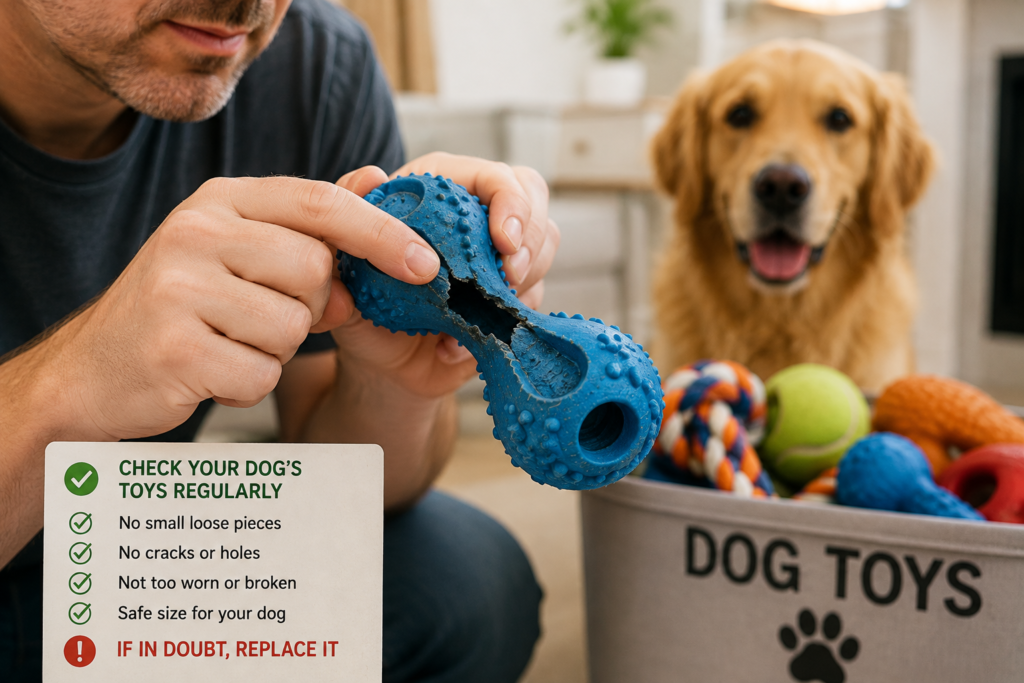
- Inspect the toy regularly.
- Remove it if pieces begin breaking off.
- Supervise your dog when introducing a new toy.
- Never assume a toy is indestructible.
The ASPCA specifically warns that durable chew products can eventually become worn or develop sections that can be broken off and swallowed.
How to Choose the Right Interactive Toy
Consider Your Dog’s Play Style
Ask yourself what your dog naturally enjoys.
Does your dog love food?
Try a treat dispenser or food puzzle.
Does your dog love chasing?
Consider an interactive ball or fetch toy.
Does your dog constantly chew?
Look for a properly sized durable chew toy.
Does your dog enjoy learning?
Try a puzzle or training-oriented enrichment toy.
Does your dog want your attention?
A tug toy may be more rewarding than an automatic toy.
Matching the toy to the dog’s motivation is often more important than buying the most complicated product.
Choose the Correct Size
This is especially important for large dogs.
A toy shouldn’t be so small that your dog can accidentally swallow it. At the same time, excessively large or awkward toys can be difficult for some dogs to manipulate.
The AKC recommends selecting toy and ball sizes appropriate for the individual dog and warns that incorrectly sized objects can create choking risks.
Check the Material
Look for products made specifically for dogs and appropriate for the intended activity.
For chewing toys, examine the material and construction rather than relying solely on marketing claims such as “tough” or “indestructible.”
Also consider whether the toy has:
- Small detachable components
- Squeakers
- Loose stitching
- Fragile plastic parts
- Easily removable pieces
Think About Durability
Durability is important, but it should be evaluated relative to your dog.
A toy that survives six months with a gentle player might last six minutes with a determined power chewer.
Inspect toys regularly, especially if your dog likes to chew.
Consider Cleaning
Food-filled toys can quickly become unpleasant if they aren’t cleaned properly.
Before buying, check whether the toy can be easily washed and whether food can become trapped in difficult-to-reach areas.
VCA recommends cleaning and drying activity toys after use and following the manufacturer’s cleaning directions.
Don’t Ignore the Budget
You don’t need to spend a fortune on enrichment.
A practical approach is to have a small rotation:
- One food puzzle
- One durable chew or treat toy
- One interactive ball
- One tug toy
Rotate them rather than leaving every toy available all the time.
This can make familiar toys feel more interesting without constantly buying new products.
How to Introduce a New Interactive Toy
Don’t immediately give your dog the hardest puzzle available.
Instead:
- Start with an easy version of the activity.
- Show your dog how the toy works.
- Use a reward your dog genuinely enjoys.
- Let your dog succeed quickly.
- Increase difficulty gradually.
- Stop if your dog becomes frustrated.
- Inspect the toy after the session.
VCA recommends starting activity toys at an appropriate difficulty and increasing the challenge as the dog becomes more proficient.
If your dog doesn’t understand the toy, that doesn’t necessarily mean the product is bad. The difficulty may simply be too high.
Common Mistakes to Avoid
Choosing a Toy Only Because It Says “Indestructible”
No toy should be treated as impossible to destroy.
Your dog’s chewing style matters more than the label.
Buying the Wrong Size
A small ball or toy may create a choking or swallowing risk for a large dog.
Always check the manufacturer’s sizing guidance.
Making Puzzles Too Difficult
A challenging toy isn’t useful if your dog can’t figure it out.
Start easy and build up.
Leaving Every Toy Out All Day
Constant access can reduce novelty for some dogs.
Rotating toys can create more variety.
Ignoring Damage
A damaged toy can become a different safety risk from the product you originally purchased.
Inspect toys frequently and replace them when necessary.
Using Toys as a Substitute for Everything Else
Interactive toys are useful enrichment, but dogs still benefit from appropriate exercise, training, social interaction, rest, and opportunities to explore.
VCA notes that play can provide physical exercise, mental stimulation, and social interaction, while also emphasizing that activities should be tailored to the individual dog.
Expert Tips for Getting More From Interactive Toys
Rotate Rather Than Constantly Buy
Keep some toys stored away and bring them back into rotation.
A familiar toy can seem more interesting when it hasn’t been available for several days.
Use Part of Your Dog’s Normal Meal
Food-dispensing toys don’t always need special treats.
Using an appropriate portion of your dog’s regular food can turn mealtime into enrichment while helping you control additional calories.
Match Difficulty to Experience
A beginner may need a simple treat dispenser.
A dog that quickly solves basic puzzles may be ready for a more complex challenge.
Combine Toys With Training
Ask your dog for a simple behavior such as “sit” before starting a play session.
This turns the toy into part of a structured routine rather than simply an object your dog receives.
Supervise New Toys
Especially when your dog is a powerful chewer, watch the first few sessions.
You’ll quickly learn whether your dog licks, paws, carries, chews, throws, or tries to destroy the product.
Are Interactive Toys Good for Dogs With Destructive Behavior?
They can provide an appropriate outlet for chewing, food-seeking, and problem-solving, but they shouldn’t be viewed as a guaranteed solution to destructive behavior.
If a dog repeatedly destroys objects, becomes distressed when left alone, or shows other concerning behavioral changes, identify the underlying cause rather than simply buying more toys.
Enrichment works best alongside appropriate exercise, training, routine, and professional guidance when necessary. VCA recommends providing suitable outlets for natural behaviors while addressing unwanted behavior through appropriate training and management.
Frequently Asked Questions
1. What are the best interactive dog toys for large dogs?
The best toy depends on your dog’s play style. Puzzle toys are excellent for problem-solving and food-motivated dogs, while treat dispensers, durable chew toys, interactive balls, and tug toys may suit different personalities.
2. Are interactive toys good for large dogs?
Yes. Properly selected interactive toys can provide mental stimulation, food-based enrichment, physical activity, and opportunities for problem-solving. They should complement—not replace—exercise and interaction.
3. What are the best puzzle toys for large dogs?
Look for puzzles that are appropriately sized, sturdy, easy to clean, and matched to your dog’s experience level. Start with an easier puzzle and increase difficulty gradually.
4. What toys are best for aggressive chewers?
Choose toys specifically designed for strong chewing and appropriate for your dog’s size. No toy is truly indestructible, so inspect it regularly and remove it when damaged.
5. Can interactive toys help a bored dog?
They can provide useful mental enrichment and give a bored dog an appropriate activity. Food puzzles, scent games, treat dispensers, and training exercises can all add variety to a dog’s routine.
6. How long should a dog use an interactive toy?
There isn’t one ideal duration for every dog. Start with short sessions and watch your dog’s behavior. If your dog becomes frustrated, overly aroused, or loses interest, end the session and try again later.
7. Are automatic dog toys worth buying?
They can be useful for dogs that enjoy movement and chasing, but they’re not necessary for effective enrichment. A simple food puzzle or interactive game with an owner can be equally valuable.
8. How do I know if an interactive toy is safe?
Check that it’s the appropriate size, made for dogs, suitable for your dog’s chewing habits, and free from easily detachable pieces. Supervise your dog when introducing a new product and replace it if it becomes damaged.
9. Can interactive toys replace exercise?
No. Interactive toys provide enrichment, but dogs still need appropriate physical activity and social interaction. The amount and type of exercise should be suitable for the individual dog’s age, health, breed, and abilities.
10. How often should I rotate my dog’s toys?
There is no universal schedule. Try keeping a smaller selection available and rotating other toys periodically. Watch which toys generate genuine interest and adjust the rotation around your dog’s preferences.
Product-Selection Framework: Best Interactive Dog Toys for Large Dogs
Overall Priority Ranking
| Rank | Toy Type | Best Dog Profile | Best Use Case | Durability Priority | Maintenance | Buying Priority |
| 1 | Treat Dispensers | Food-motivated, bored, independent dogs | Mental stimulation, mealtime enrichment, keeping dogs occupied | ⭐⭐⭐⭐⭐ | Easy–Medium | Essential |
| 2 | Puzzle Toys | Curious, intelligent, problem-solving dogs | Mental stimulation and enrichment | ⭐⭐⭐⭐ | Medium | Essential |
| 3 | Durable Chew Toys | Strong chewers, destructive chewers | Chewing, independent play, boredom relief | ⭐⭐⭐⭐⭐ | Easy | Essential for chewers |
| 4 | Interactive Balls | High-energy, fetch-loving dogs | Exercise, fetch, outdoor play | ⭐⭐⭐⭐ | Easy | High |
| 5 | Tug Toys | Social, energetic dogs that love owner interaction | Bonding, training, physical play | ⭐⭐⭐⭐ | Easy | High for interactive play |
| 6 | Electronic Toys | Curious dogs that enjoy movement | Independent entertainment and chasing | ⭐⭐⭐ | Medium–High | Optional |
Why This Ranking Works
Treat dispensers and puzzle toys rank highest overall because they can provide meaningful mental engagement while also making food or treats part of the activity. VCA specifically describes food-based enrichment as a way to encourage foraging and problem-solving, while recommending appropriate difficulty and supervision when introducing toys.
Durable chew toys move to #1 for strong chewers. A Labrador that destroys every food puzzle in minutes needs a different buying strategy from a gentle Golden Retriever that enjoys working through a puzzle.
For large breeds, size also matters. AKC notes that large and giant breeds may require larger, more durable balls and toys, with the toy being large enough that it can’t be swallowed accidentally.
1. Treat Dispensers — Best Overall
Best for
- Food-motivated dogs
- Dogs that eat meals quickly
- Dogs that get bored easily
- Dogs that enjoy independent activities
- Owners looking for toys to keep large dogs busy
Best use cases
Mealtime enrichment + mental stimulation + boredom relief
Treat dispensers should be one of the first products considered for a large dog because they combine a natural reward with a problem-solving task.
A good dispenser might require the dog to roll, push, lick, nudge, or manipulate the toy before food is released.
Durability
★★★★★
For large dogs, prioritize thick, sturdy construction and a size appropriate for the dog’s mouth.
A toy that releases food but can easily be ripped apart isn’t a good choice for a determined chewer.
Maintenance
★★★☆☆
Food residue means these toys generally require more cleaning than a simple ball or tug toy.
Look for:
- Wide openings
- Simple internal surfaces
- Dishwasher-safe construction where applicable
- Minimal areas where food can become trapped
Buying priority
Essential
Especially valuable for food-driven dogs.
2. Puzzle Toys — Best for Mental Stimulation
Best for
- Curious dogs
- Problem solvers
- Food-motivated dogs
- Dogs that become bored indoors
- Owners looking for enrichment toys for large dogs
Best use cases
Mental stimulation + problem solving + enrichment
Puzzle toys require the dog to figure out how to access a reward.
Difficulty can range from a simple hidden-treat compartment to multi-step puzzles involving several actions.
The important point is progressive difficulty.
VCA recommends beginning with a difficulty level that keeps the dog interested without causing frustration and increasing the challenge as the dog becomes more proficient.
Durability
★★★★☆
Durability varies considerably by design.
A fabric puzzle may be excellent for a gentle dog but inappropriate for a dog that immediately starts ripping it apart.
Maintenance
★★★☆☆
More moving pieces and food compartments generally mean more cleaning.
Buying priority
Essential
Particularly for dogs that enjoy figuring things out.
3. Durable Chew Toys — Best for Strong Chewers
Best for
- Aggressive or power chewers
- Dogs that destroy ordinary toys
- Dogs that naturally love chewing
- Dogs that need an appropriate chewing outlet
Best use cases
Chewing + independent entertainment + boredom management
This category deserves special attention because large dogs can vary dramatically in chewing strength.
A toy marketed as “indestructible” should never be interpreted literally.
VCA recommends matching a chew toy to the individual dog’s bite force and replacing it when it becomes damaged. It also cautions against excessively hard objects that can damage teeth.
Durability
★★★★★
This is the single most important selection criterion.
Prioritize:
- Appropriate size
- Strong construction
- Dog-specific materials
- No easily detachable pieces
- Appropriate firmness
Maintenance
★★★★★
Simple rubber chew toys are generally easier to clean than complex puzzles.
Buying priority
Essential for strong chewers
If the dog destroys toys regularly, this may actually be the #1 category for that individual dog.
4. Interactive Balls — Best for High-Energy Dogs
Best for
- Retrievers
- High-energy dogs
- Dogs that love chasing
- Fetch-oriented dogs
- Owners who want physical exercise
Best use cases
Fetch + running + chasing + outdoor play
Interactive balls can provide substantially more physical activity than stationary puzzle toys.
For large dogs, however, don’t simply choose the largest-looking ball. The ball needs to be appropriately sized so it isn’t easily swallowed. AKC specifically recommends considering both durability and appropriate ball size for large and giant breeds.
Durability
★★★★☆
Prioritize durable rubber or other dog-specific materials appropriate for the intended activity.
Maintenance
★★★★★
Generally very easy.
A simple ball can usually be wiped or washed after outdoor play.
Buying priority
High
Especially for dogs that need substantial physical activity.
5. Tug Toys — Best for Owner-Dog Interaction
Best for
- Social dogs
- Dogs that love playing with their owners
- Energetic dogs
- Training-focused owners
Best use cases
Bonding + exercise + training + interactive play
Tug toys have one major advantage over many other categories: the owner becomes part of the enrichment.
They’re therefore excellent for dogs that don’t enjoy playing alone.
Durability
★★★★☆
Choose construction appropriate for the dog’s size and chewing strength.
Rope and fabric can eventually fray, so inspection is important.
AKC recommends using tug toys interactively and putting them away rather than allowing a dog to shred and potentially consume pieces.
Maintenance
★★★★★
Usually straightforward, although rope toys can collect dirt, saliva, and debris.
Buying priority
High
Particularly if the owner has time for daily interactive play.
6. Electronic Toys — Best for Movement-Loving Dogs
Best for
- Curious dogs
- Dogs interested in moving objects
- Dogs that enjoy chasing
- Owners seeking supplemental independent play
Best use cases
Movement + chasing + novelty + independent entertainment
Electronic toys can be fun, but I would rank them below simpler enrichment products.
Why?
They can have:
- Batteries
- Electronics
- Moving parts
- More complicated cleaning
- More opportunities for mechanical failure
And some dogs simply don’t care about them.
Durability
★★★☆☆
The electronic mechanism may survive perfectly while the dog’s teeth destroy the exterior.
Maintenance
★★★☆☆
Usually more involved than a basic ball or chew toy.
Buying priority
Optional
Consider them an additional enrichment tool rather than the foundation of a dog’s toy collection.
Product Recommendation Matrix
| Dog Profile | #1 Choice | #2 Choice | #3 Choice |
| Food-obsessed dog | Treat dispenser | Puzzle toy | Food puzzle |
| Strong chewer | Durable chew toy | Treat dispenser | Durable ball |
| Easily bored dog | Puzzle toy | Treat dispenser | Snuffle/enrichment toy |
| High-energy dog | Interactive ball | Tug toy | Treat dispenser |
| Fetch lover | Interactive ball | Tug toy | Treat dispenser |
| Destructive dog | Durable chew toy | Food-filled rubber toy | Puzzle toy |
| Curious/problem-solving dog | Puzzle toy | Treat dispenser | Electronic toy |
| Social dog | Tug toy | Interactive ball | Puzzle toy |
| Dog left alone for short periods | Treat dispenser | Appropriate puzzle | Durable food-filled toy |
| Dog that ignores normal toys | Food-based puzzle | Treat dispenser | Movement-based toy |
| Beginner at interactive toys | Simple treat dispenser | Easy puzzle | Food-filled toy |
| Experienced puzzle solver | Advanced puzzle | Multi-step feeder | Treat dispenser |
Buying Priority by Use Case
| Primary Goal | Highest Priority | Second Choice | Priority Level |
| Mental stimulation | Puzzle toy | Treat dispenser | ⭐⭐⭐⭐⭐ |
| Keep dog occupied | Treat dispenser | Puzzle toy | ⭐⭐⭐⭐⭐ |
| Strong chewing | Durable chew toy | Food-filled rubber toy | ⭐⭐⭐⭐⭐ |
| Physical exercise | Interactive ball | Tug toy | ⭐⭐⭐⭐⭐ |
| Mealtime enrichment | Treat dispenser | Puzzle feeder | ⭐⭐⭐⭐⭐ |
| Owner bonding | Tug toy | Fetch ball | ⭐⭐⭐⭐ |
| Indoor entertainment | Puzzle toy | Treat dispenser | ⭐⭐⭐⭐ |
| Outdoor play | Interactive ball | Tug toy | ⭐⭐⭐⭐ |
| Novelty/technology | Electronic toy | Motion toy | ⭐⭐⭐ |
| Easy maintenance | Chew toy | Ball | ⭐⭐⭐⭐⭐ |
Durability Framework
Level 1 — Gentle Player
Suitable for dogs that lick, nudge, carry, or gently manipulate toys.
Priority: enrichment design > extreme durability.
Level 2 — Moderate Chewer
Dog occasionally chews but doesn’t routinely destroy toys.
Priority: balanced durability + enrichment.
Level 3 — Strong Chewer
Dog routinely damages ordinary rubber, fabric, or plush toys.
Priority: durability + appropriate size > complexity.
Level 4 — Power Destroyer
Dog attempts to rip apart virtually everything.
Priority: maximum appropriate durability + direct supervision.
At this level, avoid assuming any product is “indestructible.” VCA notes that individual dogs differ substantially in their tendency to destroy toys, and swallowed pieces can create serious problems.
Maintenance Ranking
For buyers who want low-maintenance products:
| Toy Type | Maintenance | Why |
| Durable chew toy | ⭐⭐⭐⭐⭐ Easy | Few parts |
| Ball | ⭐⭐⭐⭐⭐ Easy | Simple surface |
| Tug toy | ⭐⭐⭐⭐ Easy | Wash/inspect periodically |
| Treat dispenser | ⭐⭐⭐ Moderate | Food residue |
| Puzzle toy | ⭐⭐⭐ Moderate | Multiple compartments |
| Electronic toy | ⭐⭐ More involved | Batteries + moving/electronic parts |
For food-based toys, cleaning becomes especially important because leftover food can remain inside the toy. VCA recommends following manufacturer cleaning instructions and ensuring toys are cleaned and dried appropriately.
The “Buy First” Framework
For most large-dog households, I would recommend building a three-category starter collection rather than buying six toys immediately:
🥇 First Purchase: Food-Based Interactive Toy
Choose either:
Treat dispenser OR beginner puzzle toy
Best for mental enrichment and keeping the dog engaged.
🥈 Second Purchase: Durable Chew Toy
Especially important if the dog is a strong chewer.
🥉 Third Purchase: Interactive Ball or Tug Toy
Choose:
- Ball → if the dog loves fetch and chasing
- Tug → if the dog loves interacting with the owner
Then add an electronic toy or advanced puzzle only if the dog’s behavior indicates that it would add something useful.
Important Safety Filter
Before any product reaches the “best” list, I would apply these non-negotiable filters:
Reject the product if:
- It is too small for the dog.
- It has easily detachable pieces.
- The dog can rapidly break off and swallow pieces.
- It becomes damaged during normal use.
- The difficulty causes repeated frustration.
- The material is excessively hard and potentially damaging to teeth.
- The manufacturer doesn’t provide appropriate sizing/use information.
AKC and VCA both emphasize size, durability, supervision, and inspecting toys for damage.
Final Verdict
The best interactive dog toys for large dogs aren’t necessarily the biggest, most expensive, or most complicated products.
The right choice is the one that matches your dog’s size, chewing strength, motivation, intelligence, activity level, and play preferences.
For a food-driven dog, start with a treat dispenser or puzzle. For a powerful chewer, prioritize appropriate size and durability. For an active retriever, an interactive ball can add physical play, while a people-oriented dog may prefer tug.
Most importantly, don’t rely on the word “indestructible.” Inspect every toy, supervise your dog when appropriate, and replace damaged products. Safety should always come before entertainment.
A balanced collection of interactive toys for large dogs can give your companion more opportunities to think, sniff, chew, search, play, and work for rewards throughout the day.
Explore Interactive Dog Toys at Al Falah Trader
Looking for ways to make your dog’s playtime more engaging?
Explore the Al Falah Trader Pet Essentials collection for interactive, enrichment, chew, and other dog products designed to help you find practical options for your pet’s daily routine.
Choose based on your dog’s individual needs rather than simply buying the most popular-looking toy. The best toy is one your dog can use safely—and actually enjoys using.
Read More Pet Care Tips/Articles from Al Falah Trader
If you found this guide helpful, you might also enjoy these Blogs/articles:
Best Puzzle Toys for Dogs: Mental Stimulation Guide
Best Dog Toys: Safe, Fun, and Durable Picks for Every Dog
Best Durable Dog Toys for Aggressive Chewers
Best Interactive Dog Toys for Mental Stimulation
How Much Sleep Do Dogs Need? A Complete Age-by-Age Guide
How to Keep Your Dog Healthy: A Complete Care Guide
Recommended Products
Memory Foam Dog Beds for Maximum Comfort & Support – Shop Now
Best Heated Dog Beds for Winter – Shop Now
Plush Calming Dog Bed – Soft Pet Nest Bed for Dogs & Cats – Shop Now
Princess Dog Bed – Cozy Fantasy Pet Nest Bed for Dogs & Cats – Shop Now
Dog Potty Training in 7 Days – E-books
Durable Cactus Dog Chew Toy – Interactive Toy for Aggressive Chewers & Puppies – Shop Now
Durable Dog Toys For Aggressive Chewers Tough Interactive Dog Toys For Large Dogs Birthday Dog Chew Toy Teething Toys Treat Dispensing Dog Toy – Shop Now
Authoritative External Resources
For readers who want to learn more about canine health and behavior, consider linking to:
- American Veterinary Medical Association (AVMA)
- American Kennel Club (AKC)
- American Animal Hospital Association (AAHA)
Editorial note:
Interactive toys are enrichment tools, not medical treatment. If a dog develops sudden destructive behavior, unusual eating, severe anxiety, or another significant behavior change, a veterinarian can help determine whether an underlying medical or behavioral issue needs attention.