
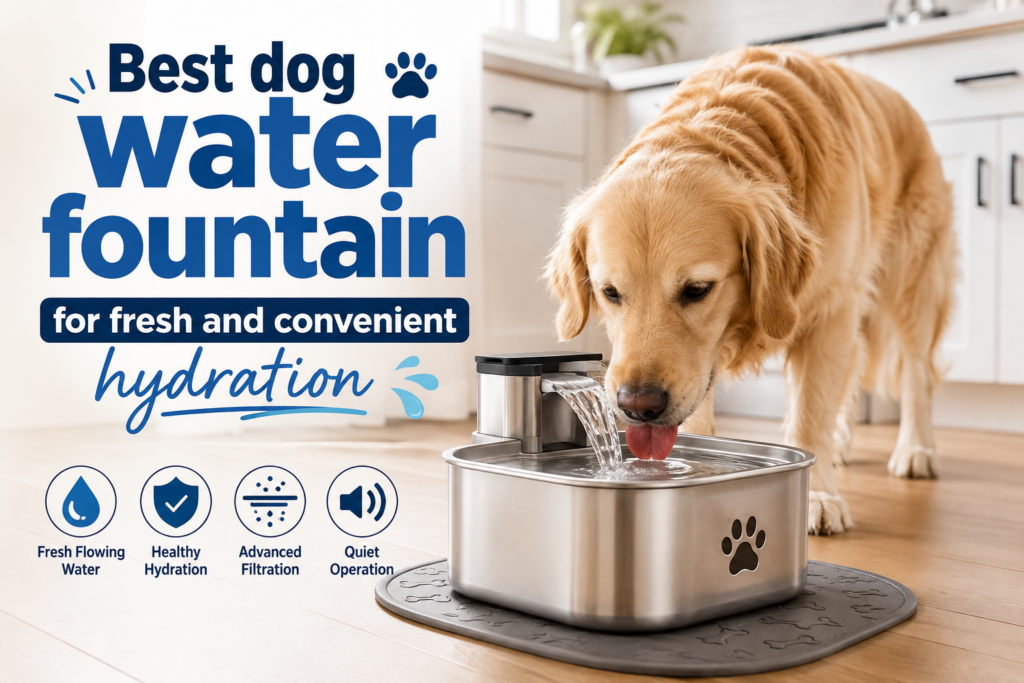
Best Dog Water Fountain: Complete Buying Guide for 2026
A clean, reliable water supply is one of the simplest but most important parts of caring for a dog. Yet some dogs ignore a traditional bowl, prefer moving water, or make a mess by tipping their bowl over. That is where choosing the best dog water fountain can make everyday hydration more convenient.
A good fountain continuously circulates water, and many models use filters to catch hair, food particles, and other debris. Some dogs may also find moving water more appealing. However, a fountain is not automatically better than a bowl for every dog, and the best choice depends on your dog’s size, drinking habits, household, and how much cleaning you are willing to do.
In this guide, we’ll explain what to look for in a best water fountain for dogs, compare the major types, discuss the advantages and drawbacks, and show you how to choose a practical option for your home.
Important: A dog water fountain can support convenient access to fresh water, but it is not a treatment for dehydration or an underlying health condition. If your dog’s drinking habits suddenly change, speak with your veterinarian.
Why a Dog Water Fountain Matters
Water is an essential nutrient, and dogs should have access to clean, fresh drinking water at all times. The amount they need varies with factors such as body size, diet, activity, environment, and health.
For example, a dog eating mostly dry food may obtain less water from its diet than a dog eating moisture-rich canned food. Likewise, an active dog spending time outdoors in hot weather may have different hydration needs from a sedentary indoor dog.
A dog water fountain doesn’t replace the need for fresh water. Instead, it can make providing that water easier and, for some dogs, more attractive.
Moving Water Can Be Appealing
Some dogs naturally show interest in running water. If your dog likes drinking from a hose, faucet, or outdoor water feature, a fountain may encourage them to use a dedicated drinking station instead.
That doesn’t mean every dog prefers a fountain. Some dogs may be nervous around the pump noise or simply prefer their familiar bowl.
What Is a Dog Water Fountain?
A dog water fountain is a pet drinking system that uses a pump to circulate water through a reservoir. Depending on the design, water may flow through a spout, stream, waterfall-style opening, or bubbling drinking area.
Many models include one or more filters. These can help capture larger particles such as hair and food debris, although a pet fountain filter should not be treated as a substitute for safe household drinking water or a professional water-purification system.
A typical fountain contains:
- Water reservoir
- Pump
- Drinking area or spout
- Filter
- Filter housing
- Power source
- Water-level indicator on some models
The exact design varies considerably, so looking beyond appearance is important when choosing the best pet water fountain.
Benefits of Using a Dog Water Fountain
A fountain can be useful, but its value depends on your dog and your routine.
1. Encourages Some Dogs to Drink
Dogs that enjoy moving water may be more interested in a fountain than a stationary bowl.
This can be particularly useful if your dog regularly walks past a full bowl but immediately investigates running water elsewhere.
However, don’t assume that refusing a fountain means your dog isn’t getting enough water. Your dog’s overall drinking behavior matters more than whether they use a particular product.
2. Keeps Water Moving
A circulating fountain keeps the water moving instead of leaving it completely still.
The movement can make the water more noticeable and may help reduce the accumulation of floating debris between cleanings. Some fountain systems also use filters to capture hair and larger particles.
3. Convenient for Busy Households
An automatic dog water fountain can be useful for owners who don’t want to refill a small bowl repeatedly throughout the day.
A larger reservoir may reduce the frequency of refilling, although you still need to monitor the water level and clean the fountain regularly.
4. Useful for Multiple Dogs
A large-capacity fountain can be convenient in a household with multiple dogs.
However, don’t rely on one fountain as the only water source. Veterinary guidance recommends providing fresh water sources for individual pets in multi-pet households because animals can compete for access.
5. Can Help Reduce Some Bowl Mess
Some dogs splash, push, or tip lightweight bowls.
A stable dog water bowl fountain with a wide base can be harder to knock over. Still, no fountain is completely mess-proof, especially with enthusiastic drinkers.
Drawbacks of Dog Water Fountains
Before buying one, consider the maintenance involved.
Regular Cleaning Is Essential
A fountain isn’t a self-cleaning water system.
Hair, saliva, food particles, mineral deposits, and other debris can accumulate around the reservoir and pump. Regular cleaning helps maintain hygiene and keeps the water appealing.
The American Kennel Club recommends replacing water and cleaning a bowl or fountain regularly, while veterinary guidance also emphasizes routine cleaning of pet water containers.
Filters Need Replacement
If your fountain uses a filter, you’ll need to replace it according to the manufacturer’s instructions.
That creates an ongoing cost that you wouldn’t have with a simple bowl.
Before buying, check:
- Filter replacement price
- Filter availability
- Recommended replacement interval
- Whether generic replacements are available
- How easy the filter is to install
Pumps Can Make Noise
Some pumps produce a quiet hum, while others can become louder as water levels fall or the pump becomes dirty.
A nervous dog may dislike the sound.
If your dog is noise-sensitive, a quiet dog water fountain with a low-noise pump may be a better choice.
Power Outages Can Be a Problem
Most automatic fountains depend on electricity or batteries.
If the pump stops working, your dog still needs access to water. For that reason, keeping a clean traditional bowl available as a backup is a smart idea.
Best Dog Water Fountain: What Should You Look For?
There isn’t one fountain that is perfect for every household. Instead, look for the combination of features that matches your dog’s needs.
1. Material
The three most common materials are plastic, stainless steel, and ceramic.
Stainless Steel
A stainless steel dog water fountain is a strong choice for many households because stainless steel is durable and relatively easy to clean.
It is particularly appealing if you want a long-lasting fountain that doesn’t feel flimsy.
Ceramic
A ceramic dog water fountain can look attractive in a kitchen or living space and is generally heavier than plastic.
The downside is that ceramic can chip or break if dropped.
Plastic
A plastic dog water fountain is often lightweight and less expensive.
However, plastic may develop scratches over time, and some dogs may experience skin issues associated with certain plastic bowls. The AKC recommends considering stainless steel or other alternatives when choosing a pet fountain.
2. Capacity
Capacity is one of the easiest features to overlook.
A small fountain may work well for a small dog living in a one-pet household. A large dog or multi-dog household generally benefits from a larger reservoir.
Consider:
- Your dog’s size
- Number of dogs
- How frequently you’re home
- Whether the fountain is your primary water station
- How quickly your dog drinks
A large capacity dog water fountain can reduce refilling, but don’t choose an oversized model if it makes cleaning difficult.
3. Filtration
A dog water fountain with filter can help capture hair and larger debris.
Some systems use activated carbon filters, while others combine different filtration materials. Don’t assume that a filter makes questionable water safe to drink. If your household water isn’t considered safe for human consumption, choose an appropriate safe water source rather than relying on a pet fountain filter.
Also remember that filters themselves require maintenance.
4. Ease of Cleaning
This may be more important than having a smartphone app or decorative design.
Look for:
- Removable reservoir
- Accessible pump
- Few complicated parts
- Dishwasher-safe components where permitted by the manufacturer
- Easy-to-replace filters
- Smooth surfaces that are easy to scrub
An easy clean dog water fountain is more likely to be maintained properly over time.
5. Noise Level
If your dog is cautious around appliances, choose a low-noise design.
Keep in mind that even a quiet pump can become louder when the water level gets low or when debris builds up around the pump.
Check the water level regularly and clean the pump according to the manufacturer’s instructions.
6. Power Source
Most fountains fall into three categories:
| Power Type | Advantages | Drawbacks | Best For |
| Plug-in | Consistent operation | Needs nearby outlet | Indoor everyday use |
| Battery-operated | Portable | Batteries require replacement | Flexible placement |
| Rechargeable/cordless | No constant cable | Requires charging | Homes needing flexible placement |
A battery operated dog water fountain or rechargeable model can be useful where a wall outlet isn’t convenient.
For outdoor use, pay particularly close attention to the manufacturer’s safety and weather-resistance instructions. Don’t assume an indoor fountain is suitable for outdoor exposure.
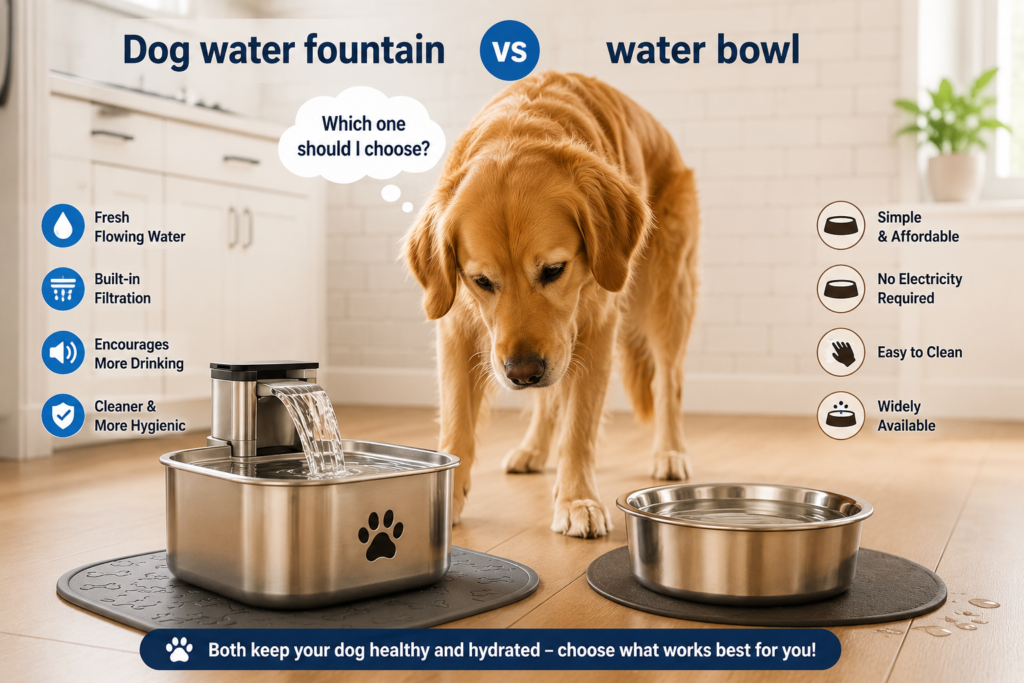
Dog Water Fountain vs. Traditional Water Bowl
Both options can work.
The better choice depends on your dog’s preferences and your willingness to maintain the equipment.
| Feature | Traditional Water Bowl | Dog Water Fountain | Best Choice |
| Initial cost | Usually lower | Usually higher | Bowl |
| Moving water | No | Yes | Fountain |
| Filtration | Usually no | Often available | Fountain |
| Cleaning simplicity | Very easy | More components | Bowl |
| Electricity required | No | Often yes | Bowl |
| Large capacity | Available | Available | Tie |
| Good for dogs that like running water | Limited | Excellent | Fountain |
| Backup during power outage | Excellent | Depends on model | Bowl |
| Maintenance | Simple | Pump + reservoir + filter | Bowl |
| Convenience for some busy owners | Moderate | High | Fountain |
The important point is that a fountain isn’t automatically an upgrade.
If your dog happily drinks from a clean bowl, there may be little reason to switch. The AKC similarly notes that fountains are optional rather than essential and recommends keeping a traditional bowl available as a backup.
Who Should Buy a Dog Water Fountain?
A fountain may be worth considering if:
- Your dog likes running water.
- Your dog ignores a stationary bowl.
- Your dog frequently tips over lightweight bowls.
- You have multiple dogs.
- You want circulating water.
- You prefer a larger-capacity drinking station.
- You want a filtered fountain.
- You want to reduce how frequently you refill a small bowl.
On the other hand, a basic bowl may be better if:
- Your dog already drinks well from a bowl.
- You don’t want filter replacement costs.
- You don’t have a convenient power source.
- Your dog is frightened by pump noise.
- You want the simplest possible cleaning routine.
Best Dog Water Fountain for Different Dogs
Best for Large Dogs
Look for a best dog water fountain for large dogs with:
- Large drinking surface
- High reservoir capacity
- Stable base
- Strong pump
- Easy cleaning
- Replacement filters that are readily available
Large dogs can consume more water than small dogs, so a tiny fountain may require constant refilling.
Best for Small Dogs
For a best dog water fountain for small dogs, prioritize accessibility over enormous capacity.
The drinking area shouldn’t be too high or awkward to reach. A compact fountain can also make more sense in an apartment or smaller kitchen.
Best for Multiple Dogs
Choose a larger reservoir and consider having more than one water station.
VCA recommends providing fresh water sources for individual pets in multi-pet households because animals can compete for resources.
Best for Puppies
Puppies can be curious about fountains, but they may also play with them.
Choose a stable design that won’t tip easily and avoid placing electrical components where your puppy can chew the cord.
Best for Senior Dogs
For senior dogs, accessibility matters.
Choose a fountain that doesn’t require awkward positioning and place it somewhere your dog spends time. Senior dogs should continue to have regular access to fresh, clean water.
How to Introduce a Dog to a Water Fountain
Don’t immediately remove your dog’s familiar bowl and expect them to understand the new fountain.
Instead:
- Place the fountain beside the existing bowl.
- Keep the fountain running at a comfortable flow.
- Let your dog investigate it without pressure.
- Reward calm curiosity.
- Continue providing the traditional bowl.
- Observe which water source your dog prefers.
- Gradually make the fountain part of the normal routine.
Some dogs adapt within minutes. Others need several days.
If your dog becomes frightened by the pump, turn it off temporarily and introduce the sound more gradually.
How to Keep a Dog Water Fountain Clean
A fountain only provides value when it is maintained properly.
Daily
- Check the water level.
- Remove visible hair or food particles.
- Top up with fresh water as appropriate.
- Look for unusual pump noise.
Regularly
- Empty and wash the reservoir.
- Clean the drinking surface.
- Clean the pump according to the manufacturer’s instructions.
- Inspect the filter.
- Replace filters when required.
Don’t Ignore the Pump
The pump is one of the easiest components to overlook.
Hair and debris can collect around it, reducing water flow or making the motor noisier. Follow the manufacturer’s cleaning instructions rather than simply rinsing the visible reservoir.
How Often Should You Change a Dog Fountain Filter?
There isn’t one universal replacement schedule.
Filter life depends on:
- Fountain design
- Filter material
- Water quality
- Number of pets
- Amount of hair and debris
- How frequently the fountain is cleaned
Follow the manufacturer’s replacement instructions and inspect the filter regularly.
If it looks heavily soiled, smells unusual, or isn’t allowing normal water flow, don’t wait simply because the calendar says it has more time remaining.
Common Mistakes to Avoid
1. Buying the Cheapest Fountain
A low upfront price isn’t necessarily a bargain if replacement filters are expensive or the pump is difficult to clean.
Consider the total cost of ownership, not just the purchase price.
2. Choosing Capacity Without Considering Cleaning
A huge reservoir sounds convenient, but if the fountain is difficult to disassemble, you may eventually stop cleaning it thoroughly.
3. Ignoring Pump Noise
A fountain can look excellent online but still produce a sound your dog dislikes.
4. Assuming the Filter Makes Unsafe Water Safe
Pet fountain filters can improve water by catching certain particles, but they aren’t a replacement for safe drinking water.
5. Removing the Traditional Bowl Immediately
Keep a clean bowl available, particularly during the transition and during power outages or pump failures.
6. Ignoring Sudden Changes in Drinking
A fountain is a convenience product, not a diagnostic tool.
If your dog suddenly starts drinking dramatically more or less than usual, consult a veterinarian rather than assuming the fountain will solve the problem.
Expert Tips for Better Dog Hydration
Keep Water Available in Multiple Locations
Multiple water stations can be useful, especially in larger homes or homes with multiple pets. Merck Veterinary Manual notes that multiple water sources can encourage consumption.
Match the Fountain to Your Dog
Don’t buy a fountain because it looks impressive.
A simple, quiet, easy-to-clean fountain may be a better purchase than a feature-heavy model that your dog refuses to use.
Watch Water Intake, Not Just the Fountain
The goal isn’t to get your dog to interact with an expensive gadget. The goal is convenient access to clean water.
Consider Your Local Climate
Dogs living in hot environments or exercising heavily can have increased water needs. Always provide fresh water and avoid relying on a fountain as the only hydration source during outdoor activities.
Are Dog Water Fountains Worth It?
For some households, absolutely.
A fountain can be particularly useful for dogs that enjoy running water, owners who prefer circulating water, multi-dog homes, or pets that frequently knock over ordinary bowls.
But a fountain isn’t necessary for every dog. If your dog drinks comfortably from a clean traditional bowl, switching isn’t mandatory.
The best dog water fountain is therefore not necessarily the most expensive or technologically advanced model. It’s the one your dog will actually use and that you can realistically keep clean.
Frequently Asked Questions
1. Are dog water fountains safe?
Generally, a properly designed and maintained fountain can be a suitable source of drinking water. Choose a stable product, keep electrical components protected, clean it regularly, and follow the manufacturer’s instructions.
2. Do dogs prefer water fountains?
Some dogs do, particularly dogs that already show interest in running water. However, preferences vary. A fountain should be introduced gradually rather than forced.
3. Is a stainless steel dog water fountain better than plastic?
Stainless steel is an attractive option because it is durable and easy to clean. Plastic can be lighter and less expensive, but scratches and material quality are considerations.
4. Does a dog water fountain keep water fresh?
Circulation can make water more appealing and filters can capture some debris, but the fountain still needs regular water replacement and cleaning. A fountain should never be treated as maintenance-free.
5. How often should I clean a dog water fountain?
Cleaning frequency depends on the product and household conditions. However, don’t wait for visible buildup. Regular cleaning of the water container and pump is important for hygiene.
6. What is the best dog water fountain for large dogs?
Look for a stable, large-capacity model with an accessible drinking area, reliable pump, and easy-to-clean construction. Capacity should match the number of dogs and their drinking habits.
7. Can a dog water fountain replace a water bowl?
It can serve as a primary water station for some households, but keeping a clean traditional bowl available is sensible as a backup, especially during power outages or pump problems.
8. How often should I change a dog fountain filter?
Follow the manufacturer’s recommended schedule and inspect the filter regularly. Water quality, pet hair, debris, and the number of animals using the fountain can affect filter life.
9. What if my dog won’t drink from the fountain?
Don’t force the change. Keep the regular bowl available, place it next to the fountain, and allow your dog to investigate the new device gradually.
10. Can a fountain help a dog that suddenly drinks much more water?
A fountain may make water more accessible, but sudden changes in drinking behavior can have medical causes. If your dog’s drinking pattern changes noticeably, consult your veterinarian.
Final Verdict: What Is the Best Dog Water Fountain?
The best dog water fountain is one that combines safe construction, appropriate capacity, quiet operation, effective filtration, easy cleaning, and reliable availability of replacement parts.
For many households, stainless steel is a strong material choice. A larger-capacity model makes sense for large or multiple dogs, while smaller households may benefit from a compact design. If your dog is sensitive to noise, prioritize a quiet pump over unnecessary smart features.
Most importantly, don’t confuse convenience with necessity. Fresh, clean water is the priority; the fountain is simply a tool that can make providing it easier. Veterinary references consistently emphasize unrestricted access to fresh water for healthy dogs.
Explore the dog-care products available at Al Falah Trader
If you’re looking for practical pet essentials, explore the dog-care products available at Al Falah Trader and compare features such as capacity, materials, filtration, cleaning requirements, and suitability for your dog’s size before choosing.
Read More Pet Care Tips/Articles from Al Falah Trader
If you found this guide helpful, you might also enjoy these Blogs/articles:
Best Puzzle Toys for Dogs: Mental Stimulation Guide
Best Dog Toys: Safe, Fun, and Durable Picks for Every Dog
Best Durable Dog Toys for Aggressive Chewers
Best Interactive Dog Toys for Mental Stimulation
How Much Sleep Do Dogs Need? A Complete Age-by-Age Guide
How to Keep Your Dog Healthy: A Complete Care Guide
Best Interactive Dog Toys for Large Dogs
Recommended Products
Memory Foam Dog Beds for Maximum Comfort & Support – Shop Now
Best Heated Dog Beds for Winter – Shop Now
Plush Calming Dog Bed – Soft Pet Nest Bed for Dogs & Cats – Shop Now
Princess Dog Bed – Cozy Fantasy Pet Nest Bed for Dogs & Cats – Shop Now
Dog Potty Training in 7 Days – E-books
Durable Cactus Dog Chew Toy – Interactive Toy for Aggressive Chewers & Puppies – Shop Now
Durable Dog Toys For Aggressive Chewers Tough Interactive Dog Toys For Large Dogs Birthday Dog Chew Toy Teething Toys Treat Dispensing Dog Toy – Shop Now
Stainless Steel Cat Water Fountain 7L – Automatic Pet Water Dispenser with Ultra-Quiet Pump – Shop Now
Authoritative External Resources
For readers who want to learn more about canine health and behavior, consider linking to: