
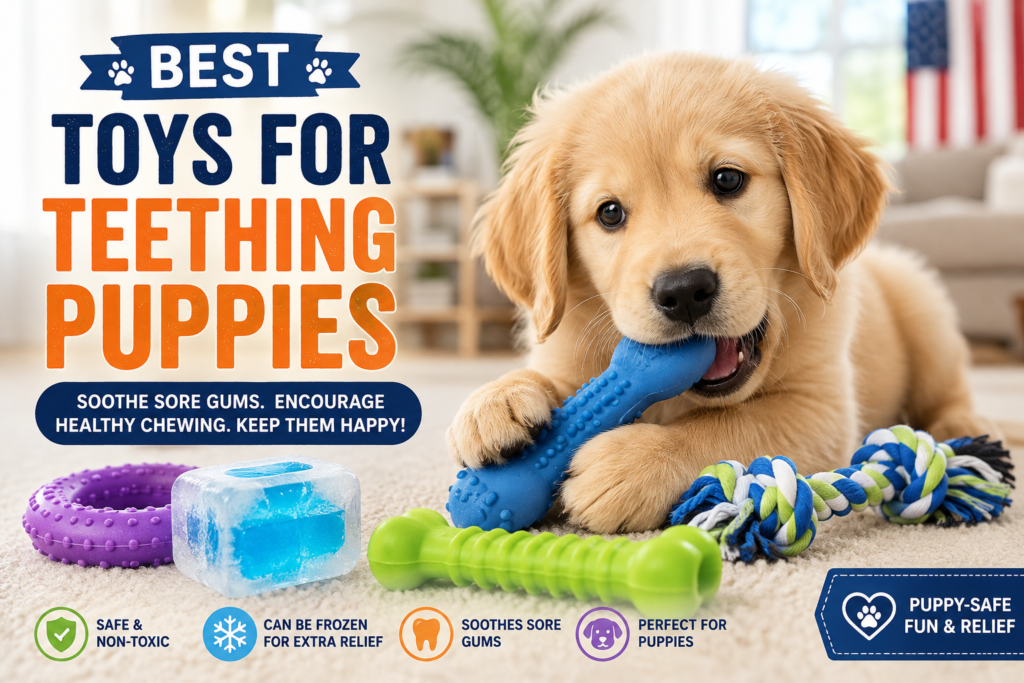
Introduction
When a puppy starts teething, almost everything can suddenly look like a chew toy. Shoes, furniture, blankets, electrical cords, and even your hands may become targets. The good news is that puppy chewing is a normal part of development, and the right toys can give your puppy a safer outlet.
The challenge is choosing toys that are appropriate for a developing mouth. A toy that works well for an adult power chewer may be far too hard for a young puppy, while a soft plush toy may be destroyed within minutes.
So, what are the best toys for teething puppies? For most puppies, a combination of appropriately sized soft-to-moderate rubber toys, freezable toys, supervised rope toys, and interactive or stuffable toys can provide variety while helping redirect chewing behavior.
This guide explains what to look for, what to avoid, and how to choose a teething toy based on your puppy’s age, size, chewing style, and individual needs.
Why Puppy Teething Toys Matter
Puppies have baby teeth that eventually make way for adult teeth. During this transition, their gums can become uncomfortable, which is one reason puppies may chew more frequently.
Chewing also gives puppies an appropriate way to investigate their surroundings and stay occupied. Providing designated chew toys can make it easier to teach the important lesson that toys are acceptable to chew, while shoes and furniture are not.
The American Kennel Club recommends giving teething puppies appropriate chew toys and notes that frozen options can help provide relief for tender gums.
The goal isn’t simply to find the hardest toy possible. The best puppy teething toys balance safety, texture, size, durability, and your puppy’s chewing strength.
When Do Puppies Need Teething Toys?
Puppy teething begins early, but the period when chewing becomes especially noticeable often occurs as baby teeth are replaced by permanent teeth.
You may notice increased chewing around:
- 8 weeks: Your puppy may already be chewing as part of normal puppy behavior.
- 10–12 weeks: Chewing and mouthing can become more noticeable.
- 3–4 months: Baby teeth begin falling out as adult teeth develop.
- 4–5 months: Many puppies experience particularly active chewing.
- Around 6 months: Most puppies have lost their baby teeth and are developing their adult set.
The exact schedule varies between individual puppies and breeds. Your veterinarian can check whether your puppy’s teeth are developing normally.
The American Animal Hospital Association recommends discussing acceptable chew toys for dental health and safety during puppy care.
The Best Toys for Teething Puppies
There isn’t one perfect toy for every puppy. Instead, consider keeping several types available and rotating them throughout the day.
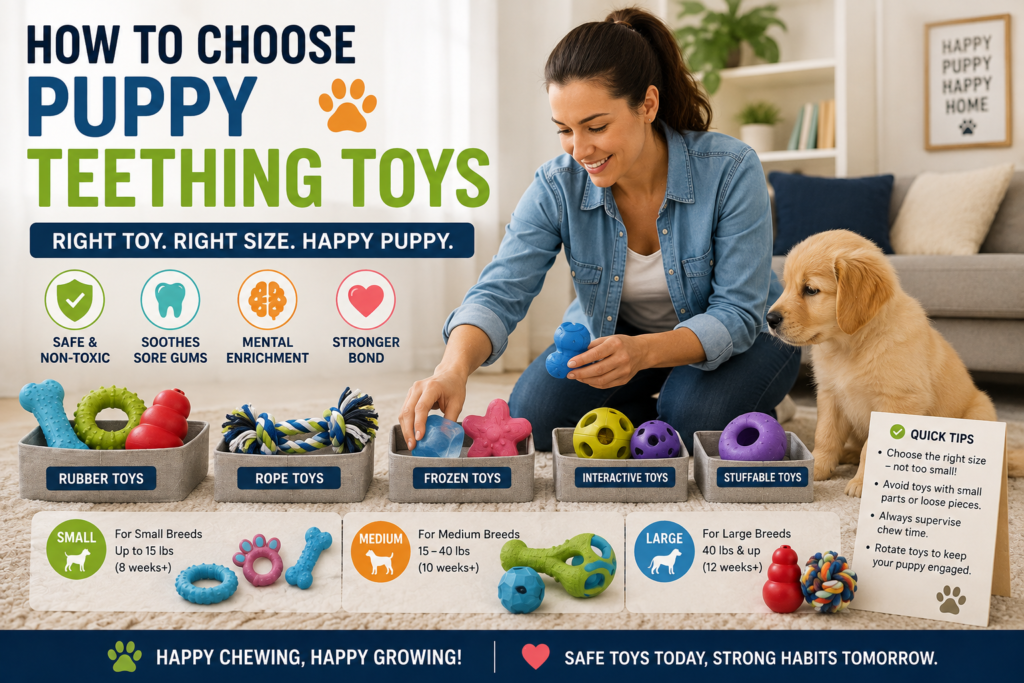
1. Rubber Teething Toys
For many puppies, appropriately designed rubber toys are an excellent starting point.
Soft or puppy-specific rubber can provide resistance without being as unforgiving as extremely hard materials. Many rubber toys also have textured surfaces that make chewing more interesting.
Look for:
- Puppy-specific rubber
- Flexible or slightly yielding construction
- Appropriate size for your puppy
- No easily detachable pieces
- A shape that is easy for small mouths to grip
- A design that can be cleaned easily
Best for: Everyday chewing, redirecting inappropriate chewing, and puppies that enjoy gnawing.
Rubber toys can also be useful when your puppy needs something to do while you are supervising play.
2. Frozen Teething Toys
Cold toys can be particularly appealing when a puppy has sore gums.
Some puppy toys can be filled with water, softened food, or another puppy-appropriate filling and then frozen. The cold surface can provide temporary soothing relief while giving the puppy something appropriate to chew.
You can also purchase freezable puppy teething toys specifically designed for this purpose.
A simple approach is:
- Choose a puppy-safe, freezable toy.
- Fill it according to the manufacturer’s instructions.
- Freeze it.
- Give it to your puppy while supervising.
- Remove it once it becomes damaged or unsafe.
The AKC specifically discusses frozen food-stuffable toys as an option for soothing teething discomfort.
3. Soft Rubber Chew Toys
Some puppies don’t want a firm chew immediately. They may prefer a toy that gives slightly when they bite it.
Soft chew toys for teething puppies can be useful for young puppies with sensitive gums, provided the toy is designed for puppy chewing and cannot be easily torn apart.
The key is not simply “soft equals safe.” A toy that is too soft for your puppy’s chewing strength may quickly become a choking or swallowing hazard if pieces break away.
4. Rope Toys
Rope toys can provide a different texture and are especially useful for supervised interactive play.
A puppy may enjoy chewing the fibers and playing gentle tug games with you. However, rope toys should be inspected frequently.
Replace a rope toy if:
- Long strands start coming loose.
- Your puppy is swallowing fibers.
- Knots become damaged.
- Large sections become unraveled.
For that reason, rope toys for teething puppies are best treated as supervised play toys rather than something every puppy should have available unattended.
5. Stuffable Toys
Stuffable toys combine chewing with food-based enrichment.
You can put appropriate treats or softened puppy food inside some rubber toys. Freezing the filled toy can make it last longer and provide additional cooling relief.
These can be especially useful when your puppy is restless because they encourage chewing while also making the puppy work for the food.
Examples include:
- Softened kibble
- Puppy-safe wet food
- Appropriate treats
- A small amount of dog-safe food recommended by your veterinarian
Always consider the extra calories when adding treats or food to toys.
6. Interactive and Enrichment Toys
Teething isn’t only about the mouth. Puppies also need mental stimulation.
Interactive chew toys and treat-dispensing toys can combine chewing, problem-solving, and food motivation.
These can be helpful for puppies that start chewing furniture because they’re bored rather than simply because their gums hurt.
AAHA also recommends appropriate puzzle toys as a way to provide mental stimulation and redirect chewing behavior.
Comparison: Which Teething Toy Is Best?
| Toy Type | Main Benefit | Durability | Teething Comfort | Best For |
| Soft rubber | Gentle chewing | High | High | Young puppies |
| Rubber toy | Everyday chewing | High | High | Most puppies |
| Frozen toy | Cooling relief | Medium–High | Very High | Sore gums |
| Rope toy | Texture + interaction | Medium | Medium | Supervised play |
| Stuffable toy | Chewing + enrichment | High | High | Food-motivated puppies |
| Interactive toy | Mental stimulation | Varies | Medium | Bored puppies |
| Very hard nylon | Long-lasting | Very High | Low | Generally not ideal for young teething puppies |
Important: Durability does not automatically mean safety. Veterinary guidance from VCA notes that very hard objects, including hard nylon, bones, and antlers, can damage or fracture teeth.
Rubber vs. Nylon Chew Toys for Puppies
When comparing rubber vs nylon chew toys for puppies, don’t assume the harder option is better.
Nylon can be extremely durable, but some veterinary dental professionals advise against very hard chew objects because they can damage teeth. VCA specifically warns that hard objects can fracture both baby and adult teeth.
For a teething puppy, a properly sized puppy-specific rubber toy may be a more appropriate starting point.
As your dog matures, the appropriate toy can change based on chewing strength and dental development.
Rope vs. Rubber Toys for Puppies
Rope toys are excellent for interactive games, texture variety, and supervised tug.
Rubber toys are often more practical for independent chewing because they don’t contain loose fibers that can be swallowed as the toy deteriorates.
A useful combination is to use rubber toys for regular chewing and rope toys for supervised interaction.
Soft vs. Hard Chew Toys for Puppies
Harder isn’t necessarily better.
A puppy’s teeth are still developing, so extremely hard chew toys can create unnecessary dental risk. AAHA recommends avoiding extremely hard chews and suggests that appropriate chew toys should have some flexibility.
When shopping, consider whether the toy gives slightly under pressure rather than simply selecting the toughest product available.
What Makes a Safe Teething Toy?
A safe teething toy for puppies should match the puppy rather than simply carry a generic “durable” label.
Look for:
Appropriate Size
The toy should be large enough that your puppy cannot easily swallow it.
At the same time, it needs to be manageable enough for the puppy to hold and chew.
Appropriate Hardness
Avoid extremely hard materials that don’t yield at all.
One practical screening method suggested by AAHA is to check whether you can make a slight indentation with your thumbnail.
Strong Construction
A puppy shouldn’t be able to immediately rip the toy apart.
Check seams, handles, squeakers, stuffing, rope fibers, and rubber surfaces regularly.
Easy Cleaning
A toy that collects food, saliva, and debris can become unpleasant quickly.
Wash toys according to the manufacturer’s instructions and allow them to dry properly.
Puppy-Specific Design
A toy designed specifically for puppies may be more appropriate than an adult-dog toy, particularly during the early stages of teething.
What Toys Should Puppies Not Chew?
Some of the biggest mistakes happen when owners assume that something extremely durable must be safe.
Avoid giving puppies unrestricted access to:
- Extremely hard bones
- Antlers
- Very hard nylon chews
- Toys small enough to swallow
- Toys with easily detachable parts
- Severely damaged rope toys
- Broken squeakers
- Toys with exposed stuffing
- Sticks
- Household objects
- Electrical cords
VCA notes that different chew objects can create risks including choking, gastrointestinal obstruction, intestinal injury, or dental damage. It also emphasizes that no chew toy is completely risk-free.
If you are unsure whether a particular chew is appropriate for your puppy, ask your veterinarian.
Benefits of Good Puppy Teething Toys
The right puppy chew toys can provide several practical benefits.
1. They Redirect Destructive Chewing
Instead of chewing your furniture, your puppy has an appropriate alternative.
2. They Can Help Soothe Sore Gums
Cooling and appropriately textured toys can make the teething period more comfortable.
3. They Provide Mental Stimulation
Stuffable and interactive toys encourage puppies to think while they play.
4. They Support Training
You can teach your puppy that toys are acceptable things to chew while household items are not.
5. They Give Puppies Appropriate Outlets
Chewing is a natural behavior. Providing an appropriate outlet is generally more useful than trying to eliminate chewing altogether.
Drawbacks and Things to Consider
Even the best teething toys have limitations.
Toys Don’t Replace Dental Care
Chew toys should not be treated as a substitute for proper veterinary dental care.
AAHA recommends discussing dental health and safe chew toys with your veterinary team as part of puppy care.
Some Puppies Destroy Toys Quickly
A “durable” toy may last weeks for one puppy and minutes for another.
Chewing style matters more than the marketing label.
Some Toys Can Be Messy
Frozen and food-stuffed toys can leave moisture or food residue around the house.
Supervision Is Still Important
A puppy should be monitored when chewing, especially when using a new toy.
The AKC recommends checking toys for damage and removing them when pieces can be pulled or chewed off.
Buying Guide: How to Choose the Best Puppy Teething Toys
Before you buy puppy teething toys, consider these factors.
1. Your Puppy’s Age
An 8-week-old puppy may need a different texture and size from a 5-month-old puppy with a stronger bite.
Don’t automatically buy an adult-dog power chew for a young puppy.
2. Breed and Size
A toy appropriate for a Chihuahua puppy may be too small for a Labrador puppy.
Conversely, a huge toy may be difficult for a tiny puppy to use properly.
3. Chewing Style
Ask yourself:
- Does my puppy gently nibble?
- Does the puppy chew continuously?
- Does the puppy immediately destroy soft toys?
- Does the puppy prefer rubber, rope, or food-filled toys?
Choose accordingly.
4. Material
Rubber is often a versatile choice for teething puppies.
Rope can provide useful texture and interactive play, while frozen toys can offer cooling relief.
5. Durability
Look beyond the word “indestructible.”
No toy is truly indestructible, and a toy that survives aggressive chewing may still be too hard for a puppy’s developing teeth.
6. Maintenance
Choose toys that are easy to clean.
If a toy is difficult to wash, inspect, or dry, it may become less practical over time.
7. Budget
You don’t necessarily need an expensive collection.
A practical starter selection could include:
- One puppy-specific rubber chew
- One freezable or stuffable toy
- One supervised rope toy
- One interactive enrichment toy
You can then see which textures your puppy actually prefers before purchasing additional toys.
8. Warranty
Some manufacturers offer product warranties or replacement guarantees, while others don’t.
If warranty coverage matters to you, read the manufacturer’s terms before buying. Don’t assume that “durable” automatically means the product is covered against chewing damage.
Expert Tips for Teething Puppies
Rotate Toys Instead of Leaving Everything Out
Put two or three toys out at a time and rotate them.
A toy that has been unavailable for several days may suddenly become exciting again.
Freeze Appropriate Toys
If the manufacturer allows freezing, try filling a suitable rubber toy and chilling it.
This can turn an ordinary chew into a more interesting teething activity.
Redirect, Don’t Punish
If your puppy grabs a shoe, calmly exchange it for an appropriate toy.
Once the puppy takes the toy, praise the correct choice.
Keep Toys Close During High-Chewing Times
If your puppy tends to chew after waking, eating, or playing, keep a suitable toy nearby.
Fast redirection is easier than chasing a puppy around the house after they grab something inappropriate.
Teach “Leave It” and “Drop It”
These commands are valuable safety skills.
The AKC recommends teaching puppies cues such as “leave it” and “drop it” while providing appropriate chewing alternatives.
Inspect Toys Regularly
Look for:
- Cracks
- Deep punctures
- Missing pieces
- Loose threads
- Torn seams
- Exposed stuffing
- Broken squeakers
When in doubt, replace the toy.
Common Puppy Teething Toy Mistakes
Mistake 1: Choosing the Hardest Toy
Extreme durability can come with excessive hardness.
Better approach: Match the toy’s firmness to your puppy’s developmental stage and chewing style.
Mistake 2: Buying the Wrong Size
A tiny toy can become a choking hazard for a larger puppy.
Better approach: Follow the manufacturer’s size guidance and consider your puppy’s mouth and chewing behavior.
Mistake 3: Assuming “Non-Toxic” Means Completely Safe
Material safety is only one part of the equation.
A toy can be made from an appropriate material but still become dangerous if pieces break off.
Mistake 4: Leaving Damaged Toys Available
Once a toy starts falling apart, its original safety characteristics no longer apply.
Better approach: Remove damaged toys immediately.
Mistake 5: Giving Too Many Toys at Once
A large pile isn’t necessarily better.
Better approach: Rotate a small selection and observe what your puppy actually enjoys.
Mistake 6: Ignoring Your Puppy’s Chewing Style
A gentle chewer and an aggressive chewer have very different needs.
Better approach: Watch how your puppy uses the toy rather than relying only on product descriptions.
Frequently Asked Questions
1. What are the best toys for teething puppies?
For many puppies, appropriately sized puppy-specific rubber toys, freezable toys, stuffable toys, and supervised rope toys are useful choices. The best option depends on your puppy’s size, age, chewing strength, and preferences.
2. What is the best chew toy for a teething puppy?
There isn’t one universal winner. A soft-to-moderate rubber toy designed for puppies is often a practical starting point because it provides a chewable surface without requiring an extremely hard material.
3. Are rubber toys safe for teething puppies?
Puppy-specific rubber toys can be a good option when appropriately sized and used according to the manufacturer’s instructions. Inspect them regularly and remove them if your puppy can tear pieces off.
4. Can puppies chew on hard toys?
Extremely hard toys can damage developing teeth. Veterinary guidance from VCA specifically warns about hard chew objects such as bones, antlers, and hard nylon.
5. What toys help puppies with teething pain?
Cooling toys, including appropriately designed frozen or freezable toys, may help soothe uncomfortable gums. A veterinarian can advise you if your puppy appears to be experiencing significant pain.
6. What can puppies chew when teething?
Give puppies appropriately sized toys designed for chewing, such as puppy rubber toys, certain stuffable toys, and supervised interactive toys. Avoid household objects and extremely hard materials.
7. How do I stop a puppy from chewing everything?
First, puppy-proof the environment and provide several appropriate chew options. Then redirect your puppy whenever they choose an inappropriate object and reinforce the correct behavior.
8. How long do puppies need teething toys?
Puppies need appropriate chewing outlets throughout puppyhood, not just during the most intense teething period. Even after teething ends, chewing remains a normal canine behavior.
9. Are rope toys safe for puppies?
Rope toys can be useful during supervised play, but they should be removed if fibers begin coming loose or your puppy is swallowing pieces. They are not automatically appropriate for unsupervised chewing.
10. What should I do if my puppy swallows part of a toy?
Contact your veterinarian promptly, particularly if your puppy swallowed a large piece, is choking, vomiting, showing abdominal pain, acting unusually tired, or having difficulty breathing. If the object could create an obstruction, don’t wait for symptoms to become severe.
Final Verdict: Which Teething Toys Should You Choose?
The best toys for teething puppies aren’t necessarily the toughest toys on the shelf. They’re toys that match your puppy’s age, size, chewing style, and developmental stage while giving them a safe and engaging reason to chew.
For most new puppy owners, a small collection of puppy-specific rubber toys, frozen or freezable toys, stuffable enrichment toys, and supervised rope toys is a sensible starting point.
Remember three rules:
- Choose the right size and firmness.
- Supervise chewing and inspect toys regularly.
- Replace damaged toys immediately.
If your puppy has unusually painful teething, persistent bleeding, difficulty eating, a retained baby tooth, or another dental concern, consult your veterinarian rather than relying solely on toys.
For additional dental information, the Veterinary Oral Health Council maintains a current list of products that have earned its Seal of Acceptance, while AAHA provides veterinary guidance on puppy dental health and appropriate chew toys.
Shop Puppy Essentials at Al Falah Trader
Ready to give your new puppy better options for chewing and play?
Explore the Al Falah Trader pet collection for puppy-friendly toys and other pet essentials designed to make everyday life with your new companion easier.
Choose toys based on your puppy’s size, age, chewing habits, and safety needs—and build a small rotation rather than buying everything at once.
Read More Pet Care Tips/Articles from Al Falah Trader
If you found this guide helpful, you might also enjoy these Blogs/articles:
How Often Should You Feed a Puppy? Complete Feeding Guide
Puppy Essentials Checklist: 35 Must-Haves for New Owners
Puppy Feeding Schedule by Age: Complete Guide
Best Orthopedic Dog Beds for Comfort and Joint Support
Best Dog Toys: Safe, Fun, and Durable Picks for Every Dog
Best Durable Dog Toys for Aggressive Chewers
Best Dog Water Fountain: Buying Guide
How Much Sleep Do Dogs Need? A Complete Age-by-Age Guide
How to Keep Your Dog Healthy: A Complete Care Guide
Best Interactive Dog Toys for Large Dogs
Recommended Products
Memory Foam Dog Beds for Maximum Comfort & Support – Shop Now
Best Heated Dog Beds for Winter – Shop Now
Plush Calming Dog Bed – Soft Pet Nest Bed for Dogs & Cats – Shop Now
Princess Dog Bed – Cozy Fantasy Pet Nest Bed for Dogs & Cats – Shop Now
Dog Potty Training in 7 Days – E-books
Durable Cactus Dog Chew Toy – Interactive Toy for Aggressive Chewers & Puppies – Shop Now
Durable Dog Toys For Aggressive Chewers Tough Interactive Dog Toys For Large Dogs Birthday Dog Chew Toy Teething Toys Treat Dispensing Dog Toy – Shop Now
Stainless Steel Cat Water Fountain 7L – Automatic Pet Water Dispenser with Ultra-Quiet Pump – Shop Now
Authoritative External Resources
For readers who want to learn more about canine health and behavior, consider linking to: